Draw the molecular orbital picture of the following molecules and ions. In each, how many electrons are in the p orbital on the central atom? (c) AlCl3
Verified step by step guidance
1
Step 1: Identify the central atom in the molecule. In AlCl₃, aluminum (Al) is the central atom because it is less electronegative than chlorine (Cl) and can form bonds with three chlorine atoms.
Step 2: Determine the valence electrons of the central atom. Aluminum (Al) is in Group 13 of the periodic table, so it has 3 valence electrons.
Step 3: Analyze the bonding in AlCl₃. Each chlorine atom forms a single covalent bond with aluminum, using one of aluminum's valence electrons. This leaves no lone pairs on aluminum, and all three valence electrons are involved in bonding.
Step 4: Consider the molecular geometry. AlCl₃ has a trigonal planar geometry due to sp² hybridization of the aluminum atom. The p orbitals on aluminum are involved in forming the sigma bonds with chlorine atoms, leaving no unoccupied p orbitals.
Step 5: Conclude the number of electrons in the p orbital of the central atom. Since all p orbitals of aluminum are involved in bonding and there are no lone pairs, there are 0 electrons in the p orbital of the central aluminum atom in AlCl₃.
Verified video answer for a similar problem:
This video solution was recommended by our tutors as helpful for the problem above
Video duration:
3m
Play a video:
0 Comments
Key Concepts
Here are the essential concepts you must grasp in order to answer the question correctly.
Molecular Orbital Theory
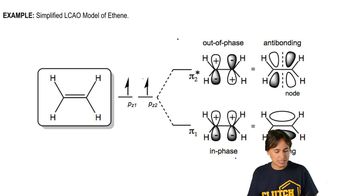
Molecular Orbital Theory describes how atomic orbitals combine to form molecular orbitals, which can be occupied by electrons. In this theory, electrons are delocalized over the entire molecule rather than being localized around individual atoms. Understanding this concept is crucial for visualizing the electron distribution in molecules like AlCl₃ and determining the occupancy of p orbitals.
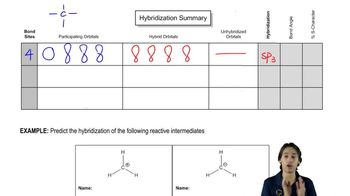
Hybridization is the process by which atomic orbitals mix to form new hybrid orbitals that are suitable for the pairing of electrons to form chemical bonds. In AlCl₃, the aluminum atom undergoes sp² hybridization, resulting in three equivalent hybrid orbitals that form sigma bonds with chlorine atoms. Recognizing the hybridization state helps in understanding the geometry and bonding characteristics of the molecule.
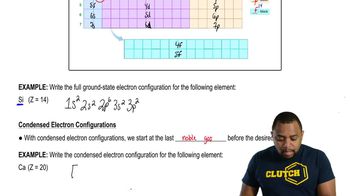
Electron configuration refers to the distribution of electrons in an atom's orbitals. For the central atom in AlCl₃, aluminum has an atomic number of 13, leading to a specific electron configuration. Analyzing the electron configuration allows us to determine how many electrons occupy the p orbitals, which is essential for answering the question regarding the p orbital occupancy in the molecule.