Explain why a σ bond formed by overlap of an s orbital with an sp3 orbital of carbon is stronger than a σ bond formed by overlap of an s orbital with a p orbital of carbon.
Verified step by step guidance
1
Understand the nature of the orbitals involved: An s orbital is spherical and has a high electron density near the nucleus. An sp³ orbital is a hybrid orbital formed by mixing one s orbital and three p orbitals, resulting in a shape that is more directional and has significant electron density along the bonding axis. A p orbital, on the other hand, is dumbbell-shaped and less directional compared to an sp³ orbital.
Consider the concept of orbital overlap: The strength of a σ bond depends on the extent of overlap between the orbitals of the two atoms. Greater overlap leads to a stronger bond because it allows for more effective sharing of electrons between the nuclei.
Compare the overlap of s and sp³ orbitals: The sp³ orbital has a larger lobe pointing in a specific direction, which allows for better overlap with the spherical s orbital. This directional nature of the sp³ orbital maximizes the electron density in the bonding region, leading to a stronger bond.
Compare the overlap of s and p orbitals: The p orbital is less directional and has a smaller region of electron density along the bonding axis compared to the sp³ orbital. This results in less effective overlap with the s orbital, making the σ bond weaker.
Conclude the reasoning: The σ bond formed by the overlap of an s orbital with an sp³ orbital is stronger than that formed with a p orbital because the sp³ orbital's directional nature and larger lobe allow for greater overlap and more effective electron sharing in the bonding region.
Verified video answer for a similar problem:
This video solution was recommended by our tutors as helpful for the problem above
Video duration:
2m
Play a video:
0 Comments
Key Concepts
Here are the essential concepts you must grasp in order to answer the question correctly.
Orbital Hybridization
Orbital hybridization is the process by which atomic orbitals mix to form new hybrid orbitals that are degenerate in energy. In carbon, the sp3 hybridization involves the mixing of one s orbital and three p orbitals, resulting in four equivalent sp3 orbitals. This hybridization allows for stronger sigma bonds due to the optimal overlap of orbitals in bonding.
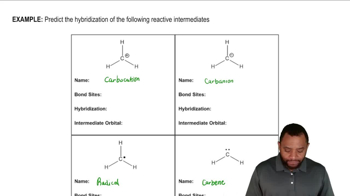
Bond sites, hybridization, and intermediate orbitals
Sigma (σ) Bonds
Sigma bonds are the strongest type of covalent bond formed by the head-on overlap of atomic orbitals. The strength of a σ bond is influenced by the extent of overlap between the orbitals involved. The overlap of an sp3 hybrid orbital with an s orbital is more effective than that of a p orbital with an s orbital, leading to a stronger σ bond.
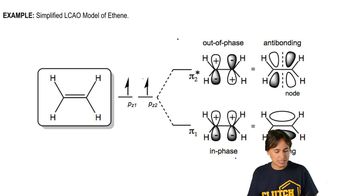
Orbital overlap refers to the region where two atomic orbitals come into contact, allowing for the sharing of electrons. The greater the overlap, the stronger the bond formed. In the case of an sp3 and s orbital overlap, the geometry and orientation of the hybrid orbitals facilitate a larger area of overlap compared to the overlap between an s and a p orbital, resulting in a stronger bond.