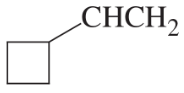
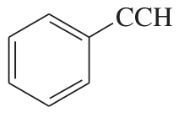
Classify the following hydrocarbons, and draw a Lewis structure for each one. A compound may fit into more than one of the following classifications: alkane alkene alkyne cycloalkane cycloalkene cycloalkyne aromatic hydrocarbon (d) (e) (f)
Verified step by step guidance
1
Step 1: Begin by identifying the general formula for each type of hydrocarbon. Alkanes have the formula CnH2n+2, alkenes CnH2n, alkynes CnH2n-2, cycloalkanes CnH2n, cycloalkenes CnH2n-2, cycloalkynes CnH2n-4, and aromatic hydrocarbons typically follow the formula CnHn (such as benzene, C6H6).
Step 2: For each compound, determine the number of carbon and hydrogen atoms present. This will help you match the compound to one or more of the hydrocarbon classifications based on the formulas provided in Step 1.
Step 3: Analyze the structure of each compound to identify any rings or multiple bonds. Cycloalkanes, cycloalkenes, and cycloalkynes will have ring structures, while alkenes and alkynes will have double and triple bonds, respectively. Aromatic hydrocarbons will have a distinct ring structure with alternating double bonds.
Step 4: Draw the Lewis structure for each compound. Start by arranging the carbon atoms in the appropriate structure (linear, cyclic, etc.), then add hydrogen atoms to satisfy the valency of carbon (four bonds per carbon atom). Ensure that all atoms have complete valence shells.
Step 5: Verify the classification by checking the drawn Lewis structure against the characteristics of each hydrocarbon type. Ensure that the structure matches the expected formula and bonding patterns for the classification(s) identified.
Verified video answer for a similar problem:
This video solution was recommended by our tutors as helpful for the problem above
Video duration:
4m
Play a video:
0 Comments
Key Concepts
Here are the essential concepts you must grasp in order to answer the question correctly.
Hydrocarbon Classification
Hydrocarbons are organic compounds consisting entirely of hydrogen and carbon. They can be classified based on the types of bonds between carbon atoms: alkanes have single bonds, alkenes have at least one double bond, and alkynes have at least one triple bond. Cyclic hydrocarbons form rings, and aromatic hydrocarbons contain conjugated ring systems with delocalized electrons, like benzene.
Lewis structures are diagrams that represent the bonding between atoms of a molecule and the lone pairs of electrons that may exist. They help visualize the arrangement of atoms and the distribution of electrons, showing how atoms are bonded and the presence of any non-bonding electron pairs. Drawing Lewis structures involves identifying valence electrons and arranging them to satisfy the octet rule.
Functional groups are specific groups of atoms within molecules that are responsible for the characteristic chemical reactions of those molecules. In hydrocarbons, functional groups include alkenes, alkynes, and aromatic rings, which determine the molecule's reactivity and properties. Recognizing these groups is essential for classifying hydrocarbons and predicting their behavior in chemical reactions.

 4:28 minutes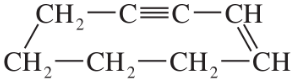
 Verified step by step guidance
 04:52
04:52