A carboxylic acid has two oxygen atoms, each with two nonbonding pairs of electrons. (a) Draw the resonance forms of a carboxylic acid that is protonated on the hydroxy oxygen atom. (b) Compare the resonance forms with those given previously for an acid protonated on the carbonyl oxygen atom. (c) Explain why the carbonyl oxygen atom of a carboxylic acid is more basic than the hydroxy oxygen.
Verified step by step guidance
1
Step 1: Begin by understanding the structure of a carboxylic acid. A carboxylic acid typically has the functional group -COOH, where the carbonyl group (C=O) and the hydroxyl group (OH) are present. The oxygen atoms in these groups have lone pairs of electrons that can participate in resonance.
Step 2: For part (a), draw the resonance forms of a carboxylic acid protonated on the hydroxy oxygen atom. When the hydroxy oxygen is protonated, it forms an OH2+ group. Consider how the positive charge can be delocalized through resonance. The lone pairs on the carbonyl oxygen can shift to form a double bond with the carbon, while the existing C=O bond can shift its electrons to the oxygen, creating a resonance structure.
Step 3: For part (b), compare the resonance forms of the carboxylic acid protonated on the hydroxy oxygen with those protonated on the carbonyl oxygen. When the carbonyl oxygen is protonated, it forms a C=OH+ group. The resonance involves shifting the lone pairs from the hydroxyl oxygen to form a double bond with the carbon, while the positive charge is delocalized onto the hydroxyl oxygen. Compare the stability and delocalization of charge in both scenarios.
Step 4: For part (c), explain why the carbonyl oxygen atom is more basic than the hydroxy oxygen. Basicity is related to the ability to donate electrons. The carbonyl oxygen has a greater electron density due to resonance stabilization and is less hindered compared to the hydroxyl oxygen, which is involved in hydrogen bonding and has a more stable lone pair configuration.
Step 5: Summarize the key points: Resonance forms help in understanding the distribution of charges and electron density in protonated carboxylic acids. The carbonyl oxygen's ability to stabilize positive charge through resonance makes it more basic than the hydroxy oxygen, which is more involved in hydrogen bonding and less available for electron donation.
Verified video answer for a similar problem:
This video solution was recommended by our tutors as helpful for the problem above
Video duration:
7m
Play a video:
0 Comments
Key Concepts
Here are the essential concepts you must grasp in order to answer the question correctly.
Resonance in Carboxylic Acids
Resonance involves the delocalization of electrons across adjacent atoms, stabilizing the molecule. In carboxylic acids, resonance forms show electron movement between the carbonyl and hydroxy groups. Understanding resonance helps visualize how protonation affects electron distribution and stability in different oxygen atoms.
Protonation refers to the addition of a proton (H+) to a molecule, affecting its structure and reactivity. In carboxylic acids, protonation can occur at either the hydroxy or carbonyl oxygen. The site of protonation influences the resonance forms and the overall stability of the molecule, crucial for comparing basicity.
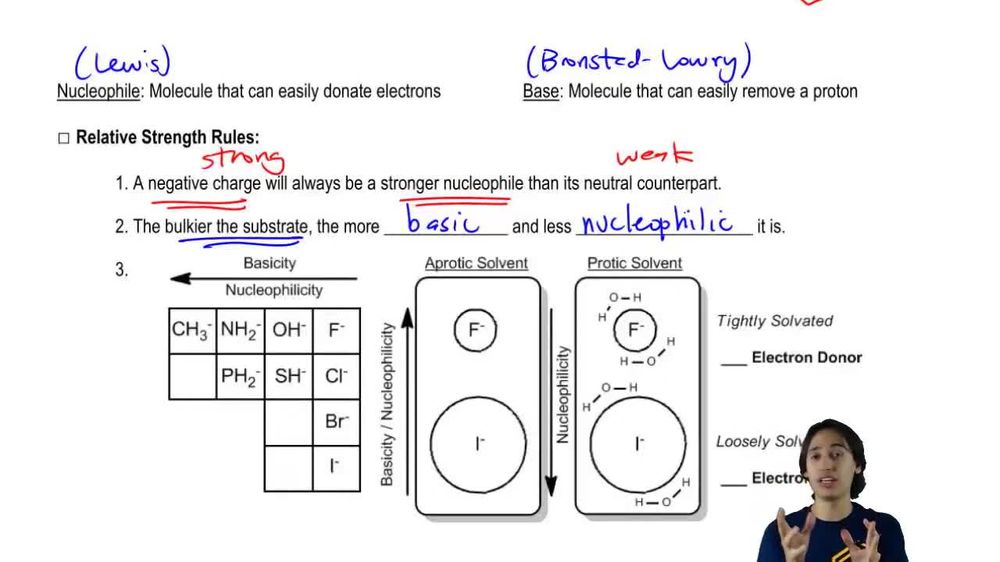
Basicity is the ability of an atom to accept protons. In carboxylic acids, the carbonyl oxygen is more basic than the hydroxy oxygen due to its higher electron density and resonance stabilization. This concept explains why protonation preferentially occurs at the carbonyl oxygen, affecting the molecule's reactivity and stability.

 7:44 minutes
 Verified step by step guidance
 04:20
04:20