Draw the major products obtained from the reaction of one equivalent of HCl with the following compounds. For each reaction, indicate the kinetic and thermodynamic products. a. 2,3-dimethyl-1,3-pentadiene
Verified step by step guidance
1
Identify the structure of 2,3-dimethyl-1,3-pentadiene. It is a conjugated diene with two double bonds: one between carbons 1 and 2, and another between carbons 3 and 4. The methyl groups are attached to carbons 2 and 3.
Understand the reaction mechanism: The reaction of HCl with a conjugated diene proceeds via electrophilic addition. The proton (H⁺) from HCl will add to one of the double bonds, generating a carbocation intermediate. The location of this carbocation determines the products.
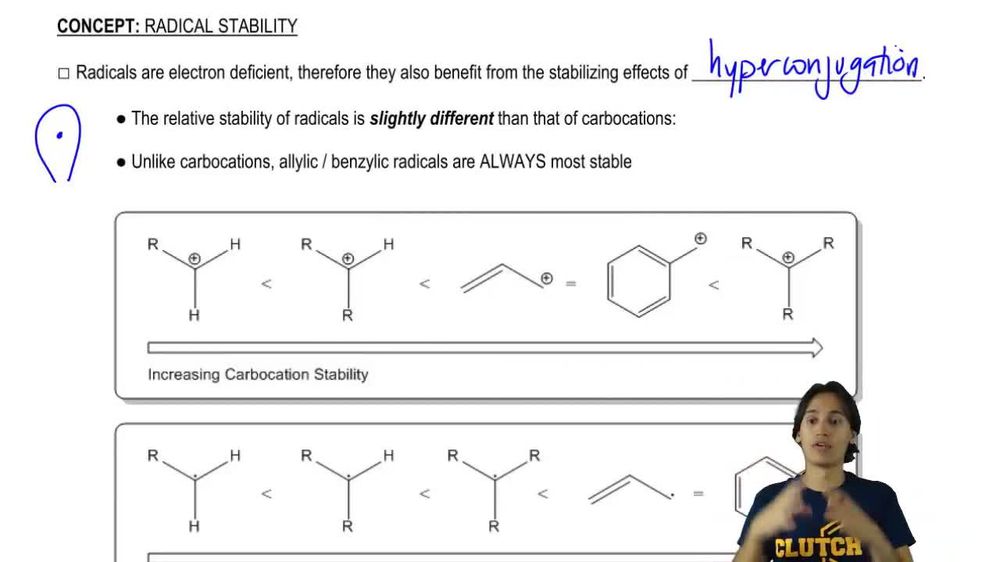
Determine the possible carbocation intermediates: Protonation can occur at either the C1 or C4 position of the diene. This leads to two possible carbocation intermediates: a primary carbocation at C1 or a secondary carbocation at C3. The secondary carbocation is more stable due to hyperconjugation and inductive effects.
Analyze the resonance structures of the carbocation: The secondary carbocation at C3 can delocalize its positive charge through resonance, forming an allylic carbocation. This delocalization allows for the formation of two different products depending on where the chloride ion (Cl⁻) attacks.
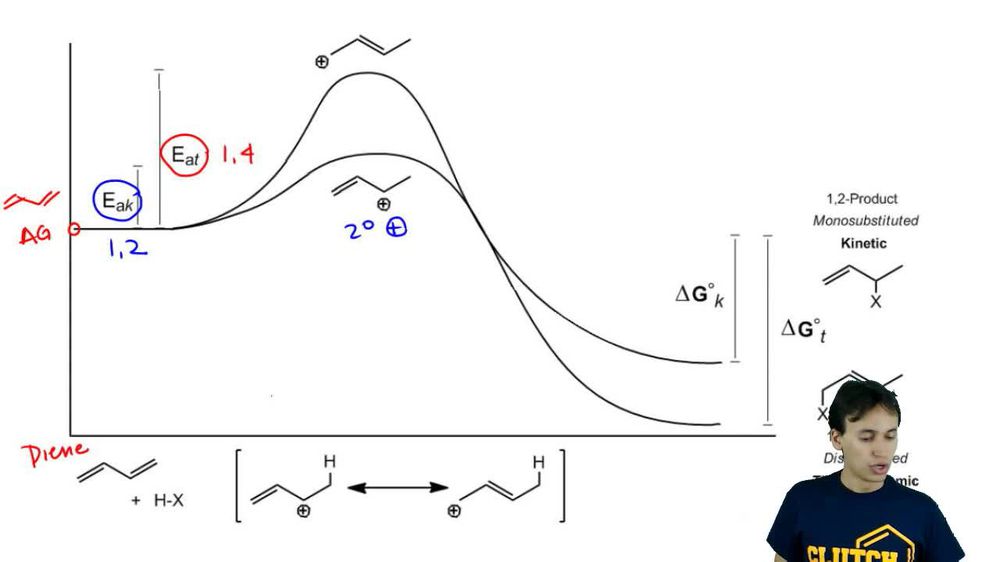
Distinguish between kinetic and thermodynamic products: The kinetic product forms faster and results from the direct attack of Cl⁻ on the carbocation without significant rearrangement. The thermodynamic product is more stable and forms when the reaction has enough time to reach equilibrium, allowing the most stable product to dominate. Draw the structures of both products and label them as kinetic or thermodynamic.
Verified video answer for a similar problem:
This video solution was recommended by our tutors as helpful for the problem above
Video duration:
5m
Play a video:
0 Comments
Key Concepts
Here are the essential concepts you must grasp in order to answer the question correctly.
Electrophilic Addition Reactions
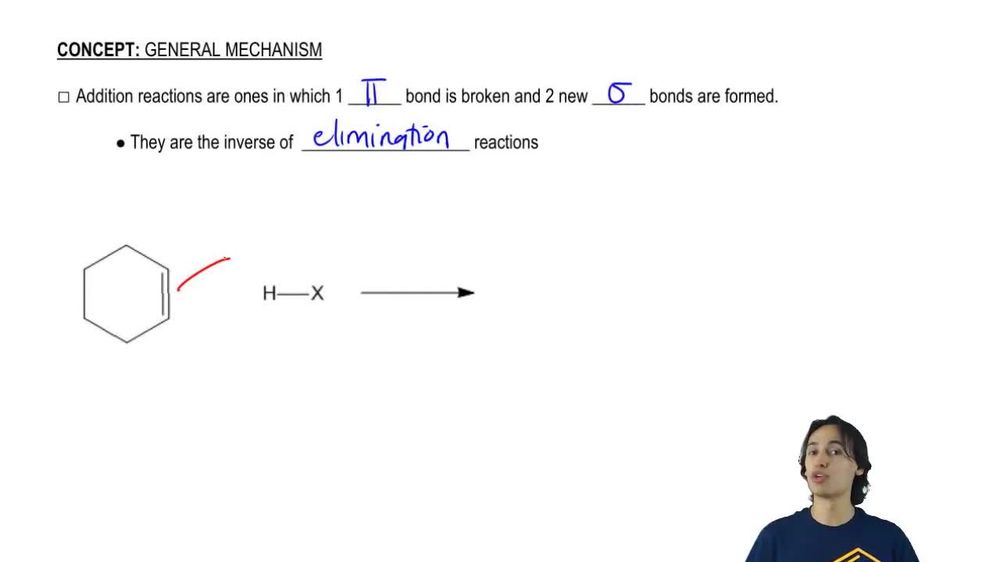
Electrophilic addition reactions involve the addition of an electrophile to a nucleophile, typically seen in alkenes and alkynes. In this context, HCl acts as the electrophile, adding across the double bonds of the diene. Understanding this mechanism is crucial for predicting the products formed during the reaction.
Kinetic products are formed faster and are typically less stable, while thermodynamic products are more stable and form more slowly. In reactions involving dienes, the kinetic product is favored at lower temperatures, while the thermodynamic product is favored at higher temperatures. Recognizing these distinctions helps in predicting the outcome of the reaction under different conditions.
Dienes, such as 2,3-dimethyl-1,3-pentadiene, can undergo reactions that lead to different product distributions based on their structure. The stability of the resulting carbocations and the steric effects of substituents play a significant role in determining which products are formed. Analyzing the structure of the diene is essential for understanding the reaction pathways and products.

 5:39 minutes
 Verified step by step guidance
 05:39
05:39