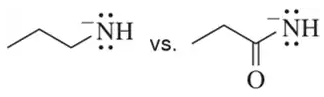
Which anion in each pair would you expect to react more quickly with H+? (b)
Verified step by step guidance
1
Step 1: Analyze the two anions provided in the image. The first anion is an ethylamine anion (CH3CH2NH−), and the second anion is an amide anion (CH3CONH−). Both contain a negatively charged nitrogen atom, but their reactivity with H+ will depend on the electronic environment around the nitrogen atom.
Step 2: Consider the resonance effects in the amide anion (CH3CONH−). The carbonyl group (C=O) adjacent to the nitrogen can delocalize the negative charge through resonance, reducing the availability of the lone pair on nitrogen for reaction with H+. This makes the amide anion less reactive toward H+ compared to the ethylamine anion.
Step 3: Evaluate the inductive effects. In the amide anion, the electronegative oxygen atom in the carbonyl group pulls electron density away from the nitrogen atom, further decreasing its nucleophilicity and reactivity with H+. The ethylamine anion does not have such an electron-withdrawing group, so its nitrogen is more nucleophilic and reactive toward H+.
Step 4: Consider the basicity of the two anions. The ethylamine anion (CH3CH2NH−) is a stronger base because its nitrogen atom has a higher electron density and is not stabilized by resonance or inductive effects. Stronger bases react more quickly with H+.
Step 5: Conclude that the ethylamine anion (CH3CH2NH−) will react more quickly with H+ compared to the amide anion (CH3CONH−) due to the absence of resonance stabilization and inductive effects, which make its nitrogen more nucleophilic and basic.
Verified video answer for a similar problem:
This video solution was recommended by our tutors as helpful for the problem above
Play a video:
0 Comments
Key Concepts
Here are the essential concepts you must grasp in order to answer the question correctly.
Acidity and Basicity
Acidity refers to the ability of a substance to donate protons (H⁺ ions), while basicity is the ability to accept protons. In organic chemistry, the strength of an acid or base can significantly influence reaction rates. Anions, which are negatively charged species, can act as bases and their reactivity with protons depends on their basicity, which is often determined by factors such as charge density and electronegativity.
Understanding the difference between basicity and nucleophilicity.
Nucleophilicity
Nucleophilicity is a measure of how readily a species donates an electron pair to form a bond with a proton or electrophile. Anions are typically nucleophiles, and their reactivity with H⁺ can be influenced by their charge, size, and the presence of electronegative atoms. Stronger nucleophiles will react more quickly with protons, making this concept crucial for predicting reaction outcomes.
Steric hindrance refers to the prevention of reactions due to the spatial arrangement of atoms within a molecule. In the context of anions reacting with H⁺, bulky groups around the anion can impede its approach to the proton, slowing down the reaction. Understanding steric effects is essential for predicting which anion will react more quickly, as less hindered anions are generally more reactive.