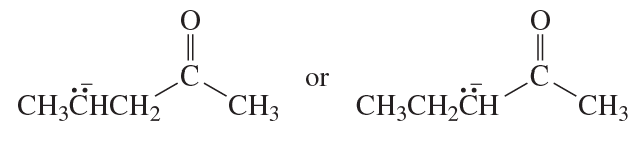
Which species in each of the pairs in Problem 80 is the stronger base? a. b.
Verified step by step guidance
1
Step 1: Analyze the chemical structures in pair A. The species (i) is the formate ion (HCOO⁻), and species (ii) is the acetate ion (CH₃COO⁻). The difference lies in the substituent attached to the carboxylate group: hydrogen in (i) and a methyl group in (ii).
Step 2: Consider the inductive effect of the substituents. The methyl group in acetate (ii) is electron-donating, which stabilizes the negative charge on the oxygen atom through hyperconjugation and inductive effects. This stabilization reduces the basicity of acetate compared to formate.
Step 3: Conclude that formate (i) is the stronger base in pair A because it lacks the electron-donating methyl group, making the negative charge on the oxygen less stabilized and more available to accept a proton.
Step 4: Analyze the chemical structures in pair B. Both species are enolate ions, but the difference lies in the position of the negative charge. In species (i), the negative charge is on the carbon adjacent to the carbonyl group, while in species (ii), the negative charge is on the carbon further away from the carbonyl group.
Step 5: Consider resonance stabilization. In species (i), the negative charge is delocalized through resonance with the carbonyl group, making it more stable and less basic. In species (ii), the negative charge is less delocalized, making it less stable and more basic. Therefore, species (ii) is the stronger base in pair B.
Verified video answer for a similar problem:
This video solution was recommended by our tutors as helpful for the problem above
Video duration:
5m
Play a video:
0 Comments
Key Concepts
Here are the essential concepts you must grasp in order to answer the question correctly.
Acidity and Basicity
Acidity refers to the ability of a species to donate a proton (H+), while basicity is the ability to accept a proton. In organic chemistry, the strength of an acid or base is often determined by the stability of its conjugate base or acid. A stronger base corresponds to a weaker acid, and vice versa, which is crucial for comparing the species in the given problem.
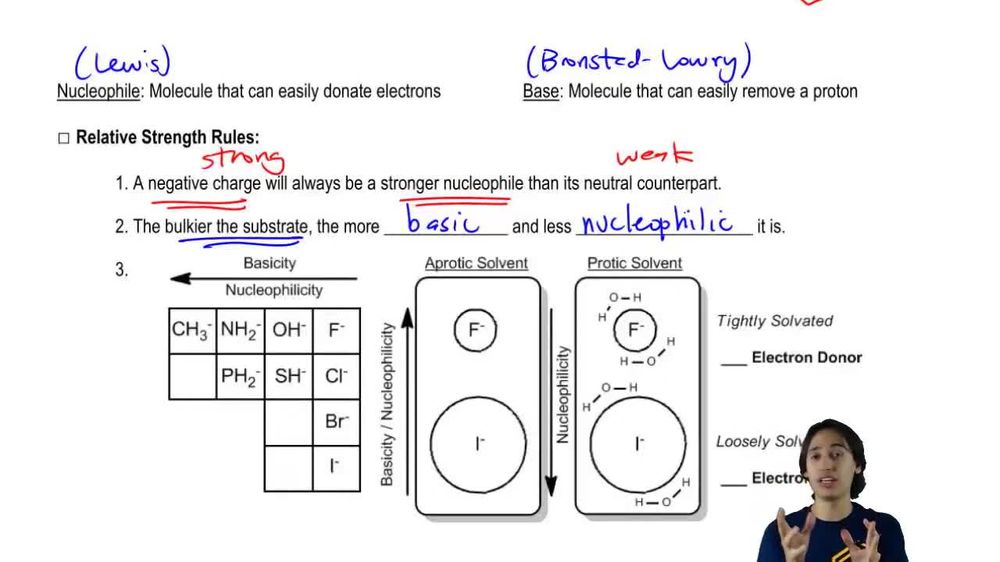
Understanding the difference between basicity and nucleophilicity.
Resonance Stabilization
Resonance stabilization occurs when a molecule can be represented by two or more valid Lewis structures, leading to a delocalization of electrons. This delocalization can stabilize a negative charge in a conjugate base, making it less likely to accept a proton, thus affecting the basicity. Understanding resonance is essential for evaluating the strength of bases in the provided pairs.
The inductive effect refers to the electron-withdrawing or electron-donating effects of substituents on a molecule, which can influence acidity and basicity. Electronegative atoms or groups can stabilize a negative charge through their electron-withdrawing nature, while electron-donating groups can destabilize it. This concept is important for analyzing the structural differences in the pairs presented in the question.

 5:21 minutes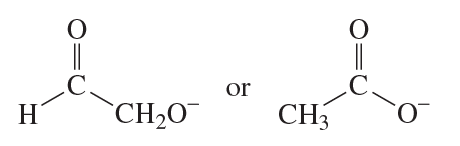
 Verified step by step guidance
 06:21
06:21