Predict the products of reaction of pent-1-yne with the following reagents. j. NaNH2 k. H2SO4/HgSO4, H2O l. Sia2BH, then H2O2, –OH
Verified step by step guidance
1
Step 1: For part (j), when pent-1-yne reacts with NaNH₂, the strong base NaNH₂ deprotonates the terminal alkyne. This results in the formation of a negatively charged acetylide ion (C≡C⁻). The reaction can be represented as: .
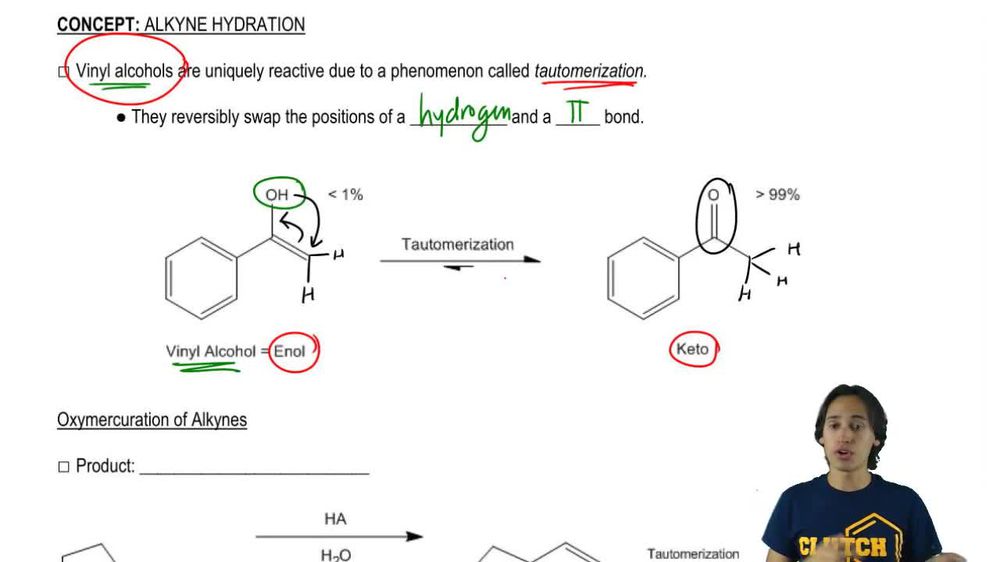
Step 2: For part (k), when pent-1-yne reacts with H₂SO₄/HgSO₄ and H₂O, this is an example of an acid-catalyzed hydration reaction. The alkyne undergoes Markovnikov addition of water, where the OH group adds to the more substituted carbon, and the H adds to the less substituted carbon. This forms an enol intermediate, which tautomerizes to a ketone. The product is pentan-2-one.
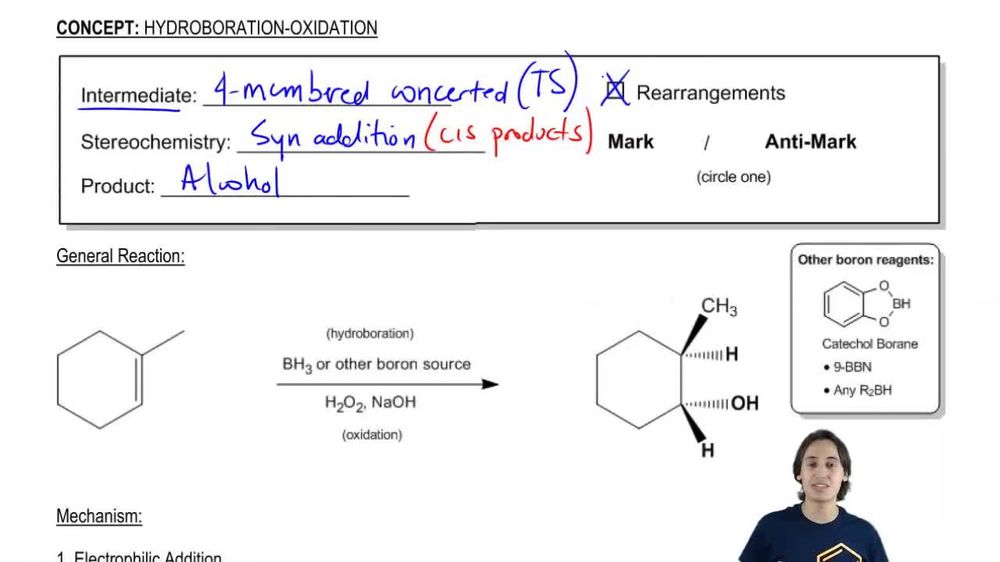
Step 3: For part (l), when pent-1-yne reacts with Sia₂BH (disiamylborane), followed by H₂O₂ and OH⁻, this is an example of hydroboration-oxidation. The reaction proceeds with anti-Markovnikov addition of water, where the OH group adds to the less substituted carbon, and the H adds to the more substituted carbon. The enol intermediate formed tautomerizes to an aldehyde. The product is pentanal.
Step 4: Summarize the products for each reaction: (j) acetylide ion (C≡C⁻), (k) pentan-2-one, and (l) pentanal. Each reaction demonstrates a different type of reactivity of alkynes: deprotonation, Markovnikov hydration, and anti-Markovnikov hydration.
Step 5: To confirm your understanding, review the mechanisms for each reaction type: (1) deprotonation of terminal alkynes, (2) acid-catalyzed hydration with tautomerization, and (3) hydroboration-oxidation with tautomerization. This will help reinforce the concepts and ensure you can apply them to similar problems.
Verified video answer for a similar problem:
This video solution was recommended by our tutors as helpful for the problem above
Video duration:
8m
Play a video:
0 Comments
Key Concepts
Here are the essential concepts you must grasp in order to answer the question correctly.
Alkyne Reactivity
Alkynes, such as pent-1-yne, are hydrocarbons with at least one carbon-carbon triple bond. Their reactivity is significantly influenced by this triple bond, allowing them to undergo various reactions, including nucleophilic substitutions and additions. Understanding how alkynes react with different reagents is crucial for predicting the products of these reactions.
Hydroboration-oxidation is a two-step reaction process used to convert alkynes into alcohols. In the first step, the alkyne reacts with diborane (Sia2BH) to form an organoborane intermediate. The second step involves oxidation with hydrogen peroxide and a base, resulting in the formation of an alcohol. This method is particularly useful for producing anti-Markovnikov alcohols.
Acid-catalyzed hydration of alkynes involves the addition of water across the triple bond in the presence of an acid catalyst, typically sulfuric acid and mercury(II) sulfate. This reaction leads to the formation of ketones or aldehydes, depending on the structure of the alkyne. The mechanism involves the formation of a vinyl cation, which is then attacked by water, highlighting the importance of regioselectivity in product formation.