What products are obtained from metathesis of each of the following alkenes? a. CH3CH2CH=CH2
Verified step by step guidance
1
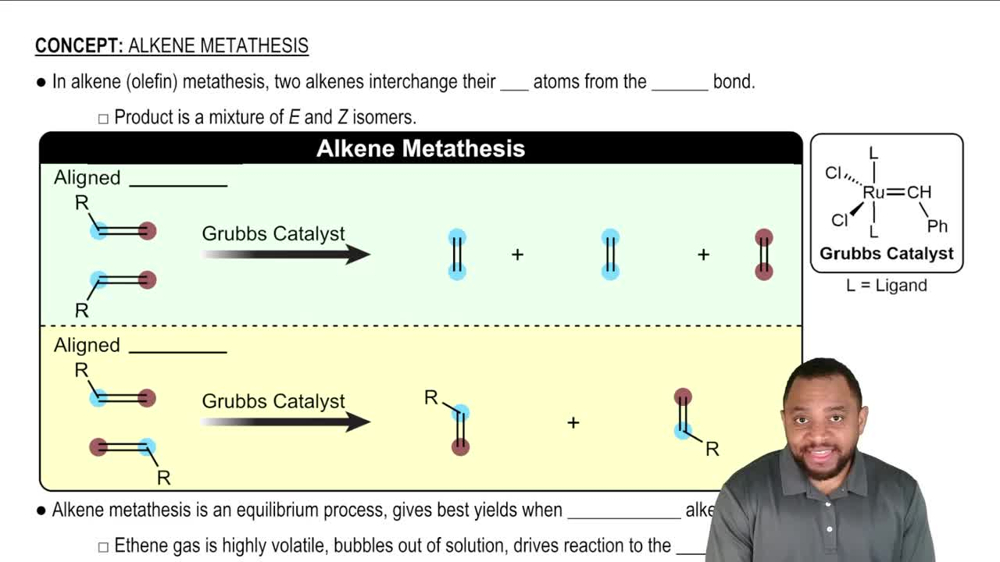
Identify the type of metathesis reaction: In this case, the reaction involves alkene metathesis, which is a reaction where two alkenes exchange their substituents to form new alkenes. This process is catalyzed by a metal carbene catalyst (e.g., Grubbs catalyst).
Write the structure of the given alkene: The structure of CH3CH2CH=CH2 is a terminal alkene with the double bond between the third and fourth carbon atoms.
Understand the mechanism of metathesis: In alkene metathesis, the double bonds of two alkenes are broken and reformed, leading to the exchange of alkyl groups. For a single alkene undergoing self-metathesis, the reaction produces two new alkenes.
Determine the products: When CH3CH2CH=CH2 undergoes self-metathesis, the double bond is broken, and the fragments recombine to form two new alkenes. The products will be CH3CH=CHCH3 (a symmetrical internal alkene) and ethene (CH2=CH2).
Verify the reaction: Ensure that the products are consistent with the conservation of atoms and the mechanism of metathesis. The reaction should balance, with no atoms lost or gained during the process.
Verified video answer for a similar problem:
This video solution was recommended by our tutors as helpful for the problem above
Video duration:
4m
Play a video:
0 Comments
Key Concepts
Here are the essential concepts you must grasp in order to answer the question correctly.
Alkene Metathesis
Alkene metathesis is a chemical reaction that involves the exchange of alkyl groups between alkenes, facilitated by catalysts such as Grubbs or Schrock catalysts. This process allows for the formation of new alkenes with different carbon skeletons, which can lead to a variety of products depending on the starting materials. Understanding this reaction is crucial for predicting the outcomes when specific alkenes are used.
Catalysts play a vital role in alkene metathesis by lowering the activation energy required for the reaction to occur. The most commonly used catalysts are transition metal complexes, which facilitate the breaking and forming of carbon-carbon double bonds. Knowledge of how these catalysts operate helps in understanding the efficiency and selectivity of the metathesis reaction.
The distribution of products in alkene metathesis depends on the structure of the starting alkenes and the reaction conditions. Factors such as sterics, electronic effects, and the presence of different alkene partners can influence which products are favored. Analyzing the potential products requires a grasp of these factors to predict the outcome accurately.

 4:26 minutes
 Verified step by step guidance
 2:09
2:09