Ch. 10 - Reactions of Alcohols, Ethers, Epoxides, Amines, and Sulfur-Containing Compounds
Bruice - Organic Chemistry 8th Edition
Bruice8th EditionOrganic ChemistryISBN: 9780135213711Not the one you use?Change textbook
Chapter 11, Problem 63c

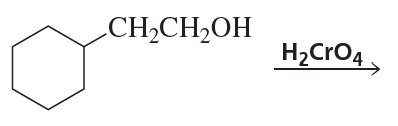
What is the major product(s) of each of the following reactions?
c. Chemical structure showing ethanol reacting with chromic acid, indicating an oxidation reaction.

Verified step by step guidance
1
Step 1: Identify the functional group in the starting material. The molecule contains a primary alcohol (-OH group) attached to a cyclopentyl group.
Step 2: Recognize the reagent used in the reaction. H₂CrO₄ (chromic acid) is a strong oxidizing agent commonly used to oxidize alcohols.
Step 3: Understand the oxidation process for primary alcohols. Primary alcohols are oxidized by chromic acid to form carboxylic acids. The intermediate aldehyde is typically not isolated because chromic acid continues to oxidize it to the carboxylic acid.
Step 4: Predict the major product. The primary alcohol will be oxidized to a carboxylic acid, resulting in a cyclopentyl carboxylic acid (cyclopentanecarboxylic acid).
Step 5: Verify the reaction conditions. Ensure that the reaction proceeds under acidic conditions, which are typical for chromic acid oxidation, and confirm that no other functional groups in the molecule interfere with the oxidation process.

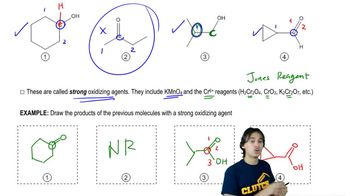
Verified video answer for a similar problem:

This video solution was recommended by our tutors as helpful for the problem above.
Video duration:
46s
Was this helpful?

Key Concepts

Here are the essential concepts you must grasp in order to answer the question correctly.

Oxidation of Alcohols

The oxidation of alcohols involves the conversion of the hydroxyl (-OH) group into a carbonyl group (C=O) or a carboxylic acid, depending on the type of alcohol and the oxidizing agent used. Primary alcohols typically oxidize to aldehydes and can further oxidize to carboxylic acids, while secondary alcohols oxidize to ketones. Tertiary alcohols do not undergo oxidation under these conditions.
Recommended video:
Guided course
05:53
Strong oxidizing agents

Chromic Acid (H2CrO4) as an Oxidizing Agent

Chromic acid (H2CrO4) is a strong oxidizing agent commonly used in organic chemistry to oxidize alcohols. It is particularly effective for converting primary and secondary alcohols into their corresponding carbonyl compounds. The reaction typically involves the transfer of oxygen and the reduction of chromium from a +6 to a +3 oxidation state, resulting in a color change that indicates the progress of the reaction.
Recommended video:
Guided course
05:53
Strong oxidizing agents

Reaction Mechanism

Understanding the reaction mechanism is crucial for predicting the products of organic reactions. In the case of alcohol oxidation, the mechanism involves the formation of a chromate ester intermediate, followed by the elimination of water to form the carbonyl compound. This stepwise process highlights the importance of electron movement and the role of the oxidizing agent in facilitating the transformation of functional groups.
Recommended video:
Guided course
02:16
Heck Reaction Mechanism