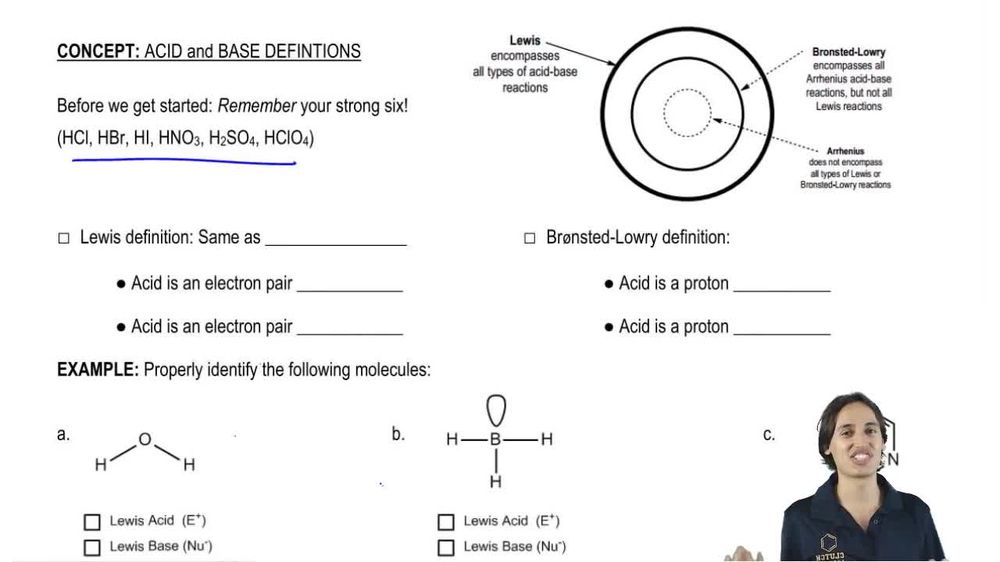
When an atom loses a proton in an acid–base reaction, its formal charge is decreased by one. Thinking about the equation for calculating formal charge, explain this observation in your own words.
Verified step by step guidance
1
The formal charge of an atom is calculated using the formula: , where is the number of valence electrons in the neutral atom, is the number of non-bonding electrons, and is the number of bonding electrons.
When an atom loses a proton (H⁺) in an acid-base reaction, it typically loses a bond to hydrogen. This reduces the number of bonding electrons () by 2, as a single bond consists of two electrons.
In the formal charge equation, the term decreases because the number of bonding electrons has been reduced. This makes the subtraction in the formula less negative, effectively decreasing the formal charge by 1.
Additionally, the atom does not gain or lose any non-bonding electrons () or valence electrons () in this process, so the change in formal charge is solely due to the loss of bonding electrons.
Thus, the decrease in formal charge by 1 reflects the loss of a proton and the associated bonding electrons in the acid-base reaction.
Verified video answer for a similar problem:
This video solution was recommended by our tutors as helpful for the problem above
Play a video:
0 Comments
Key Concepts
Here are the essential concepts you must grasp in order to answer the question correctly.
Formal Charge
Formal charge is a theoretical charge assigned to an atom in a molecule, calculated using the formula: Formal Charge = Valence Electrons - (Non-bonding Electrons + 1/2 Bonding Electrons). It helps in understanding the distribution of electrons in a molecule and predicting reactivity. A lower formal charge generally indicates a more stable structure.
Acid-base reactions involve the transfer of protons (H+) between reactants. In these reactions, acids donate protons while bases accept them. The loss of a proton by an atom can lead to a change in its formal charge, as the number of protons in the nucleus directly influences the charge balance of the atom.
When an atom loses a proton during an acid-base reaction, it effectively reduces its positive charge, as protons contribute to the overall charge of the atom. This decrease in positive charge results in a lower formal charge, which can stabilize the atom and influence the overall stability of the molecule involved in the reaction.

 Verified step by step guidance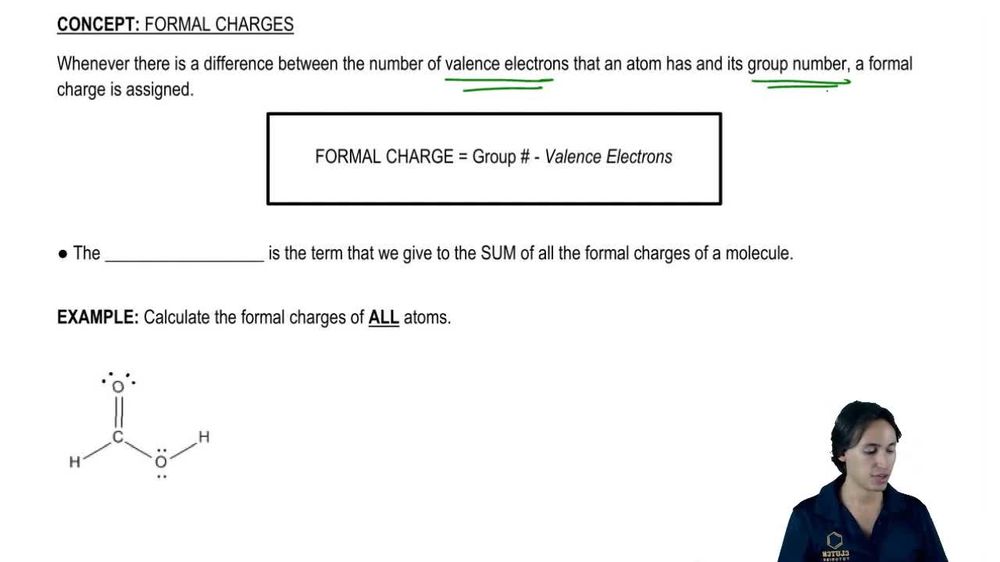
 01:34
01:34