Using the convention that the acid and base are on the left side of the chemical equation, label the acid, base, conjugate acid, and conjugate base in the following reactions. (c)
Verified step by step guidance
1
Identify the acid and base on the left side of the chemical equation. The acid is the species that donates a proton (H⁺), and the base is the species that accepts a proton.
Determine the conjugate acid and conjugate base on the right side of the equation. The conjugate acid is formed when the base gains a proton, and the conjugate base is formed when the acid loses a proton.
Label the acid and base on the left side of the equation. Use the definition of acids and bases to assign these roles based on proton transfer.
Label the conjugate acid and conjugate base on the right side of the equation. Match the products to their corresponding reactants to identify which species gained or lost a proton.
Verify your labels by ensuring that the acid-base pair on each side of the equation corresponds to a proton transfer, and that the conjugate acid-base pairs are correctly identified.
Verified video answer for a similar problem:
This video solution was recommended by our tutors as helpful for the problem above
Video duration:
3m
Play a video:
0 Comments
Key Concepts
Here are the essential concepts you must grasp in order to answer the question correctly.
Brønsted-Lowry Acid-Base Theory
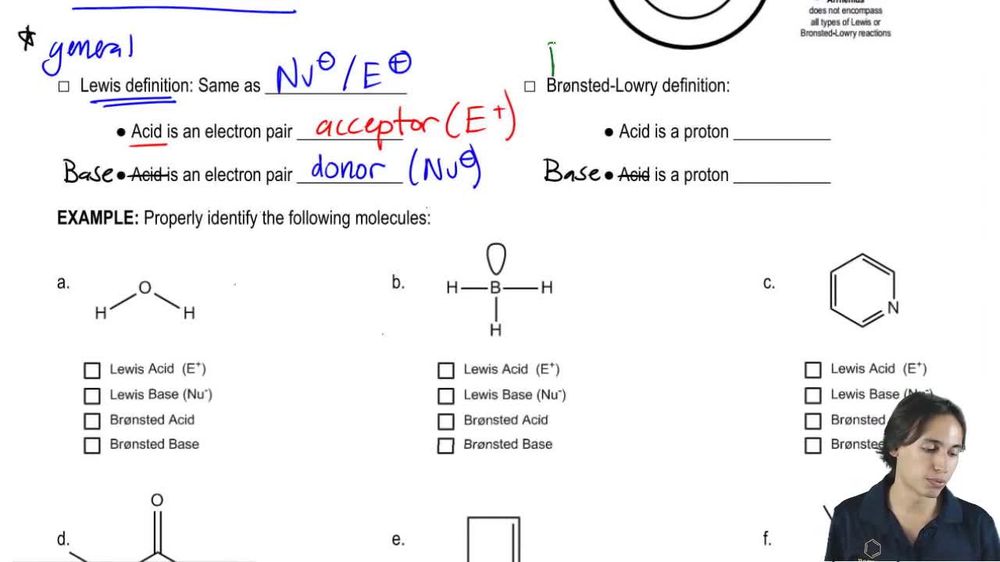
The Brønsted-Lowry theory defines acids as proton donors and bases as proton acceptors. In a chemical reaction, the acid donates a hydrogen ion (H+) to the base, which accepts it. This theory helps in identifying the roles of substances in acid-base reactions, making it essential for labeling acids and bases in chemical equations.
A conjugate acid-base pair consists of two species that differ by the presence or absence of a proton. When an acid donates a proton, it forms its conjugate base, while the base that accepts the proton becomes its conjugate acid. Understanding these pairs is crucial for identifying the products of acid-base reactions and labeling them correctly.
Chemical equations represent the reactants and products of a reaction, showing how substances interact. In the context of acid-base reactions, the left side typically contains the acid and base, while the right side shows the conjugate acid and conjugate base. Familiarity with this representation is vital for accurately labeling the components in the given reactions.

 3:09 minutes
 Verified step by step guidance
 00:54
00:54