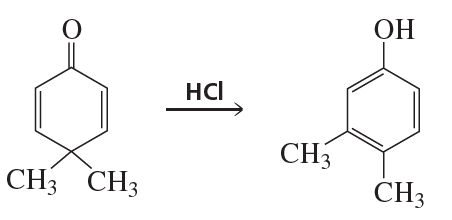
Propose a mechanism for each of the following reactions: b.
Verified step by step guidance
1
Step 1: Analyze the starting material and the product. The starting material is a ketone (cyclohexanone derivative) with two alkyl substituents, and the product is a phenol (aromatic ring with an -OH group) with alkyl substituents. This suggests an acid-catalyzed rearrangement reaction leading to aromatization.
Step 2: Protonation of the ketone group by H₂SO₄. The sulfuric acid donates a proton to the oxygen atom of the ketone, forming a protonated ketone intermediate. This increases the electrophilicity of the carbonyl carbon.
Step 3: Formation of a carbocation. The protonated ketone undergoes a rearrangement where one of the alkyl groups migrates to the carbonyl carbon, leading to the formation of a carbocation intermediate. This step is crucial for the rearrangement process.
Step 4: Aromatization. The carbocation intermediate undergoes a series of hydride shifts and/or alkyl migrations to form a conjugated aromatic ring structure. This step stabilizes the molecule by forming the aromatic system.
Step 5: Deprotonation to form the phenol. A water molecule or another base removes a proton from the hydroxyl group, resulting in the final product, which is a phenol with alkyl substituents.
Verified video answer for a similar problem:
This video solution was recommended by our tutors as helpful for the problem above
Video duration:
8m
Play a video:
0 Comments
Key Concepts
Here are the essential concepts you must grasp in order to answer the question correctly.
Tautomerization
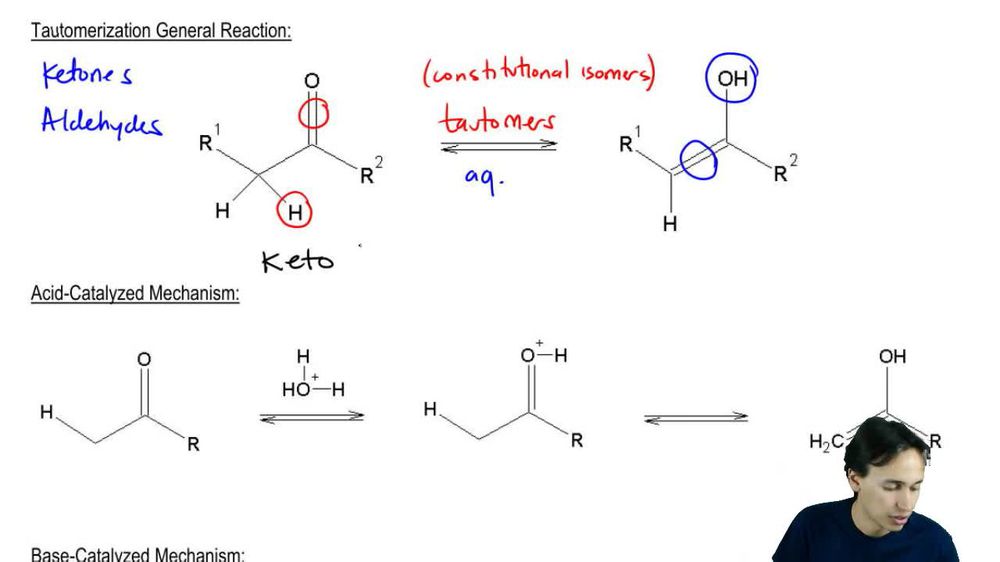
Tautomerization is a chemical reaction that involves the interconversion of two isomers, typically involving the relocation of a hydrogen atom and a switch of a double bond. In this case, the reaction converts a ketone to an alcohol through the transfer of a proton, resulting in the formation of an enol intermediate that can further stabilize into the final alcohol product.
Acid-catalyzed reactions involve the use of an acid, such as sulfuric acid (H2SO4), to facilitate the reaction process. The acid donates protons (H+) to the reactants, enhancing their reactivity. In the provided reaction, H2SO4 acts as a catalyst to promote the tautomerization of the ketone to the alcohol, making the reaction more efficient.
The mechanism of tautomerization typically involves the formation of an enol intermediate. In this reaction, the ketone is protonated by the acid, leading to the formation of a carbocation. A subsequent deprotonation step results in the formation of the enol, which can then rearrange to yield the final alcohol product. Understanding this mechanism is crucial for predicting the outcome of the reaction.