Phenylacetone can form two different enols. (c) Propose mechanisms for the formation of the first enol in acid.
Verified step by step guidance
1
Identify the structure of phenylacetone: It consists of a phenyl group (C₆H₅-) attached to a carbonyl group (C=O) via a CH₂ group. The carbonyl group is the reactive site for enol formation.
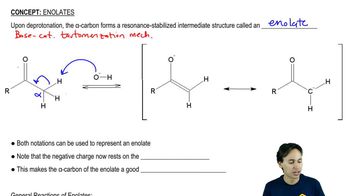
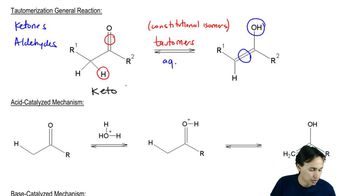
Understand the concept of enol formation: Enols are formed through keto-enol tautomerism, where a proton is transferred, and a double bond is formed between the alpha-carbon (the carbon adjacent to the carbonyl group) and the carbonyl carbon.
Protonate the carbonyl oxygen: In acidic conditions, the lone pair of electrons on the oxygen atom of the carbonyl group interacts with a proton (H⁺), forming a positively charged oxonium ion (C=O⁺H). This step increases the electrophilicity of the carbonyl carbon.
Deprotonate the alpha-carbon: A base (such as water or another molecule in the acidic medium) abstracts a proton (H⁺) from the alpha-carbon. This generates a carbanion intermediate, which is stabilized by resonance with the positively charged oxonium ion.
Form the enol: The lone pair of electrons on the alpha-carbon forms a double bond with the carbonyl carbon, while the oxonium ion loses a proton to regenerate the neutral hydroxyl group (-OH). This results in the formation of the enol structure, where the alpha-carbon is now part of a C=C double bond, and the oxygen is part of an -OH group.
Verified video answer for a similar problem:
This video solution was recommended by our tutors as helpful for the problem above
Video duration:
2m
Play a video:
0 Comments
Key Concepts
Here are the essential concepts you must grasp in order to answer the question correctly.
Enol Formation
Enols are compounds with a hydroxyl group (-OH) bonded to a carbon atom that is part of a carbon-carbon double bond. The formation of enols typically involves the tautomerization of carbonyl compounds, where the keto form (C=O) converts to the enol form (C=C-OH). Understanding this process is crucial for proposing mechanisms for enol formation, especially in the context of acid-catalyzed reactions.
In acid-catalyzed reactions, the presence of an acid protonates the carbonyl oxygen, increasing the electrophilicity of the carbonyl carbon. This makes it more susceptible to nucleophilic attack, facilitating the formation of the enol. Recognizing how acids influence the reaction pathway is essential for accurately proposing the mechanism for enol formation from phenylacetone.
Tautomerization is a chemical reaction that involves the interconversion between two isomers, typically a keto form and an enol form. This process is often facilitated by acid or base catalysis. In the case of phenylacetone, understanding the tautomerization process helps in predicting the stability and formation of the enols, which is key to proposing the correct mechanism.