Ch. 3 - An Introduction to Organic Compounds:Nomenclature, Physical Properties, and Structure
Bruice - Organic Chemistry 8th Edition
Bruice8th EditionOrganic ChemistryISBN: 9780135213711Not the one you use?Change textbook
Chapter 4, Problem 51c,d

For each of the following disubstituted cyclohexanes, indicate whether the substituents in the two chair conformers are both equatorial in one chair conformer and both axial in the other or one equatorial and one axial in each of the chair conformers:
c. cis-1,3-
d. trans-1,3-

Verified step by step guidance
1
Step 1: Understand the problem. We are tasked with analyzing the chair conformations of disubstituted cyclohexanes (cis-1,3- and trans-1,3-) to determine the positions of the substituents (axial or equatorial) in each conformer.
Step 2: Recall the key concepts. In a cyclohexane chair conformation, substituents can occupy either axial (perpendicular to the ring plane) or equatorial (roughly parallel to the ring plane) positions. The relative positions of substituents (cis or trans) determine their placement in the chair conformers.
Step 3: Analyze the cis-1,3-disubstituted cyclohexane. For cis-1,3-, the two substituents are on the same side of the ring. In one chair conformer, one substituent will be axial, and the other will be equatorial. When the chair flips, the positions will switch, so the other substituent becomes axial, and the first becomes equatorial. Thus, in both conformers, one substituent is axial, and the other is equatorial.
Step 4: Analyze the trans-1,3-disubstituted cyclohexane. For trans-1,3-, the two substituents are on opposite sides of the ring. In one chair conformer, both substituents will occupy equatorial positions. When the chair flips, both substituents will occupy axial positions. Thus, in one conformer, both are equatorial, and in the other, both are axial.
Step 5: Summarize the findings. For cis-1,3-, the substituents are one axial and one equatorial in each conformer. For trans-1,3-, the substituents are both equatorial in one conformer and both axial in the other.

Verified video answer for a similar problem:

This video solution was recommended by our tutors as helpful for the problem above.
Video duration:
6m
Was this helpful?

Key Concepts

Here are the essential concepts you must grasp in order to answer the question correctly.

Chair Conformation

Chair conformation is the most stable form of cyclohexane, allowing for minimized steric strain. In this conformation, carbon atoms are arranged in a staggered manner, which provides two types of positions for substituents: axial (pointing up or down) and equatorial (pointing outward). Understanding chair conformations is crucial for analyzing the spatial arrangement of substituents in disubstituted cyclohexanes.
Recommended video:
Guided course
03:29
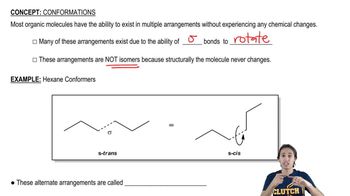
Understanding what a conformer is.

Cis and Trans Isomerism

Cis and trans isomerism refers to the orientation of substituents around a ring or double bond. In cyclohexanes, 'cis' indicates that substituents are on the same side of the ring, while 'trans' indicates they are on opposite sides. This distinction affects the stability and conformational preferences of the molecule, influencing whether substituents can be both equatorial or axial in chair conformations.
Recommended video:
Guided course
00:44
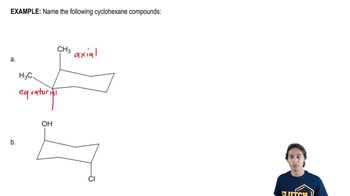
Is the following cyclohexane cis or trans?

Axial and Equatorial Positions

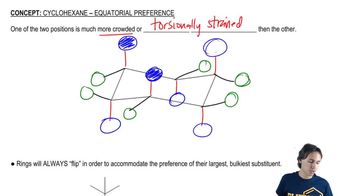
In cyclohexane chair conformations, substituents can occupy axial or equatorial positions, which significantly impacts steric interactions. Axial substituents are aligned parallel to the axis of the ring, leading to potential 1,3-diaxial interactions that increase steric strain. Conversely, equatorial substituents extend outward, reducing steric hindrance and generally leading to a more stable conformation. Understanding these positions is essential for predicting the stability of disubstituted cyclohexanes.
Recommended video:
Guided course
04:02
Equatorial Preference