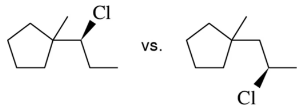
For each pair, choose the haloalkane that would react most quickly in an SN2 reaction. (c)
Verified step by step guidance
1
Step 1: Recall the key factors that influence the rate of an Sₙ2 reaction. The Sₙ2 mechanism involves a single-step nucleophilic substitution where the nucleophile attacks the electrophilic carbon and displaces the leaving group. Steric hindrance around the electrophilic carbon is a critical factor; less steric hindrance leads to faster reactions.
Step 2: Analyze the structures of the two haloalkanes. In the first compound, the chlorine atom is attached to a secondary carbon (a carbon bonded to two other carbons). In the second compound, the chlorine atom is attached to a tertiary carbon (a carbon bonded to three other carbons).
Step 3: Compare the steric hindrance around the electrophilic carbon in both compounds. The tertiary carbon in the second compound is more sterically hindered due to the presence of three alkyl groups, which makes it harder for the nucleophile to approach and react. The secondary carbon in the first compound has less steric hindrance, making it more accessible to the nucleophile.
Step 4: Recall that Sₙ2 reactions are most favorable for primary carbons, followed by secondary carbons, and least favorable for tertiary carbons due to steric hindrance. Based on this, the haloalkane with the chlorine attached to the secondary carbon will react more quickly in an Sₙ2 reaction.
Step 5: Conclude that the first compound (with the chlorine attached to the secondary carbon) will react more quickly in an Sₙ2 reaction compared to the second compound (with the chlorine attached to the tertiary carbon).
Verified video answer for a similar problem:
This video solution was recommended by our tutors as helpful for the problem above
Play a video:
0 Comments
Key Concepts
Here are the essential concepts you must grasp in order to answer the question correctly.
Sₙ2 Reaction Mechanism
The Sₙ2 (substitution nucleophilic bimolecular) reaction is a type of nucleophilic substitution where the nucleophile attacks the electrophile simultaneously as the leaving group departs. This concerted mechanism results in the inversion of configuration at the carbon center. The rate of the Sₙ2 reaction depends on steric hindrance and the strength of the nucleophile, making primary haloalkanes more reactive than secondary or tertiary ones.
Steric hindrance refers to the prevention of chemical reactions due to the spatial arrangement of atoms within a molecule. In the context of Sₙ2 reactions, bulky groups around the carbon atom can impede the approach of the nucleophile, slowing down the reaction. Therefore, haloalkanes with less steric hindrance, such as primary haloalkanes, will react more quickly than those with greater steric hindrance, like tertiary haloalkanes.
The ability of a leaving group to depart from a molecule is crucial in determining the rate of nucleophilic substitution reactions. Good leaving groups, such as iodide or bromide, stabilize the negative charge after leaving, facilitating the reaction. In Sₙ2 reactions, the presence of a better leaving group can significantly enhance the reaction rate, making it an important factor to consider when comparing different haloalkanes.

 Verified step by step guidance
 02:16
02:16