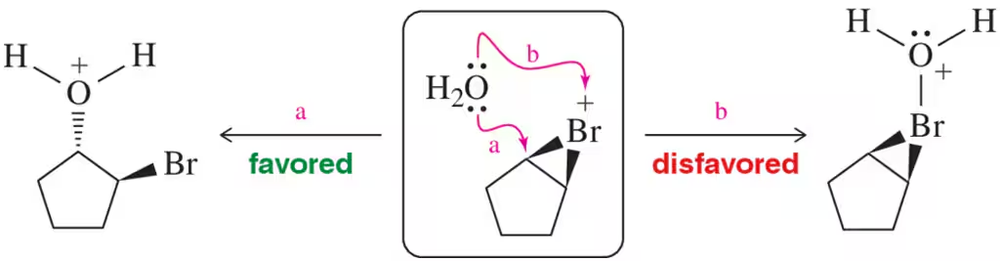
Explain why water attacks the carbon of the bromonium ion as opposed to the bromonium ion itself in the second step of halohydrin formation.
Verified step by step guidance
1
Understand the structure of the bromonium ion: The bromonium ion is a three-membered cyclic intermediate formed during the reaction of an alkene with bromine (Br₂). It consists of a positively charged bromine atom bonded to two carbons of the former double bond, creating significant ring strain and partial positive charges on the carbons.
Recognize the role of water as a nucleophile: Water is a polar molecule with lone pairs of electrons on the oxygen atom, making it a good nucleophile. It is also present in excess in the reaction medium, increasing the likelihood of its participation in the reaction.
Analyze the electrophilic sites in the bromonium ion: The carbon atoms in the bromonium ion are partially positive due to the electron-withdrawing nature of the bromine atom. These carbons are more electrophilic than the bromine atom itself, making them the preferred site for nucleophilic attack.
Consider steric and electronic factors: The bromonium ion is a strained three-membered ring, and breaking the ring by attacking one of the carbons relieves this strain. Additionally, attacking the bromine atom directly would not relieve the strain and is less favorable.
Conclude why water attacks the carbon: Water attacks the carbon of the bromonium ion because it is more electrophilic and breaking the ring relieves strain. This leads to the formation of a halohydrin, where the hydroxyl group (-OH) is added to one carbon and the bromine atom to the other.
Verified video answer for a similar problem:
This video solution was recommended by our tutors as helpful for the problem above
Video duration:
4m
Play a video:
0 Comments
Key Concepts
Here are the essential concepts you must grasp in order to answer the question correctly.
Bromonium Ion
A bromonium ion is a cyclic intermediate formed during the electrophilic addition of bromine to an alkene. It features a positively charged bromine atom that is bonded to two carbon atoms, creating a three-membered ring. This structure is highly reactive and stabilizes the positive charge through resonance, making it a key player in the mechanism of halohydrin formation.
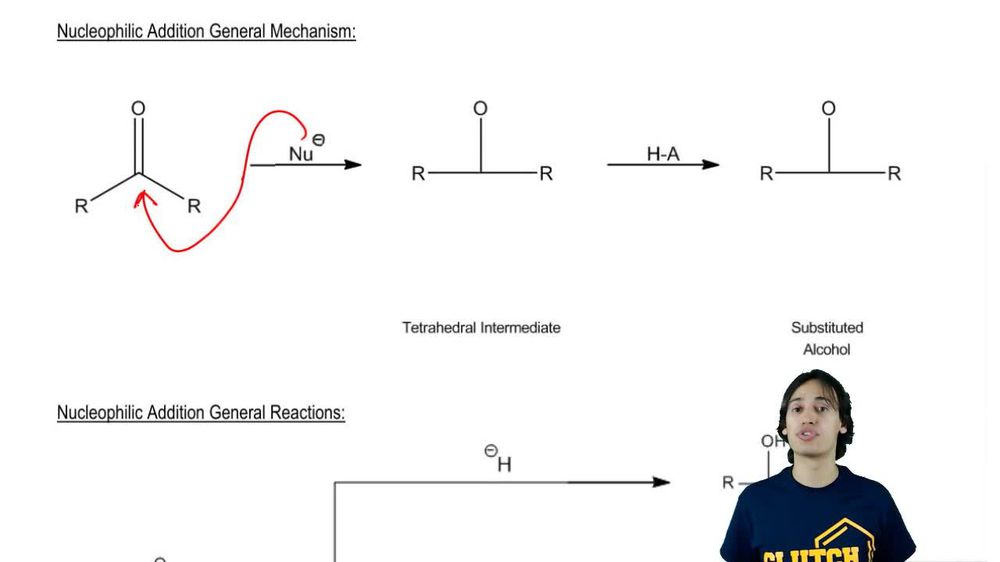
Nucleophilic attack refers to the process where a nucleophile, such as water, donates a pair of electrons to an electrophile, leading to the formation of a new bond. In the context of halohydrin formation, water acts as a nucleophile that attacks the more electrophilic carbon of the bromonium ion. This step is crucial as it determines the final structure of the halohydrin product.
Regioselectivity is the preference of a chemical reaction to yield one structural isomer over others when multiple products are possible. In the case of halohydrin formation, water preferentially attacks the more substituted carbon of the bromonium ion due to greater stability and steric factors. This selectivity influences the final product's configuration and properties.