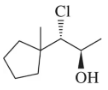
Suggest an alkene that could be used to make each of the following halohydrins. (c)
Verified step by step guidance
1
Analyze the structure of the halohydrin provided. The molecule contains a chlorine atom and a hydroxyl group (-OH) attached to adjacent carbons. This suggests that the halohydrin was formed via the addition of Cl₂ and H₂O to an alkene.
Identify the stereochemistry of the halohydrin. The chlorine atom is on a wedge (indicating it is coming out of the plane), and the hydroxyl group is on a dash (indicating it is going into the plane). This anti-addition stereochemistry is characteristic of halohydrin formation.
Determine the location of the double bond in the starting alkene. The double bond must be between the two carbons where the chlorine and hydroxyl groups are now attached. This is because halohydrin formation involves the electrophilic addition of Cl₂ and H₂O across the double bond.
Consider the structure of the alkene. The alkene must have a cyclopentyl group on one side and an isopropyl group on the other side of the double bond to match the substituents in the halohydrin product.
Propose the alkene structure. Based on the analysis, the alkene should be 1-cyclopentyl-1-isopropylethene, with the double bond positioned between the two carbons that now bear the chlorine and hydroxyl groups.
Verified video answer for a similar problem:
This video solution was recommended by our tutors as helpful for the problem above
Video duration:
2m
Play a video:
0 Comments
Key Concepts
Here are the essential concepts you must grasp in order to answer the question correctly.
Alkenes
Alkenes are hydrocarbons that contain at least one carbon-carbon double bond (C=C). They are unsaturated compounds and can undergo various reactions, including addition reactions, where atoms or groups are added to the carbon atoms of the double bond. Understanding the structure and reactivity of alkenes is crucial for predicting the products of reactions, such as the formation of halohydrins.
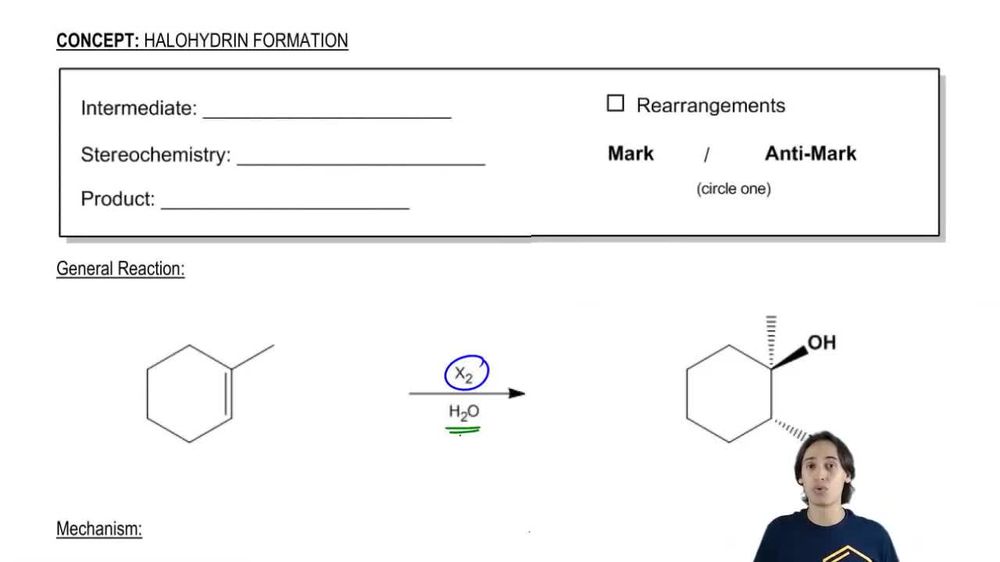
Halohydrins are compounds formed when alkenes react with halogens and water, resulting in the addition of a halogen atom and a hydroxyl group (OH) across the double bond. This reaction typically occurs via a mechanism involving the formation of a cyclic halonium ion intermediate, which influences the regioselectivity and stereochemistry of the product. Recognizing the mechanism is essential for determining which alkene can yield the desired halohydrin.
Regioselectivity refers to the preference of a chemical reaction to yield one structural isomer over others when multiple possibilities exist. In the context of halohydrin formation, the regioselectivity is influenced by the stability of the carbocation intermediates formed during the reaction. Understanding regioselectivity helps in predicting which alkene will produce the desired halohydrin based on the substitution pattern of the alkene and the nature of the halogen.