Explain why (S)-2-butanol forms a racemic mixture when it is heated in sulfuric acid.
Verified step by step guidance
1
Understand the structure of (S)-2-butanol: It is a chiral alcohol with the hydroxyl group (-OH) attached to the second carbon of a four-carbon chain. The (S) configuration indicates that the molecule has a specific spatial arrangement around the chiral center.
Recognize the role of sulfuric acid: Sulfuric acid is a strong acid that can protonate the hydroxyl group of (S)-2-butanol, converting it into a better leaving group (water). This step facilitates the formation of a carbocation intermediate.
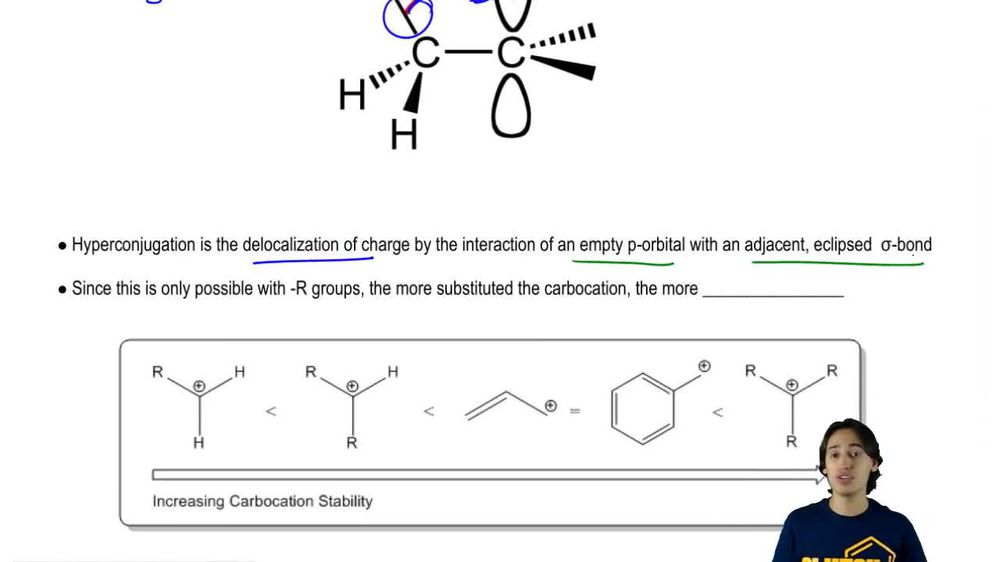
Describe the formation of the carbocation: When the hydroxyl group is protonated, it leaves as water, resulting in the formation of a planar carbocation at the second carbon. This carbocation is sp² hybridized and has a trigonal planar geometry, making it achiral.
Explain the racemization process: Because the carbocation is planar, the nucleophile (in this case, water or another molecule) can attack from either side of the plane with equal probability. This leads to the formation of both (R)-2-butanol and (S)-2-butanol in equal amounts, resulting in a racemic mixture.
Conclude the reasoning: The racemic mixture forms because the intermediate carbocation is achiral and allows for non-stereoselective attack by the nucleophile, producing both enantiomers in equal proportions.
Verified video answer for a similar problem:
This video solution was recommended by our tutors as helpful for the problem above
Video duration:
6m
Play a video:
0 Comments
Key Concepts
Here are the essential concepts you must grasp in order to answer the question correctly.
Chirality and Stereoisomers
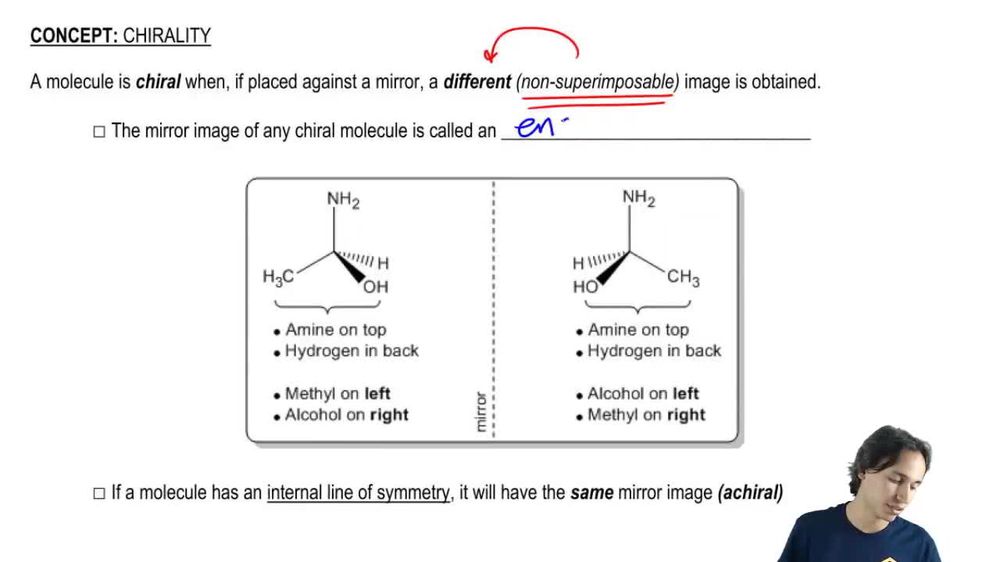
Chirality refers to the property of a molecule that makes it non-superimposable on its mirror image, leading to the existence of stereoisomers. (S)-2-butanol is a chiral molecule, meaning it has a specific three-dimensional arrangement that can exist in two enantiomeric forms. Understanding chirality is essential to grasp how reactions involving chiral centers can lead to the formation of racemic mixtures.
A racemic mixture is a 1:1 mixture of two enantiomers of a chiral compound, resulting in no optical activity. When (S)-2-butanol is heated in sulfuric acid, it can undergo dehydration to form a carbocation intermediate, which can then be attacked by nucleophiles from either side, leading to the formation of both (S)- and (R)-2-butanol. This process illustrates how racemic mixtures can arise from chiral starting materials.
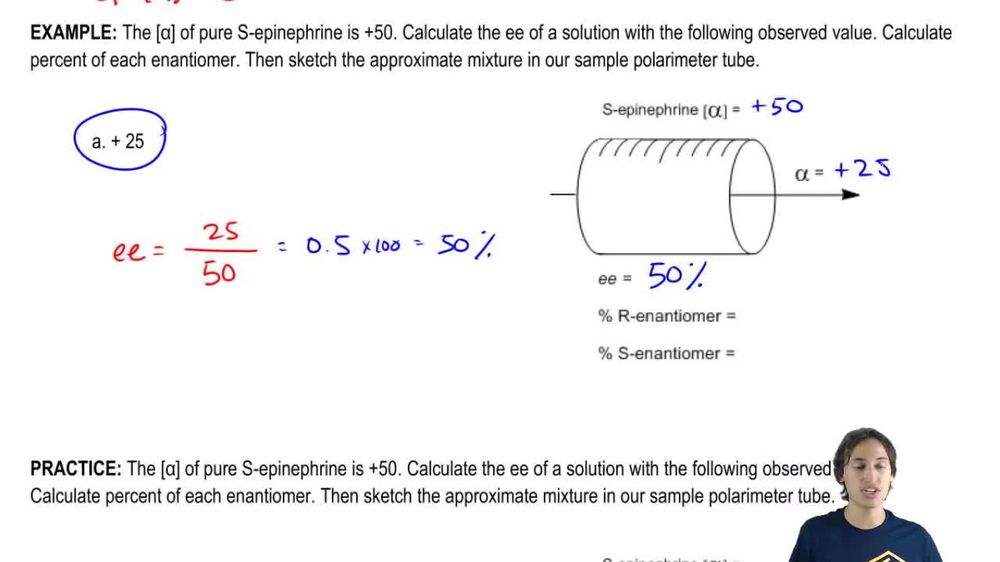
Calculating EE, percent of each enantiomer, and sketching mixture
Carbocation Stability and Rearrangement
Carbocations are positively charged species that can undergo rearrangements to form more stable structures. In the case of (S)-2-butanol, heating in sulfuric acid generates a carbocation that can rearrange or react in a way that allows for the formation of both enantiomers. The stability of the carbocation and the possibility of different pathways contribute to the racemic outcome of the reaction.