

Ch. 16 - Reactions of Aldehydes and Ketones • More Reactions of Carboxylic Acid Derivatives
Bruice - Organic Chemistry 8th Edition
Bruice8th EditionOrganic ChemistryISBN: 9780135213711Not the one you use?Change textbook
Chapter 17, Problem 98b

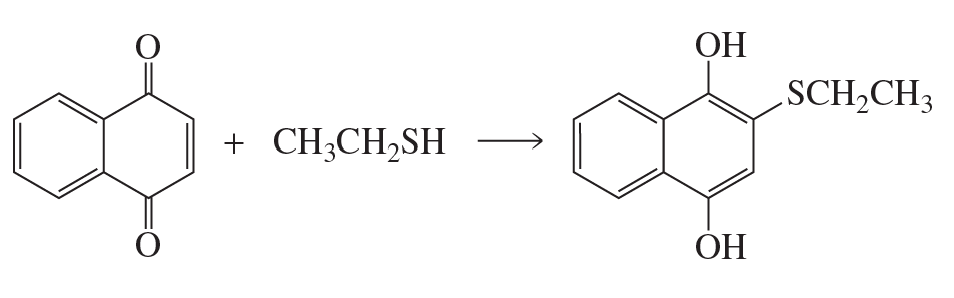
Propose a mechanism for each of the following reactions:
b. Chemical reaction diagram showing the addition of ethyl mercaptan to a diketone, resulting in a product with hydroxyl and thioether groups.

Verified step by step guidance
1
Step 1: Analyze the starting material and reagent. The starting material is a ketone (a cyclic aromatic ketone), and the reagent is methanethiol (CH₃SH). This suggests a nucleophilic addition reaction involving the sulfur atom of CH₃SH.
Step 2: Protonation of the ketone oxygen. The reaction likely begins with the protonation of the carbonyl oxygen by an acid catalyst (if present), increasing the electrophilicity of the carbonyl carbon.
Step 3: Nucleophilic attack by CH₃SH. The sulfur atom in CH₃SH acts as a nucleophile and attacks the electrophilic carbonyl carbon, forming a tetrahedral intermediate.
Step 4: Proton transfer and rearrangement. A proton transfer occurs, leading to the formation of a hydroxyl group (-OH) on the former carbonyl carbon and the attachment of the CH₃S group to the adjacent carbon.
Step 5: Final product formation. The aromaticity of the ring is restored, resulting in the final product where the hydroxyl group (-OH) and the thioether group (-SCH₃) are attached to the aromatic ring system.

Verified video answer for a similar problem:

This video solution was recommended by our tutors as helpful for the problem above.
Video duration:
6m
Was this helpful?

Key Concepts

Here are the essential concepts you must grasp in order to answer the question correctly.

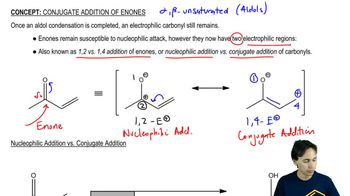
Conjugate Addition

Conjugate addition refers to the nucleophilic addition of a reagent to an α,β-unsaturated carbonyl compound. In this reaction, the nucleophile attacks the β-carbon, leading to the formation of a new bond while the double bond is shifted. This mechanism is crucial for understanding how nucleophiles like CH3SH can add to ketones or aldehydes, resulting in the formation of products with new functional groups.
Recommended video:
Guided course
09:23
1,2 vs 1,4 Addition

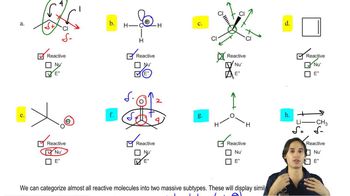
Nucleophiles and Electrophiles

In organic chemistry, nucleophiles are species that donate an electron pair to form a chemical bond, while electrophiles are electron-deficient species that accept electron pairs. In the given reaction, CH3SH acts as a nucleophile due to the presence of the sulfur atom, which has a lone pair of electrons, allowing it to attack the electrophilic carbon of the ketone. Understanding the roles of nucleophiles and electrophiles is essential for predicting reaction mechanisms.
Recommended video:
Guided course
03:
Nucleophile or Electrophile

Reaction Mechanism

A reaction mechanism is a step-by-step description of the process by which reactants are converted into products. It outlines the sequence of bond-breaking and bond-forming events, including intermediates and transition states. Proposing a mechanism for the reaction shown involves identifying the nucleophilic attack, the formation of a tetrahedral intermediate, and the subsequent proton transfer, which leads to the final product. This understanding is vital for predicting the outcome of organic reactions.
Recommended video:
Guided course
02:16
Heck Reaction Mechanism