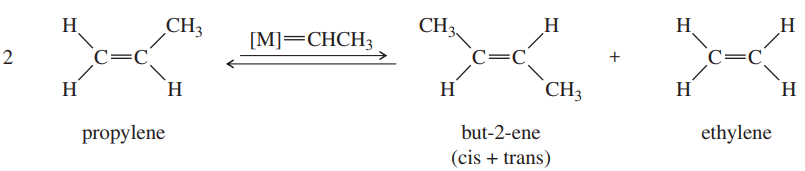
Propose a mechanism for the triolefin process using a metal alkylidene as the catalyst.
Verified step by step guidance
1
Step 1: Recognize that the triolefin process involves olefin metathesis, a reaction where carbon-carbon double bonds are broken and reformed in the presence of a metal alkylidene catalyst. The catalyst is denoted as [M]=CHCH₃ in the image.
Step 2: Initiate the mechanism by the interaction of the metal alkylidene catalyst ([M]=CHCH₃) with one molecule of propylene (CH₂=CHCH₃). This forms a metallacyclobutane intermediate through a [2+2] cycloaddition reaction.
Step 3: The metallacyclobutane intermediate undergoes a ring-opening step, leading to the formation of a new metal alkylidene species ([M]=CH₂) and a but-2-ene molecule (cis or trans).
Step 4: The newly formed metal alkylidene species ([M]=CH₂) reacts with another molecule of propylene (CH₂=CHCH₃), forming a second metallacyclobutane intermediate.
Step 5: The second metallacyclobutane intermediate undergoes ring-opening, yielding ethylene (CH₂=CH₂) and regenerating the original metal alkylidene catalyst ([M]=CHCH₃), completing the catalytic cycle.
Verified video answer for a similar problem:
This video solution was recommended by our tutors as helpful for the problem above
Video duration:
5m
Play a video:
0 Comments
Key Concepts
Here are the essential concepts you must grasp in order to answer the question correctly.
Metal Alkylidene Catalysts
Metal alkylidene catalysts are transition metal complexes that contain a metal-carbon double bond. They play a crucial role in olefin metathesis reactions, where they facilitate the exchange of alkene fragments. The metal center stabilizes the alkylidene, allowing it to participate in the reaction mechanism, leading to the formation of new carbon-carbon bonds.
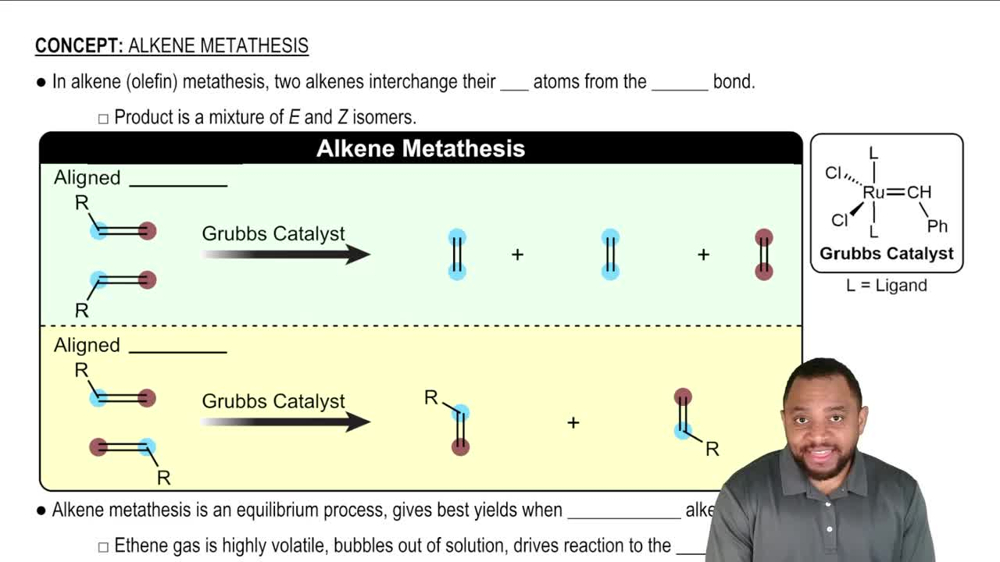
Olefin metathesis is a chemical reaction that involves the redistribution of alkene fragments through the breaking and forming of carbon-carbon double bonds. This process is typically catalyzed by metal alkylidene complexes and can lead to the synthesis of various alkenes, such as but-2-ene and ethylene from propylene, as shown in the reaction diagram.
A reaction mechanism describes the step-by-step sequence of elementary reactions that occur during a chemical transformation. In the context of the triolefin process, understanding the mechanism involves identifying the intermediates formed, such as the metal-alkylidene complex, and the transition states that lead to the final products, but-2-ene and ethylene.