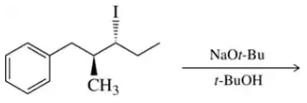
Predict the product of the following reactions. (d)
Verified step by step guidance
1
Step 1: Analyze the structure of the reactant. The molecule contains an iodine atom attached to a secondary carbon, which makes it a good leaving group. The presence of a bulky base, NaO-tBu (sodium tert-butoxide), suggests that the reaction will likely proceed via an E2 elimination mechanism.
Step 2: Consider the stereochemistry of the molecule. In an E2 elimination, the hydrogen to be removed must be anti-periplanar to the leaving group (iodine). Identify the β-hydrogens on the adjacent carbons and determine which hydrogen is anti-periplanar to the iodine.
Step 3: Predict the major product based on Zaitsev's rule. Zaitsev's rule states that the most substituted alkene will be the major product in an elimination reaction. However, due to the bulky base (NaO-tBu), the reaction may favor the formation of the less substituted alkene (Hofmann product). Consider steric hindrance in the elimination process.
Step 4: Draw the possible alkenes formed from the elimination reaction. Remove the iodine and the anti-periplanar β-hydrogen, forming a double bond between the α-carbon (where iodine was attached) and the β-carbon.
Step 5: Determine the major product based on the steric effects of the bulky base. The bulky base will favor the formation of the less substituted alkene, which is the Hofmann product. Ensure the stereochemistry of the product aligns with the anti-periplanar requirement of the E2 mechanism.
Verified video answer for a similar problem:
This video solution was recommended by our tutors as helpful for the problem above
Video duration:
3m
Play a video:
0 Comments
Key Concepts
Here are the essential concepts you must grasp in order to answer the question correctly.
Nucleophilic Substitution Reactions
Nucleophilic substitution reactions involve the replacement of a leaving group (like iodine) by a nucleophile. In this case, sodium tert-butoxide (NaO-t-Bu) acts as a strong nucleophile, attacking the carbon atom bonded to the iodine. Understanding the mechanism, whether it follows an SN1 or SN2 pathway, is crucial for predicting the product.
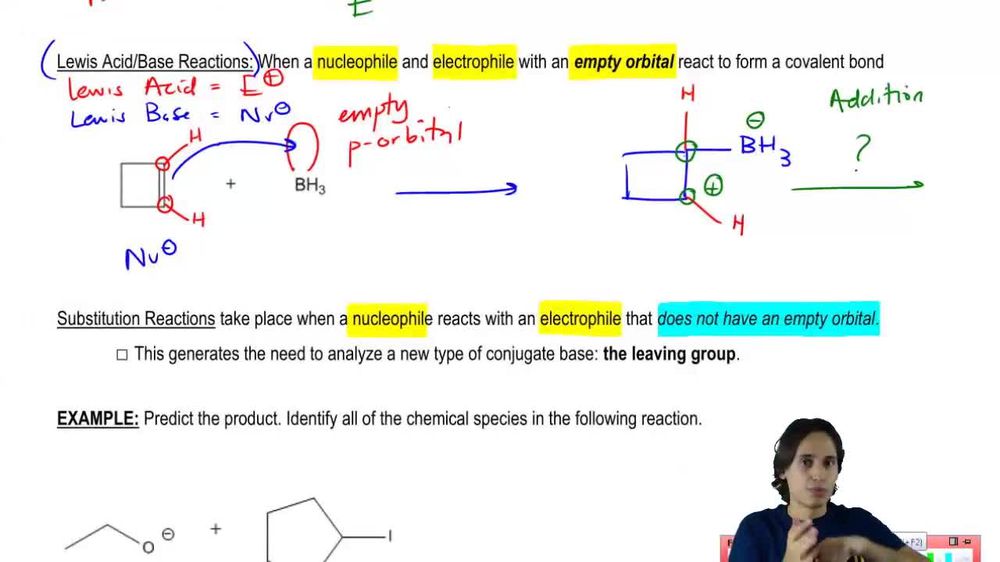
Nucleophiles and Electrophiles can react in Substitution Reactions.
Elimination Reactions
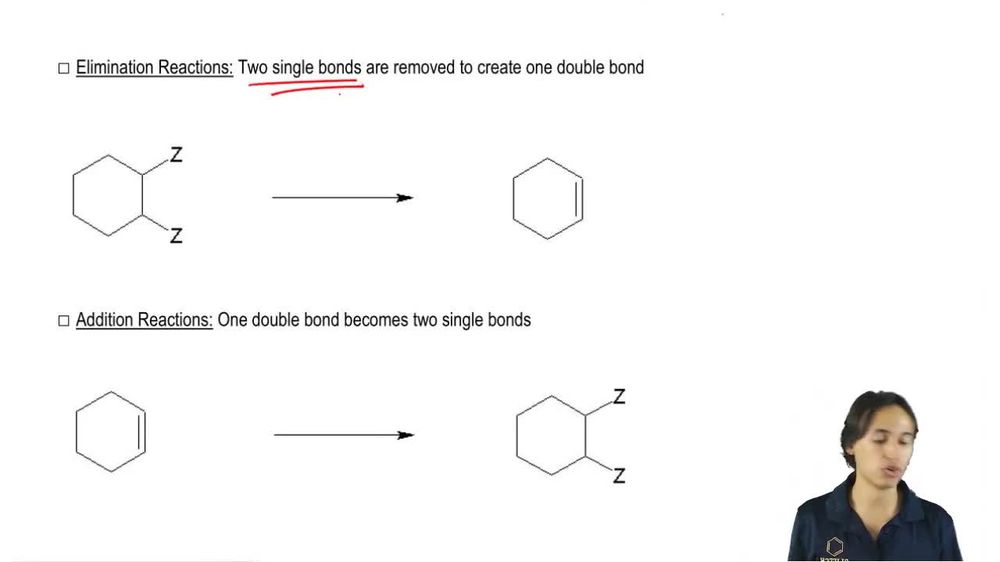
Elimination reactions involve the removal of a small molecule (like H-I) from a larger molecule, resulting in the formation of a double bond. In the presence of a strong base like NaO-t-Bu, the reaction can lead to the formation of alkenes through either E1 or E2 mechanisms. Recognizing the conditions that favor elimination over substitution is essential for predicting the outcome.
Regioselectivity refers to the preference of a chemical reaction to yield one structural isomer over others. In this reaction, the formation of the double bond can lead to different alkene products depending on the site of elimination. Additionally, stereochemistry plays a role in determining the configuration of the double bond, which can affect the stability and reactivity of the product.