Would you expect the following bases to favor E1 or E2 elimination? (c)
Verified step by step guidance
1
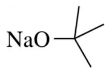
Step 1: Begin by identifying the base shown in the image. The base is sodium tert-butoxide (NaO-tBu), which is a strong and bulky base.
Step 2: Recall the characteristics of E1 and E2 elimination mechanisms. E1 elimination involves a carbocation intermediate and is typically favored by weak bases and polar protic solvents. E2 elimination is a concerted mechanism that requires a strong base and is influenced by steric hindrance.
Step 3: Analyze the steric hindrance of the base. Sodium tert-butoxide is a bulky base, meaning it has difficulty approaching the β-hydrogen in crowded environments. This steric hindrance makes it more likely to favor E2 elimination over E1.
Step 4: Consider the solvent and substrate. E2 elimination is favored in polar aprotic solvents and with substrates that have accessible β-hydrogens. The bulky nature of the base may also lead to preferential elimination of less sterically hindered β-hydrogens.
Step 5: Conclude that sodium tert-butoxide, due to its strong and bulky nature, will favor the E2 elimination mechanism over E1. The steric hindrance of the base plays a key role in this preference.
Verified video answer for a similar problem:
This video solution was recommended by our tutors as helpful for the problem above
Play a video:
0 Comments
Key Concepts
Here are the essential concepts you must grasp in order to answer the question correctly.
E1 and E2 Mechanisms
E1 (unimolecular elimination) and E2 (bimolecular elimination) are two types of elimination reactions in organic chemistry. E1 involves a two-step mechanism where the leaving group departs first, forming a carbocation, followed by deprotonation. In contrast, E2 is a one-step mechanism where the base abstracts a proton while the leaving group exits simultaneously, requiring a strong base and often leading to more sterically hindered substrates.
The structure of the substrate plays a crucial role in determining whether E1 or E2 mechanisms are favored. E1 reactions are more favorable with tertiary substrates due to the stability of the carbocation formed, while E2 reactions can occur with primary, secondary, or tertiary substrates, depending on the strength of the base and steric hindrance. Understanding the substrate's structure helps predict the reaction pathway.
The strength and steric properties of the base influence the choice between E1 and E2 mechanisms. Strong bases favor E2 eliminations as they can effectively abstract protons in a concerted manner. Conversely, weak bases or neutral conditions may lead to E1 eliminations, especially when the substrate can stabilize a carbocation. The steric hindrance of the base also affects its ability to approach the substrate for E2 reactions.

 Verified step by step guidance
 09:36
09:36