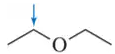
Determine the oxidation number of each carbon indicated by an arrow. (g)
Verified step by step guidance
1
Identify the structure: The molecule shown is an ether, specifically diethyl ether, with the formula \( C_2H_5OC_2H_5 \). The arrow points to the carbon atom in one of the ethyl groups.
Determine the bonds: The carbon indicated by the arrow is bonded to two hydrogen atoms and one other carbon atom, as well as the oxygen atom in the ether linkage.
Assign oxidation numbers: In organic chemistry, the oxidation number of carbon is determined by considering the electronegativity of the atoms it is bonded to. Carbon is less electronegative than oxygen but more electronegative than hydrogen.
Calculate the oxidation number: For each bond to a more electronegative atom (oxygen), assign +1. For each bond to a less electronegative atom (hydrogen), assign -1. Bonds to other carbon atoms do not affect the oxidation number.
Apply the rules: The carbon atom has two bonds to hydrogen (each contributing -1) and one bond to oxygen (contributing +1). Therefore, the oxidation number of the carbon atom is calculated as \(-1 - 1 + 1 = -1\).
Verified video answer for a similar problem:
This video solution was recommended by our tutors as helpful for the problem above
Play a video:
0 Comments
Key Concepts
Here are the essential concepts you must grasp in order to answer the question correctly.
Oxidation Number
The oxidation number, or oxidation state, is a theoretical charge assigned to an atom in a molecule, reflecting its degree of oxidation. It helps in understanding electron transfer in redox reactions. For carbon, common oxidation states range from -4 in methane (CH4) to +4 in carbon dioxide (CO2). Determining oxidation numbers involves analyzing the bonding and electronegativity of surrounding atoms.
Valence electrons are the outermost electrons of an atom and are crucial in determining how an atom bonds with others. For carbon, which has four valence electrons, this allows it to form four covalent bonds, influencing its oxidation state. Understanding the distribution of valence electrons is essential for calculating oxidation numbers, as it directly relates to the atom's bonding environment.
Electronegativity is the tendency of an atom to attract electrons in a chemical bond. In determining oxidation numbers, the relative electronegativities of the atoms involved are considered; more electronegative atoms will attract shared electrons more strongly, leading to a higher oxidation state for the less electronegative atom. This concept is vital for accurately assessing the oxidation states of carbon in various compounds.

 Verified step by step guidance
 03:40
03:40