Calculate the oxidation numbers for the indicated atoms. (d)
Verified step by step guidance
1
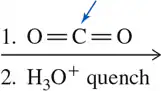
Identify the molecule in the image: The molecule shown is carbon dioxide (CO₂), where the carbon atom is double-bonded to two oxygen atoms.
Recall the general rule for oxidation numbers: Oxygen typically has an oxidation number of -2.
Set up the equation for the oxidation number of carbon: Let the oxidation number of carbon be x. The equation based on the sum of oxidation numbers being zero for a neutral molecule is: x + 2(-2) = 0.
Solve the equation for x: Simplify the equation to find the oxidation number of carbon. This involves solving x - 4 = 0.
Conclude the oxidation number: The oxidation number of carbon in carbon dioxide is determined by solving the equation, which will give you the value of x.
Verified video answer for a similar problem:
This video solution was recommended by our tutors as helpful for the problem above
Play a video:
0 Comments
Key Concepts
Here are the essential concepts you must grasp in order to answer the question correctly.
Oxidation Numbers
Oxidation numbers are a way to keep track of electrons in chemical reactions, indicating the degree of oxidation of an atom. For carbon in CO2, the oxidation number is +4, as it loses four electrons to the more electronegative oxygen atoms, each of which has an oxidation number of -2.
Carbonyl compounds contain a carbon-oxygen double bond, which is a key functional group in organic chemistry. In CO2, the carbonyl group is part of the linear structure, and understanding its reactivity is crucial for predicting chemical behavior, especially in reactions involving nucleophiles like H3O+.
Quenching refers to the process of stopping or neutralizing a chemical reaction, often by adding a reagent that reacts with reactive intermediates. In the context of the image, H3O+ is used to quench the reaction, likely stabilizing any reactive species formed during the process.

 Verified step by step guidance
 03:40
03:40