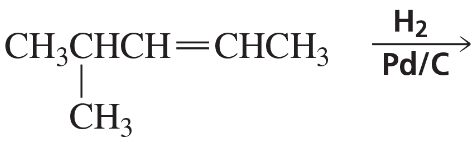
What are the products of the following reactions? Indicate whether each reaction is an oxidation or a reduction. b.
Verified step by step guidance
1
Step 1: Analyze the reactant structure. The given compound is an alkene with a double bond between two carbon atoms. The structure is 2-methyl-2-pentene.
Step 2: Identify the reaction conditions. The reaction involves hydrogen gas (H₂) and a palladium catalyst (Pd/C), which is a typical setup for catalytic hydrogenation.
Step 3: Understand the mechanism. In catalytic hydrogenation, the double bond in the alkene is reduced by the addition of hydrogen atoms, converting the alkene into an alkane. The palladium catalyst facilitates the addition of hydrogen atoms to the double bond.
Step 4: Predict the product. The double bond in 2-methyl-2-pentene will be replaced by single bonds, resulting in a saturated hydrocarbon. The product will be 2-methylpentane.
Step 5: Classify the reaction. Since hydrogen is added to the molecule and the double bond is reduced to a single bond, this reaction is classified as a reduction.
Verified video answer for a similar problem:
This video solution was recommended by our tutors as helpful for the problem above
Video duration:
2m
Play a video:
0 Comments
Key Concepts
Here are the essential concepts you must grasp in order to answer the question correctly.
Oxidation and Reduction
Oxidation and reduction are chemical processes that involve the transfer of electrons between substances. Oxidation refers to the loss of electrons or an increase in oxidation state, while reduction involves the gain of electrons or a decrease in oxidation state. These reactions are often coupled, meaning that when one substance is oxidized, another is reduced.
To determine the products of a chemical reaction, one must analyze the reactants and the conditions under which the reaction occurs. This involves understanding the functional groups present, the type of reaction (e.g., substitution, addition, elimination), and any catalysts or reagents that may influence the outcome. Predicting products often requires familiarity with reaction mechanisms and organic chemistry principles.
A reaction mechanism is a step-by-step description of the process by which reactants transform into products. It outlines the sequence of bond-breaking and bond-forming events, including intermediates and transition states. Understanding mechanisms is crucial for predicting the products of reactions and determining whether they involve oxidation or reduction, as it provides insight into the electron flow and changes in oxidation states.