When the following compound undergoes solvolysis in ethanol, three products are obtained. Propose a mechanism to account for the formation of these products.
Verified step by step guidance
1
Step 1: Identify the type of reaction occurring. The compound undergoes solvolysis in ethanol, which suggests an SN1 mechanism. Solvolysis involves the solvent (ethanol) acting as the nucleophile.
Step 2: Analyze the structure of the starting compound. The molecule contains a bromomethyl group attached to a cyclohexene ring. Bromine is a good leaving group, and the cyclohexene ring can stabilize a carbocation intermediate.
Step 3: Propose the first step of the mechanism. The bromine atom leaves, forming a carbocation at the benzylic position (the carbon adjacent to the double bond). This carbocation is stabilized by resonance with the double bond in the cyclohexene ring.
Step 4: Account for the formation of the three products. (1) Ethanol can act as a nucleophile and attack the carbocation, forming the ether product. (2) A proton transfer can occur, leading to the formation of the alkene product via elimination. (3) Ethanol can also attack the carbocation at a different position, forming the second ether product.
Step 5: Consider stereochemistry and regioselectivity. The resonance-stabilized carbocation allows for multiple sites of attack by ethanol, leading to the observed mixture of products. The reaction conditions favor both substitution and elimination pathways.
Verified video answer for a similar problem:
This video solution was recommended by our tutors as helpful for the problem above
Video duration:
9m
Play a video:
0 Comments
Key Concepts
Here are the essential concepts you must grasp in order to answer the question correctly.
Solvolysis
Solvolysis is a type of nucleophilic substitution reaction where a solvent, typically an alcohol or water, acts as the nucleophile. In this case, ethanol (CH3CH2OH) attacks the electrophilic carbon of the alkyl halide (CH2Br), leading to the formation of various products. Understanding solvolysis is crucial for predicting the products formed during the reaction.
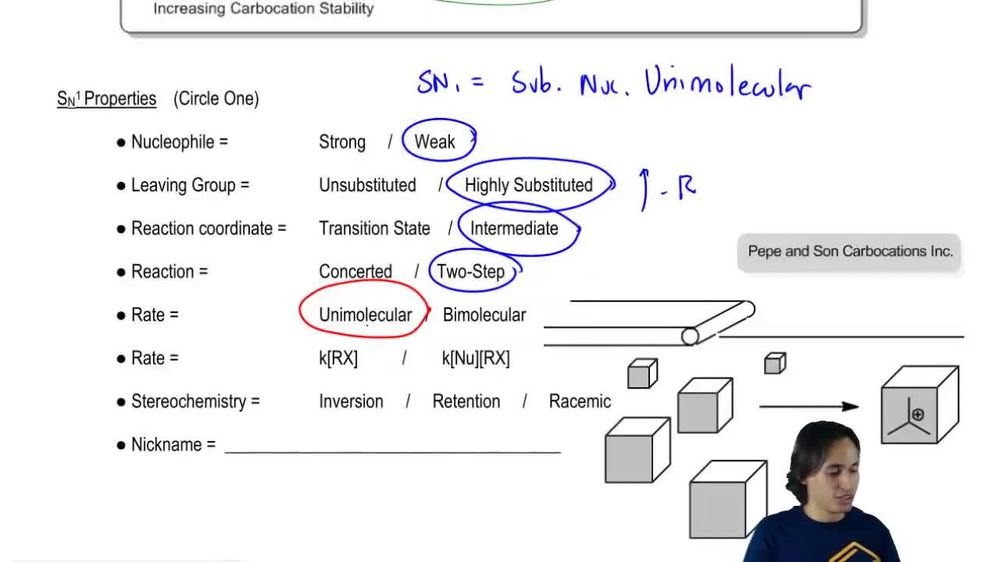
Nucleophilic substitution can occur via two primary mechanisms: SN1 and SN2. The SN1 mechanism involves a two-step process where the leaving group departs first, forming a carbocation intermediate, followed by nucleophilic attack. In contrast, the SN2 mechanism is a one-step process where the nucleophile attacks the substrate simultaneously as the leaving group departs. The mechanism chosen affects the stereochemistry and the products formed.
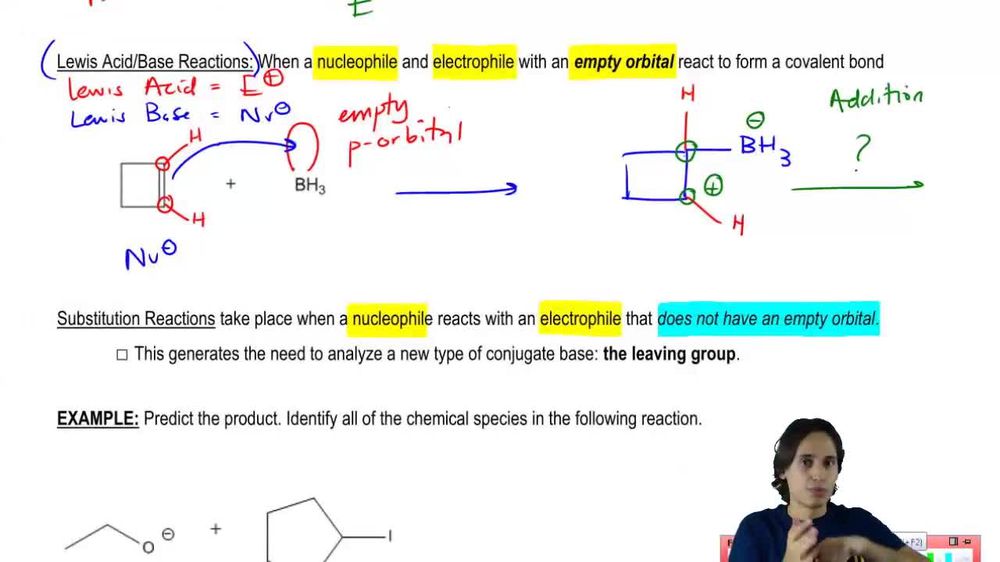
Nucleophiles and Electrophiles can react in Substitution Reactions.
Product Formation and Rearrangement
The formation of multiple products in a reaction often indicates the possibility of rearrangements or different pathways taken by the nucleophile. In this case, the presence of different products suggests that the carbocation intermediate may undergo rearrangement or that the nucleophile can attack from different angles, leading to various substitution products. Analyzing the structure of the products helps in understanding the reaction pathway.

 9:55 minutes
 Verified step by step guidance
 08:16
08:16