Skip to main content
Organic Chemistry
My Course
Learn
Exam Prep
AI Tutor
Study Guides
Textbook Solutions
Flashcards
Explore
Try the app
My Course
Learn
Exam Prep
AI Tutor
Study Guides
Textbook Solutions
Flashcards
Explore
Try the app
Back
Condensation Reactions definitions
You can tap to flip the card.
Condensation Reaction
You can tap to flip the card.
👆
Condensation Reaction
Process where two molecules combine to form a larger molecule with the simultaneous loss of a smaller molecule, often water or alcohol.
Track progress
Control buttons has been changed to "navigation" mode.
1/15
Related flashcards
Related practice
Recommended videos
Condensation Reactions quiz
Condensation Reactions
10 Terms
Condensation Reactions quiz #1
Condensation Reactions
10 Terms
Condensation Reactions
25. Condensation Chemistry
2 problems
Topic
Johnny
Aldol Condensation
25. Condensation Chemistry
7 problems
Topic
Johnny
22. Condensation Chemistry - Part 1 of 2
3 topics
9 problems
Chapter
Ernest
22. Condensation Chemistry - Part 2 of 2
3 topics
9 problems
Chapter
Johnny
Guided course
05:53
Condensation Reactions
2130
views
28
rank
2
comments
Terms in this set (15)
Hide definitions
Condensation Reaction
Process where two molecules combine to form a larger molecule with the simultaneous loss of a smaller molecule, often water or alcohol.
Enolate
Reactive anion formed by deprotonation at the alpha carbon of a carbonyl compound, featuring a negative charge on the alpha carbon.
Alpha Proton
Hydrogen atom attached to the carbon adjacent to a carbonyl group, whose removal enables enolate formation.
Alpha Carbon
Carbon atom directly bonded to a carbonyl group, serving as the site for enolate formation upon deprotonation.
Self Condensation
Reaction where a molecule reacts with another molecule of the same kind, often involving enolates, to form a larger product.
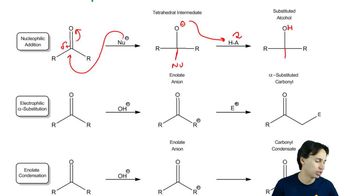
Nucleophilic Addition
Mechanism where a nucleophile attacks an electrophilic carbonyl carbon, leading to a tetrahedral intermediate.
Tetrahedral Intermediate
Transient structure formed when a nucleophile adds to a carbonyl carbon, resulting in four substituents around the central carbon.
Aldol Reaction
Condensation process between ketones or aldehydes yielding a molecule with both alcohol and aldehyde or ketone groups.
Claisen Condensation
Reaction where two esters combine via enolate formation to produce a beta-dicarbonyl compound, typically a beta-ketoester.
Beta-Dicarbonyl Compound
Molecule containing two carbonyl groups separated by one carbon, often formed in Claisen condensation.
Beta-Ketoester
Compound featuring a ketone and an ester group separated by one carbon, characteristic product of Claisen condensation.
Electrophile
Species that accepts electrons during a reaction, often targeted by nucleophiles like enolates.
Carbonyl Group
Functional group consisting of a carbon atom double-bonded to an oxygen atom, central to many organic reactions.
Alcohol Group
Functional group containing an -OH moiety, often formed as a result of nucleophilic addition to carbonyls.
Aldehyde
Organic compound containing a carbonyl group bonded to at least one hydrogen, commonly involved in aldol reactions.
 BackBack

 05:53
05:53