Skip to main content
Organic Chemistry
My Course
Learn
Exam Prep
AI Tutor
Study Guides
Textbook Solutions
Flashcards
Explore
Try the app
My Course
Learn
Exam Prep
AI Tutor
Study Guides
Textbook Solutions
Flashcards
Explore
Try the app
Back
Proteins and Amino Acids definitions
You can tap to flip the card.
Protein
You can tap to flip the card.
👆
Protein
A polypeptide chain that performs a biological function, making up nearly every part of the human body.
Track progress
Control buttons has been changed to "navigation" mode.
1/15
Related flashcards
Related practice
Recommended videos
Proteins and Amino Acids quiz #1
Proteins and Amino Acids
40 Terms
Proteins and Amino Acids quiz #2
Proteins and Amino Acids
39 Terms
Proteins and Amino Acids quiz #3
Proteins and Amino Acids
39 Terms
Proteins and Amino Acids
29. Amino Acids
7 problems
Topic
Nicole
L and D Amino Acids
29. Amino Acids
3 problems
Topic
Ernest
26. Amino Acids, Peptides, and Proteins
5 topics
13 problems
Chapter
Johnny
Guided course
09:34
Peptides and Polypeptides
1659
views
13
rank
3
comments
Guided course
09:36
Standard Amino Acids
1423
views
10
rank
1
comments
Terms in this set (15)
Hide definitions
Protein
A polypeptide chain that performs a biological function, making up nearly every part of the human body.
Polypeptide
A polymer of amino acids, typically containing between 11 and 50 residues, forming the backbone of proteins.
Peptide
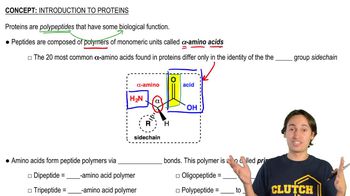
A short chain of alpha amino acids linked by peptide bonds, forming the primary structure of proteins.
Alpha Amino Acid
A molecule with an amino group and a carboxylic acid group attached to the same central (alpha) carbon.
Peptide Bond
A covalent linkage between the carbon of one amino acid and the nitrogen of another, formed with the loss of water.
Residue
A dehydrated amino acid unit within a peptide chain, resulting from the loss of water during bond formation.
R Group
A variable side chain attached to the alpha carbon of an amino acid, determining its unique properties.
Primary Structure
The linear sequence of amino acids in a peptide or protein, held together by peptide bonds.
Dipeptide
A molecule consisting of two amino acid residues joined by a single peptide bond.
Tripeptide
A molecule composed of three amino acid residues linked in sequence by peptide bonds.
Oligopeptide
A peptide chain containing between four and ten amino acid residues.
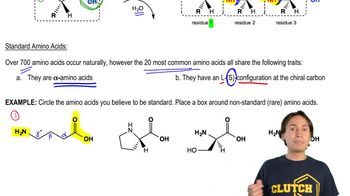
Standard Amino Acid
One of the 20 alpha amino acids with an L (S) configuration, commonly found in eukaryotic proteins.
Nonstandard Amino Acid
Amino acids not among the 20 common types, often differing by side chain position or chiral configuration.
Chiral Center
A carbon atom in an amino acid bonded to four different groups, giving rise to stereoisomerism.
L Configuration
The spatial arrangement of groups around the chiral center in standard amino acids, corresponding to the S configuration in organic chemistry.
 BackBack


 09:34
09:34