 Back
BackAcids, Bases, and the Chemistry of Organic Functional Groups
Study Guide - Smart Notes
 Tailored notes based on your materials, expanded with key definitions, examples, and context.
Acids and Bases in Organic Chemistry
Definitions and Fundamental Concepts
Understanding acids and bases is essential for predicting the behavior of organic molecules, especially in biological and pharmaceutical contexts. Two primary definitions are used in organic chemistry: the Brønsted-Lowry and Lewis definitions.
Brønsted-Lowry Acid: A substance that donates a proton (H+).
Brønsted-Lowry Base: A substance that accepts a proton.
Lewis Acid: An electron pair acceptor.
Lewis Base: An electron pair donor.
In most dilute aqueous solutions, the Brønsted-Lowry concept is most applicable for predicting acid/base behavior.
Conjugate Acid-Base Pairs
When an acid donates a proton, it forms its conjugate base; when a base accepts a proton, it forms its conjugate acid. The strength of an acid is inversely related to the strength of its conjugate base.
Strong acid: Loses protons easily; its conjugate base is weak.
Weak acid: Loses protons with difficulty; its conjugate base is strong.
Amphoteric molecules: Compounds that can act as both acids and bases (e.g., amino acids, ciprofloxacin).
Acid-Base Reactions and Ionization
Upon proton transfer, acids and bases become ionized, often increasing water solubility. This property is crucial for drug absorption, distribution, and excretion.
Quantifying Acidity: Ka and pKa
Acidity Constant (Ka) and pKa
The strength of an acid in water is measured by its acid dissociation constant (Ka), which quantifies the equilibrium between the acid and its conjugate base.
Key Equations:
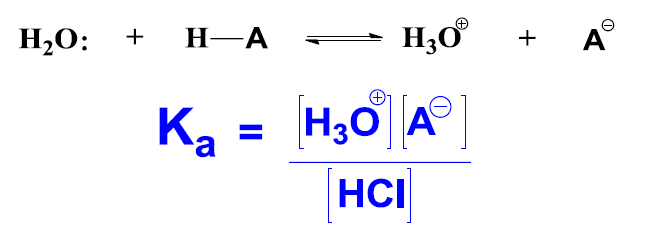
The pKa is the negative logarithm of Ka:
Strong acids: Large Ka, small pKa
Weak acids: Small Ka, large pKa
Each unit change in pKa represents a tenfold change in acidity.
pKa values for organic acids typically range from -12 (very strong acids) to 52 (very weak acids).
Factors Influencing Acidity
Electronegativity
The more electronegative the atom bonded to hydrogen, the more it stabilizes the negative charge on the conjugate base, increasing acidity. Acidity increases from left to right across a period in the periodic table.
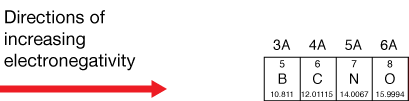
For example, pKa values: CH4 ≈ 48, NH3 ≈ 38, H2O ≈ 16, HF ≈ 3
Bond Strength and Atomic Size
Acidity increases down a group in the periodic table due to decreasing bond strength and increased ability to disperse negative charge over a larger atom (e.g., HF, HCl, HBr, HI).
pKa values: HF ≈ 3, HCl ≈ -7, HBr ≈ -9, HI ≈ -10
Inductive Effects
Electron-withdrawing groups (EWGs) increase acidity by stabilizing the conjugate base, while electron-donating groups (EDGs) decrease acidity by destabilizing the conjugate base.
EWGs: -NO2, -CN, -COOR, -CO-, -OR, -OH
EDGs: -CH3, -O-, halogens
Resonance and Delocalization
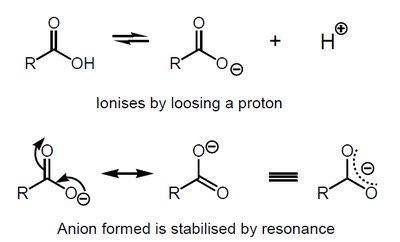
Resonance stabilization of the conjugate base greatly enhances acidity. Carboxylic acids are classic examples, where the negative charge is delocalized over two oxygen atoms.
Hybridization
The greater the s-character of the atom bearing the negative charge, the more stable the conjugate base, and thus the stronger the acid (e.g., sp > sp2 > sp3).
Acidic Functional Groups in Organic Molecules
Common Acidic Functional Groups
Recognizing acidic functional groups is essential for predicting ionization, solubility, and reactivity of organic molecules, especially drugs.
Carboxylic acids: Most common, pKa ~ 4-5
Phenols: Weak acids, pKa ~ 10
Sulfonamides, imides, thiophenes, etc.: Varying acidities
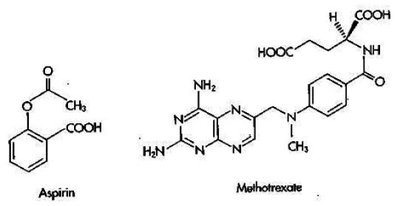
Examples of Acidic Drugs
Many drugs contain acidic groups that influence their solubility and pharmacokinetics. For example, warfarin is used as its sodium salt to increase water solubility, indicating the presence of an acidic proton.
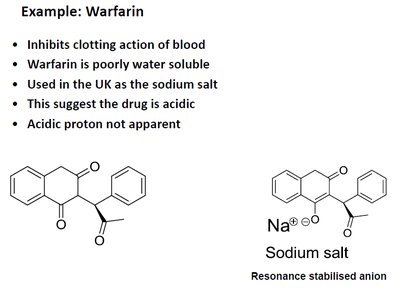
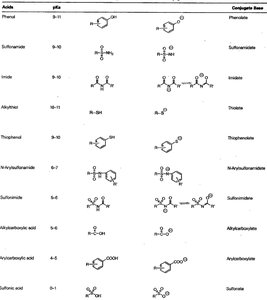
Table: Common Acidic Functional Groups and Their Conjugate Bases
The following table summarizes common acidic functional groups, their approximate pKa values, and their conjugate base forms.
Acid | pKa | Conjugate Base |
|---|---|---|
Phenol | 9-11 | Phenolate |
Sulfonamide | 9-10 | Sulfonamide anion |
Imide | 8-10 | Imide anion |
Alkylthiol | 10-11 | Thioate |
Thiophenol | 6-7 | Thiophenolate |
N-Methylsulfonamide | 6-7 | N-Methylsulfonamide anion |
Sulfonic acid | 0-1 | Sulfonate |
Carboxylic acid | 4-5 | Carboxylate |
Hydroxamic acid | 8-9 | Hydroxamate |
Summary
Acidity and basicity are central to understanding organic reactivity and drug behavior.
pKa values allow comparison of acid strengths and prediction of ionization states.
Structural features such as electronegativity, resonance, inductive effects, and hybridization all influence acidity.
Recognizing acidic functional groups is essential for predicting solubility, absorption, and compatibility of organic compounds.
