 Back
BackAlcohols and Thiols: Structure, Properties, and Reactions
Study Guide - Smart Notes
 Tailored notes based on your materials, expanded with key definitions, examples, and context.
Alcohols: Structure, Classification, and Nomenclature
Classification of Alcohols
Alcohols are organic compounds containing a hydroxyl (—OH) functional group attached to a saturated carbon atom. They are classified based on the nature of the carbon atom bonded to the —OH group:
Primary (1°) Alcohol: The —OH group is attached to a carbon bonded to one other carbon and two hydrogens.
Secondary (2°) Alcohol: The —OH group is attached to a carbon bonded to two other carbons and one hydrogen.
Tertiary (3°) Alcohol: The —OH group is attached to a carbon bonded to three other carbons and no hydrogens.
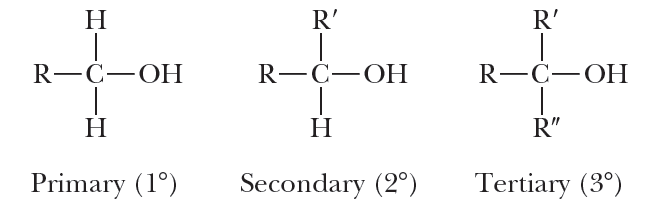
Diols and triols are compounds containing two or three hydroxyl groups, respectively. The parent alkane name is retained for these compounds.
Examples of Glycols and Triols
Glycols are diols with hydroxyl groups on adjacent carbons. Triols contain three hydroxyl groups. Common examples include:
1,2-Ethanediol (Ethylene glycol)
1,2-Propanediol (Propylene glycol)
1,3-Propanediol
1,2,3-Propanetriol (Glycerol, glycerine)

Physical Properties of Alcohols
Polarity and Intermolecular Forces
Alcohols are polar compounds due to the electronegativity difference between oxygen and hydrogen. They interact via dipole-dipole interactions and hydrogen bonding, which significantly affects their physical properties.
Dipole-dipole interaction: Attraction between the positive end of one dipole and the negative end of another.
Hydrogen bonding: Occurs when a hydrogen atom bonded to O or N interacts with another O or N atom. The strength of a hydrogen bond in water is about 21 kJ/mol.
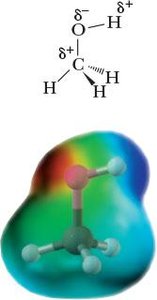
Hydrogen Bonding in Alcohols
Hydrogen bonding leads to association of alcohol molecules in the liquid state, resulting in higher boiling points compared to similar compounds lacking hydrogen bonding.
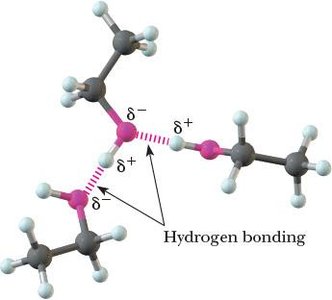
Boiling Points and Solubility
Alcohols have higher boiling points than their constitutional isomers (e.g., ethers) due to hydrogen bonding. They are also more soluble in water than alkanes and alkenes of similar molecular weight, though solubility decreases with increasing hydrocarbon chain length.
Example: Ethanol (bp 78°C) vs. Dimethyl ether (bp -24°C)
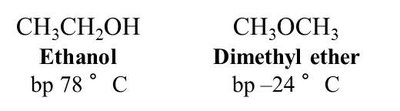
Solubility comparison: Hexane (nonpolar, insoluble), 1,4-Butanediol (polar, soluble), 1-Pentanol (moderately soluble)

Reactions of Alcohols
SN1 Reaction: Tertiary Alcohols with HX
Tertiary alcohols react with hydrogen halides (HX) via an SN1 mechanism:
Protonation: The —OH group is protonated to form an oxonium ion.
Carbocation Formation: Water is lost, forming a tertiary carbocation.
Nucleophilic Attack: The carbocation reacts with the halide ion to form the alkyl halide.
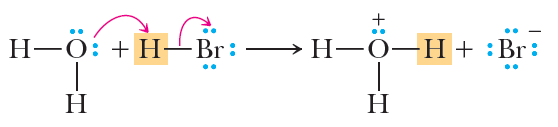
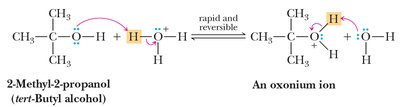
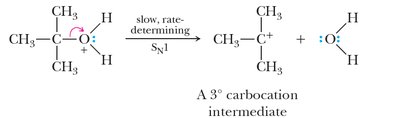
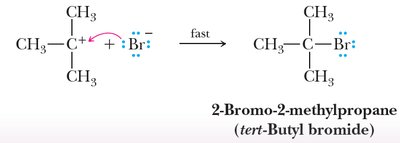
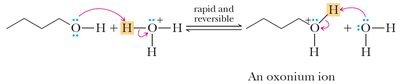
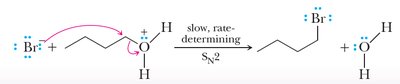
SN2 Reaction: Primary Alcohols with HBr
Primary alcohols react with HBr via an SN2 mechanism:
Protonation: The —OH group is protonated to form an oxonium ion.
Simultaneous Nucleophilic Attack and Bond Breaking: Bromide ion attacks the carbon, displacing water and forming the alkyl bromide.
Acid-Catalyzed Dehydration of Alcohols
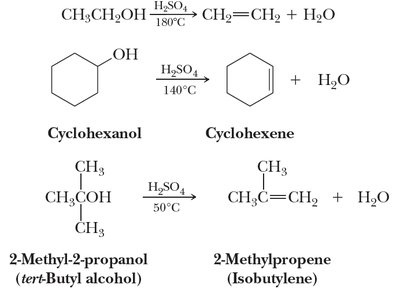
Alcohols can be converted to alkenes by dehydration, which involves elimination of water from adjacent carbon atoms. The reaction is catalyzed by acids such as H2SO4 or H3PO4.
Zaitsev Rule: When isomeric alkenes are formed, the more substituted (more stable) alkene predominates.
Mechanism: Dehydration of secondary and tertiary alcohols proceeds via an E1 mechanism, involving carbocation intermediates.


Hydration-Dehydration Equilibrium
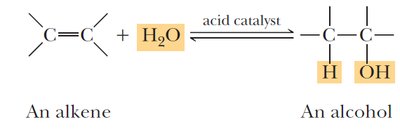
Alkene hydration and alcohol dehydration are reversible reactions, illustrating the principle of microscopic reversibility.
Oxidation of Alcohols
General Oxidation Patterns
Alcohols undergo oxidation depending on their classification:
Primary alcohols: Oxidized to aldehydes or carboxylic acids.
Secondary alcohols: Oxidized to ketones.
Tertiary alcohols: Resistant to oxidation.
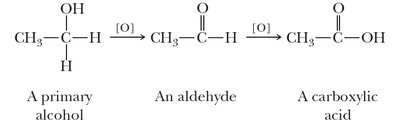
Oxidation with Chromic Acid (Jones Reagent)
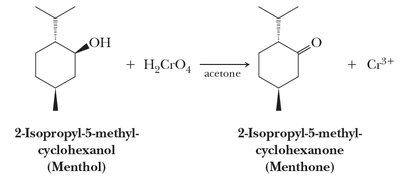
Chromic acid (H2CrO4) is commonly used for oxidation of alcohols. The Jones reagent is a solution of chromic acid in aqueous sulfuric acid.
Primary alcohols: Oxidized to carboxylic acids.
Secondary alcohols: Oxidized to ketones.

Oxidation with Pyridinium Chlorochromate (PCC)
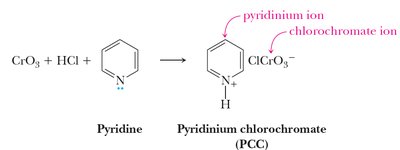
PCC is a selective oxidizing agent for primary alcohols, converting them to aldehydes without further oxidation to carboxylic acids. It is used in organic solvents and does not affect double bonds or other easily oxidized groups.

Thiols: Structure and Reactions
Structure of Thiols
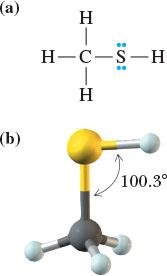
Thiols are organic compounds containing a sulfhydryl (—SH) group bonded to an sp3 hybridized carbon. The C—S—H bond angle in methanethiol is 100.3°, indicating more p character in sulfur's bonding orbitals compared to oxygen.
Oxidation of Thiols
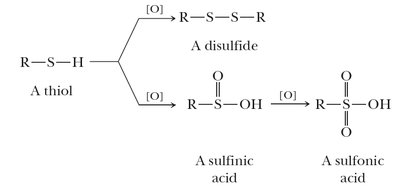
The most common oxidation-reduction reaction of thiols in biological systems is their interconversion with disulfides. Thiols can be oxidized to disulfides by molecular oxygen and further to sulfinic and sulfonic acids.
Disulfide functional group: —S—S—
Protection from air: Thiols must be protected from air to prevent oxidation.
Summary Table: Alcohol Oxidation
Alcohol Type | Oxidation Product (Jones Reagent) | Oxidation Product (PCC) |
|---|---|---|
Primary | Carboxylic acid | Aldehyde |
Secondary | Ketone | Ketone |
Tertiary | No reaction | No reaction |
Example: 1-hexanol oxidized with Jones reagent yields hexanoic acid; with PCC, yields hexanal.
Additional info: The notes above include expanded academic context and explanations for clarity and completeness, suitable for exam preparation in an organic chemistry course.
