 Back
BackCarboxylic Acid Derivatives and Nucleophilic Acyl Substitution
Study Guide - Smart Notes
 Tailored notes based on your materials, expanded with key definitions, examples, and context.
Carboxylic Acid Derivatives: Nucleophilic Acyl Substitution
Types of Carbonyl Compounds
Carbonyl compounds are classified based on the substituents attached to the carbonyl carbon. The nature of these substituents determines their reactivity and the types of reactions they undergo.
Aldehydes and Ketones: Contain substituents (R, H) that cannot stabilize a negative charge, making them poor leaving groups. They do not undergo acyl substitution reactions.
Carboxylic Acid Derivatives: Contain substituents (O, X, N) that can stabilize a negative charge, making them good leaving groups. Acyl substitution reactions are possible.
Examples of Carboxylic Acid Derivatives:
Carboxylic acid: RCOOH
Ester: RCOOR'
Acyl halide: RCOX
Acid anhydride: RCOOCOR'
Amide: RCONR'2
Lactone: Cyclic ester
Lactam: Cyclic amide
Nitrile: RCN
Thioester: RCOSR'
Acyl phosphate: RC(O)OPO(OR)2
Relationship Between Carboxylic Acids & Their Derivatives
Carboxylic acids can be converted to various derivatives by replacing the hydroxyl group with other substituents. The derivatives include acid halides, anhydrides, esters, amides, nitriles, thioesters, and acyl phosphates.
Nomenclature of Carboxylic Acid Derivatives
The naming of carboxylic acid derivatives follows systematic rules based on the parent carboxylic acid:
Acid Halides: Drop the '-ic acid' ending and append '-yl halide' (e.g., acetyl chloride).
Acid Anhydrides:
Symmetrical: Drop 'acid' and append 'anhydride'.
Unsymmetrical: List both acid components alphabetically, followed by 'anhydride'.
Esters: Drop '-ic acid' ending, append '-ate', and list the alkyl group on oxygen at the start (e.g., methyl acetate).
Amides:
Primary (NH2): Drop '-oic acid' ending and append 'amide'.
Secondary/Tertiary (NHR/NR2): Name substituents on nitrogen at the front as 'N-alkyl', drop '-oic acid', and append 'amide'.
Nucleophilic Acyl Substitution Reactions
The chemistry of carboxylic acid derivatives is dominated by nucleophilic acyl substitution. This mechanism distinguishes them from aldehydes and ketones, which lack good leaving groups.
General Mechanism:
Nucleophile attacks the carbonyl carbon, forming a tetrahedral intermediate.
The leaving group departs, regenerating the carbonyl.
Key Difference: The tetrahedral intermediate contains a good leaving group, allowing substitution.
Reactivity: Under some conditions, the product can react again, leading to further substitution.
Relative Reactivity of Carboxylic Acid Derivatives
Nucleophilic acyl substitution occurs in two steps: nucleophilic addition and elimination of the leaving group. The rate-limiting step is typically the nucleophilic attack on the carbonyl carbon. Both steric and electronic factors influence reactivity.
Steric Factors: Reactivity decreases with increasing steric hindrance within a series of the same derivative.
Electronic Factors: Reactivity parallels the electron-withdrawing ability of the substituent (Y). Derivatives with strongly polarized carbonyls react faster.
Halides: Inductively withdraw electrons, increasing carbonyl polarity and reactivity.
Alkoxy and Amino Groups: Donate electron density by resonance, decreasing carbonyl polarity and reactivity.
Order of Reactivity
Acid chloride > Acid anhydride > Ester > Amide
Consequences of Reactivity
It is possible to convert a more reactive carboxylic acid derivative to a less reactive one, but not the reverse. This principle guides synthetic strategies in organic chemistry.
Decreasing Reactivity: Acid chloride > Acid anhydride > Ester > Amide
Reactions of Carboxylic Acid Derivatives
Carboxylic acid derivatives undergo a variety of reactions with nucleophiles, including hydrolysis, alcoholysis, aminolysis, reduction, and reactions with organometallic reagents.
Hydrolysis: Reaction with water to form carboxylic acids.
Alcoholysis: Reaction with alcohols to form esters.
Aminolysis: Reaction with amines to form amides.
Reduction: Reaction with reducing agents to form alcohols.
Organometallic Reagents: Reaction with Grignard or organolithium reagents to form alcohols or other products.
Note: Carboxylic acids themselves do not readily undergo nucleophilic acyl substitution, but their derivatives do.
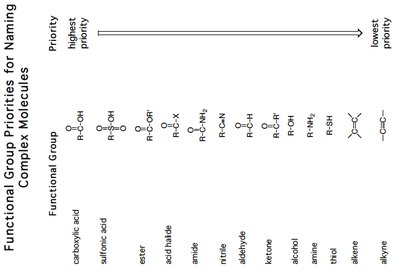
Functional Group Priorities for Naming Complex Molecules
When naming organic compounds with multiple functional groups, priority is assigned based on the functional group present. The highest priority is given to carboxylic acids, followed by sulfonic acids, esters, acid halides, amides, nitriles, aldehydes, ketones, alcohols, amines, thiols, alkenes, and alkynes.
Priority | Functional Group | Structure |
|---|---|---|
Highest | Carboxylic acid | RCOOH |
Sulfonic acid | RSO3H | |
Ester | RCOOR' | |
Acid halide | RCOX | |
Amide | RCONH2 | |
Nitrile | RCN | |
Aldehyde | RCHO | |
Ketone | RCOR' | |
Alcohol | ROH | |
Amine | RNH2 | |
Thiol | RSH | |
Alkene | RCH=CH2 | |
Lowest | Alkyne | RC≡CH |
Example: In a molecule containing both a carboxylic acid and an alcohol, the carboxylic acid group takes priority in naming.
Additional info: The table above is inferred from the provided image and standard IUPAC nomenclature rules.
----------------------------------------
