 Back
BackCarboxylic Acids and Their Derivatives: Preparation, Reactions, and Mechanisms
Study Guide - Smart Notes
 Tailored notes based on your materials, expanded with key definitions, examples, and context.
Carboxylic Acids and Their Derivatives
Preparation of Carboxylic Acids
Carboxylic acids are fundamental organic compounds that can be synthesized through several methods. One of the most common laboratory preparations involves the carbonation of Grignard reagents.
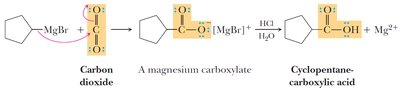
Carbonation of Grignard Reagents: An alkyl or aryl halide is first converted to a Grignard reagent, which then reacts with carbon dioxide to form a magnesium carboxylate. Acidic workup yields the carboxylic acid.
Equation:
Example: Preparation of cyclopentanecarboxylic acid from cyclopentylmagnesium bromide and CO2.
Reduction of Carboxylic Acids
Carboxylic acids are resistant to reduction by catalytic hydrogenation but can be reduced by strong hydride donors.
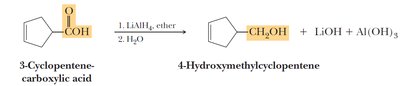
Reduction with LiAlH4: Lithium aluminum hydride reduces carboxylic acids to primary alcohols. The reaction is typically performed in ether or THF.
Equation:
Example: 3-Cyclopentenecarboxylic acid to 4-hydroxymethylcyclopentene.
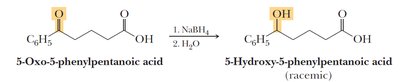
Selective Reduction: NaBH4 can reduce aldehydes or ketones in the presence of carboxylic acids, which remain unaffected.
Example: 5-Oxo-5-phenylpentanoic acid to 5-hydroxy-5-phenylpentanoic acid (racemic).
Fischer Esterification
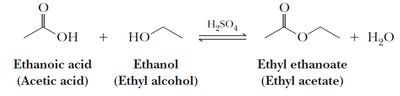
Esters are commonly synthesized by reacting a carboxylic acid with an alcohol in the presence of an acid catalyst. This process is known as Fischer esterification and is reversible.
General Reaction:
Example: Ethanoic acid and ethanol yield ethyl ethanoate and water.
Conversion to Acid Chlorides
Carboxylic acids can be converted to acid chlorides, which are more reactive derivatives, by treatment with thionyl chloride (SOCl2).
General Reaction:
Example: Butanoic acid to butanoyl chloride.

Reactivity of Carboxylic Acid Derivatives
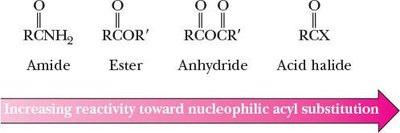
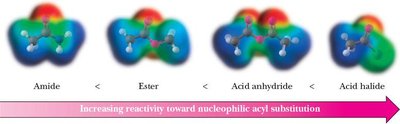
The reactivity of carboxylic acid derivatives toward nucleophilic acyl substitution depends on the nature of the leaving group and " resonance stabilization. The order of reactivity is:
Acid halides > Anhydrides > Esters > Amides
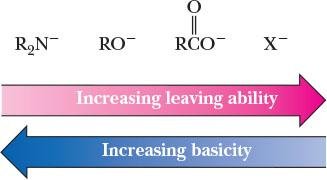
Leaving Group Ability: The best leaving groups are the weakest bases. The order is X− > RCOO− > RO− > R2N−.
/
Combined Effects: Both leaving group ability and resonance stabilization influence reactivity.
Reactions of Carboxylic Acid Derivatives
Hydrolysis
Hydrolysis is the reaction of a carboxylic acid derivative with water to yield a carboxylic acid. The rate and conditions depend on the derivative:
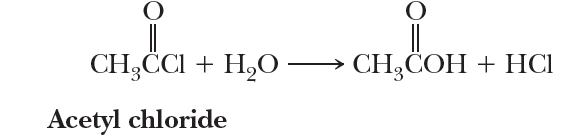
Acid Chlorides: React rapidly with water to form carboxylic acids and HCl.
Equation:
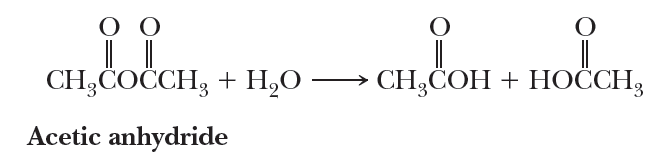
Acid Anhydrides: React with water to give two carboxylic acids.
Equation:
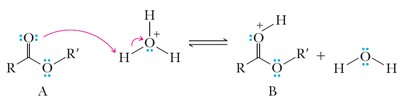
Esters: Hydrolyze slowly in neutral water but rapidly in acid or base (saponification).
Mechanism (Acid-Catalyzed): Protonation of the carbonyl, nucleophilic attack by water, and subsequent steps regenerate the acid catalyst.
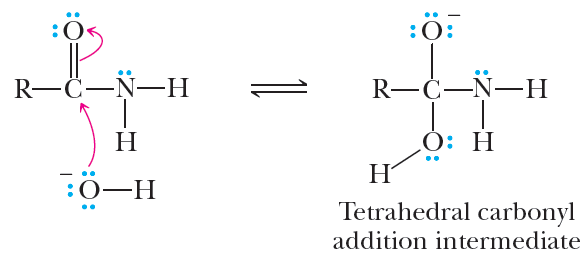
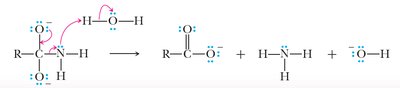
Amides: Hydrolyze only under more forcing conditions (acid or base).
Mechanism (Base-Catalyzed): Hydroxide attacks the carbonyl, forming a tetrahedral intermediate, which collapses to expel the amide anion.
Alcoholysis
Alcoholysis is the reaction of a carboxylic acid derivative with an alcohol to form an ester.
Acid Halides: React with alcohols to give esters, often without a catalyst.
Example: Butanoyl chloride and cyclohexanol yield cyclohexyl butanoate and HCl.
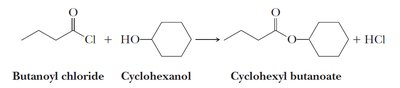
When the alcohol or ester is acid-sensitive, a tertiary amine (e.g., pyridine) is used to neutralize HCl.
Example: Benzoyl chloride, 3-methyl-1-butanol, and pyridine yield 3-methylbutyl benzoate and pyridinium chloride.

Acid Anhydrides: React with alcohols to form esters (e.g., synthesis of aspirin from salicylic acid and acetic anhydride).
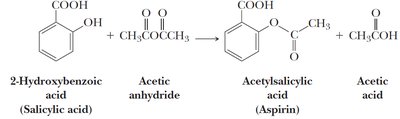
Esters: Undergo transesterification with alcohols in the presence of acid.
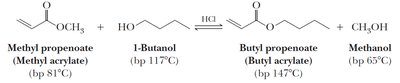
Amides: Generally do not react with alcohols due to low reactivity.
Aminolysis (Ammonolysis)
Aminolysis is the reaction of a carboxylic acid derivative with ammonia or an amine to form an amide.
Acid Halides: React with ammonia or amines to form amides and ammonium (or amine) chloride.
Example: Hexanoyl chloride and ammonia yield hexanamide and ammonium chloride.

Acid Anhydrides: React with ammonia or amines to form amides and ammonium carboxylate.
Example: Acetic anhydride and ammonia yield ethanamide and ammonium acetate.
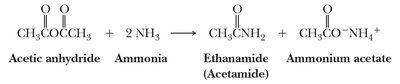
Esters: React with ammonia or amines to form amides, but require heating or high concentrations.
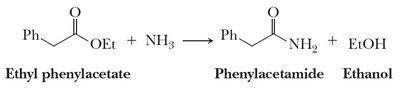
Example: Ethyl phenylacetate and ammonia yield phenylacetamide and ethanol.
Amides: Do not react with ammonia or amines.
Reactions of Esters with Grignard Reagents
Esters react with Grignard reagents to give tertiary alcohols after two additions of the Grignard reagent.
Step 1: Nucleophilic attack forms a tetrahedral intermediate.
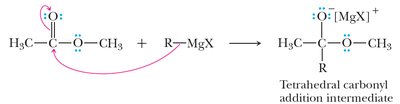
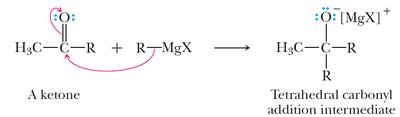
Step 2: Collapse of the intermediate yields a ketone and a magnesium alkoxide.

Step 3: The ketone reacts with a second equivalent of Grignard reagent to form another tetrahedral intermediate.
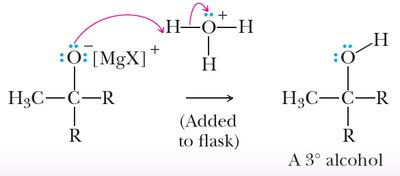
Step 4: Acidic workup yields a tertiary alcohol.
Reduction of Esters and Amides
Reduction of Esters
LiAlH4 Reduction: Esters are reduced to two alcohols (one from the acyl group, one from the alkoxy group).
Example: Methyl (S)-2-phenylpropanoate to (S)-2-phenyl-1-propanol and methanol.

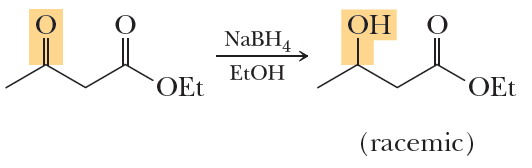
NaBH4 Reduction: Sodium borohydride is generally too mild to reduce esters but can reduce aldehydes or ketones selectively.
Example: Selective reduction of a β-keto ester to a β-hydroxy ester (racemic).
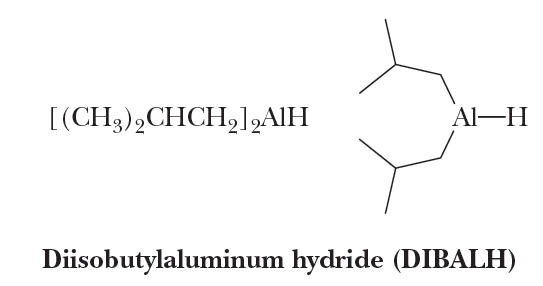
Reduction to Aldehydes: Diisobutylaluminum hydride (DIBALH) at low temperature can reduce esters to aldehydes.
Structure of DIBALH:
Example: Methyl hexanoate to hexanal using DIBALH at −78°C.

Reduction of Amides
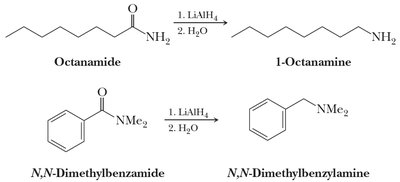
Amides are reduced by LiAlH4 to amines. The degree of substitution in the amide determines the product (1°, 2°, or 3° amine).
Example: Octanamide to 1-octanamine; N,N-dimethylbenzamide to N,N-dimethylbenzylamine.
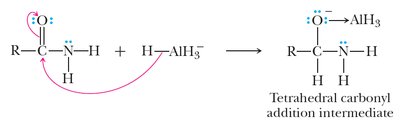
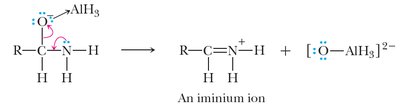
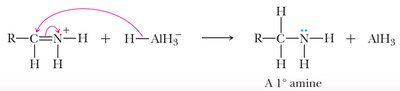
Mechanism: Involves hydride addition to the carbonyl, formation of a tetrahedral intermediate, expulsion of an aluminum species, and further reduction to the amine.
Summary Table: Reactivity of Carboxylic Acid Derivatives
Derivative | General Formula | Relative Reactivity | Typical Reaction |
|---|---|---|---|
Acid Halide | RCOCl | Most reactive | Hydrolysis, Alcoholysis, Aminolysis |
Anhydride | (RCO)2O | High | Hydrolysis, Alcoholysis, Aminolysis |
Ester | RCOOR' | Moderate | Hydrolysis, Alcoholysis, Aminolysis (slow) |
Amide | RCONH2 | Least reactive | Hydrolysis (difficult), Reduction |
