 Back
BackChapter 1: Structure Determines Properties – Foundations of Organic Chemistry
Study Guide - Smart Notes
 Tailored notes based on your materials, expanded with key definitions, examples, and context.
Structure Determines Properties
Introduction
The physical and chemical properties of organic molecules are determined by their atomic structure and bonding. Understanding the arrangement of atoms, electrons, and the types of bonds present is fundamental to predicting reactivity and behavior in organic chemistry.

Atoms, Electrons, and Orbitals
Particles and Symbols of the Atom
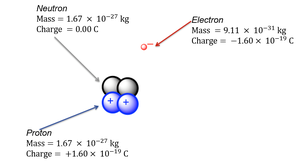
Atoms are composed of three fundamental particles: protons, neutrons, and electrons. The atomic number (Z) is defined by the number of protons in the nucleus and determines the element's identity.
Proton: Positively charged, mass ≈ kg
Neutron: Neutral, mass ≈ kg
Electron: Negatively charged, mass ≈ kg
Electrons as Waves
Electrons exhibit wavelike behavior, described by the Schrödinger equation. The wavefunction () represents the probability density of finding an electron in a particular region of space, known as an orbital. The energy and shape of an orbital reflect the stability and spatial distribution of electrons.
Quantum Numbers
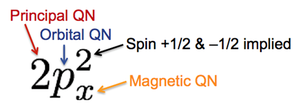
Atomic orbitals are characterized by four quantum numbers:
Principal quantum number (n): Energy level of the orbital
Orbital quantum number (l): Shape of the orbital
Magnetic quantum number (m): Orientation of the orbital
Spin quantum number (s): Electron spin direction (+1/2 or -1/2)
The Pauli exclusion principle states that no two electrons in an atom can have the same set of quantum numbers.
The s Atomic Orbitals
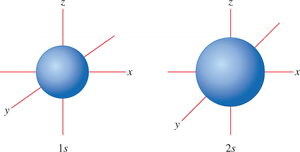
s orbitals are spherically shaped and begin at n = 1. Each shell contains one s orbital, which is lower in energy than other orbitals in the same shell. As n increases, the number of nodes (regions of zero probability) increases.
The p Atomic Orbitals
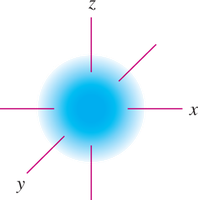
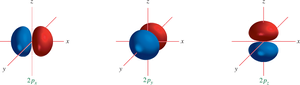
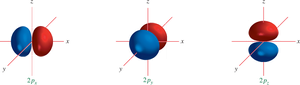
p orbitals begin at n = 2 and are dumbbell-shaped. Each np subshell contains three p orbitals (px, py, pz), oriented along the Cartesian axes. All p orbitals have a node at the nucleus and are equal in energy. Hund’s rule states that electrons fill these orbitals singly before pairing.
Ionic Bonds
Coulomb’s Law and Ionic Bonding
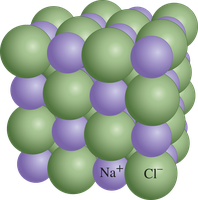
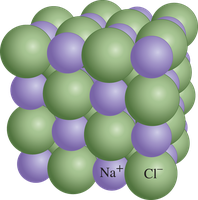
Ions are atoms or molecules with electric charge. Oppositely charged ions attract each other according to Coulomb’s law, forming ionic bonds. Ionic compounds typically form tightly packed lattices, resulting in high-melting solids that are soluble in polar solvents.
Ionic Bonding and Electron Transfer
Ionic bonds often arise from the transfer of electrons from a metal to a nonmetal. For example, sodium (Na) transfers an electron to chlorine (Cl), forming Na+ and Cl- ions. The formation of solid NaCl is exothermic due to the release of lattice energy.
Ionic Bonding in Organic Chemistry
While ionic bonds are common in salts, most organic compounds feature covalent bonds, where electrons are shared between nonmetal atoms such as C, N, O, and H.
Covalent Bonds, Lewis Formulas, and the Octet Rule
The Lewis Model of Covalent Bonding
Covalent bonds involve the sharing of electrons between two atoms. Atoms share electrons to achieve a stable electron configuration, often isoelectronic with the nearest noble gas.

Covalent Bonding in H2
Each hydrogen atom needs one more electron to complete its valence shell. By sharing electrons, both achieve a configuration analogous to helium.


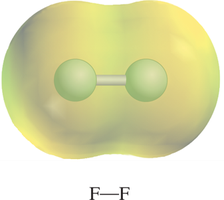
Covalent Bonding in F2
Each fluorine atom needs one more electron to complete its octet. By sharing electrons, both achieve a configuration analogous to neon. The remaining electrons are nonbonding pairs (lone pairs).
Lewis Symbols and Structures
Lewis structures use dots to represent electrons and lines to represent shared pairs in covalent bonds. Unshared pairs are shown as dots on the atom’s edges. Electrons are localized on a single atom or between two atoms.
The Octet Rule
Second-row elements achieve stability by sharing electrons until they have eight in their valence shell (octet). When checking the octet rule, shared electrons are counted for both atoms involved.
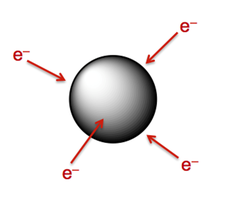
Examples of Lewis Structures
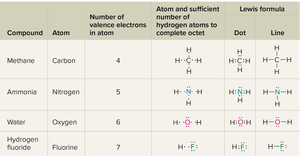
Common molecules such as methane, ammonia, water, and hydrogen fluoride illustrate the application of Lewis structures and the octet rule.
Compound | Atom | Number of valence electrons in atom | Atom and sufficient number of hydrogen atoms to complete octet | Lewis formula (Dot) | Lewis formula (Line) |
|---|---|---|---|---|---|
Methane | Carbon | 4 | H–C–H (four hydrogens) | Dot structure showing electron bonds between each C–H | Line structure showing C bonded to H on its four sides |
Ammonia | Nitrogen | 5 | N with lone pair, bonded to three H | Dot structure showing three electron bonds and lone pair | Line structure showing N bonded to three H, lone pair indicated |
Water | Oxygen | 6 | O with two lone pairs, bonded to two H | Dot structure showing electron bonds and lone pairs | Line structure showing O bonded to two H, lone pairs indicated |
Hydrogen fluoride | Fluorine | 7 | F with three lone pairs, bonded to one H | Dot structure showing electron bond and lone pairs | Line structure showing F bonded to H, lone pairs indicated |
Polar Covalent Bonds, Electronegativity, and Bond Dipoles
Covalent Bonds May be Polarized
Electrons in covalent bonds may not be shared equally, resulting in bond polarization. The electronegativity of atoms determines the degree of polarization.
Electronegativity
Electronegativity is the ability of an atom to attract electrons. Highly electronegative atoms hold electrons tightly and tend to gain electrons, while electropositive atoms may lose electrons. Periodic trends in electronegativity are crucial for predicting reactivity.
Polar Covalent Bonds
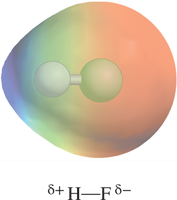
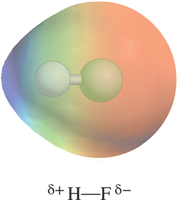
When two atoms of different electronegativities share electrons, the bond is polar covalent. The greater the difference, the more polarized the bond.

Electrostatic Potential Maps
Electrostatic potential maps (EPMs) visualize the spatial distribution of charge in molecules, providing a more accurate representation than simple dipole models.

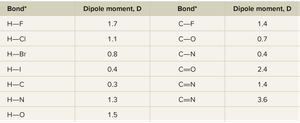
A Selection of Dipole Moments
Bond dipole moments quantify the polarity of bonds. The direction of the dipole is toward the more electronegative atom. Greater differences in electronegativity yield larger dipole moments.
Bond | Dipole moment, D | Bond | Dipole moment, D |
|---|---|---|---|
H–F | 1.7 | C–F | 1.4 |
H–Cl | 1.1 | C–O | 0.7 |
H–Br | 0.8 | C≡N | 2.4 |
H–I | 0.4 | C=N | 1.4 |
H–C | 0.3 | C=N | 3.6 |
H–N | 1.3 | ||
H–O | 1.5 |
Formal Charge
Formal Charge
Formal charge is used to determine the electron distribution in Lewis structures. It is calculated by subtracting the group number of the neutral atom from the electron count of the covalently bound atom. Only unshared electrons and half of the bonding electrons are counted.
Formula:
Formal charges greater than ±1 are rare in organic molecules.
Structural Patterns & Formal Charge
Common patterns include oxygen with two bonds (formal charge 0), oxygen with one bond (formal charge -1), and nitrogen with four bonds (formal charge +1). Boron in borohydride (BH4-) has four bonds and a formal charge of -1.
Oxygen (group 6): Two bonds, formal charge 0; one bond, formal charge -1
Nitrogen (group 5): Four bonds, formal charge +1
Boron (group 3): Four bonds, formal charge -1
Additional info: These notes expand on the brief points in the original slides, providing definitions, examples, and context for foundational concepts in organic chemistry. All images included are directly relevant to the adjacent explanations, reinforcing key ideas visually.
