 Back
BackChapter 20: The Organic Chemistry of Lipids
Study Guide - Smart Notes
 Tailored notes based on your materials, expanded with key definitions, examples, and context.
Lipids: Structure, Types, and Biological Roles
Introduction to Lipids
Lipids are a diverse group of naturally occurring organic compounds characterized by their poor solubility in water and high solubility in nonpolar solvents such as diethyl ether and acetone. Unlike other biomolecules, lipids are classified based on their solubility properties rather than a specific structural motif. This chapter explores the major classes of lipids, their structures, and their biological functions.
Fatty Acids
Structure and Properties
Fatty acids are carboxylic acids with long hydrocarbon chains ("tails") that can be either saturated (no double bonds) or unsaturated (one or more double bonds, usually cis in natural sources). The chain length and degree of unsaturation significantly influence the melting point and physical properties of fatty acids.
Saturated fatty acids have higher melting points and are typically solid at room temperature.
Unsaturated fatty acids have lower melting points and are usually liquid at room temperature.
Some polyunsaturated fatty acids, such as linoleic acid (omega-6) and alpha-linolenic acid (omega-3), are essential nutrients that humans must obtain from their diet.
Examples of essential fatty acids: Linoleic acid (18:2), alpha-linolenic acid (18:3), eicosapentaenoic acid (20:5), and docosahexaenoic acid (22:6).
Waxes
Structure and Biological Function
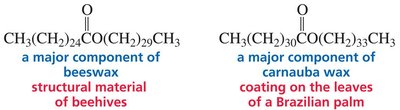
Waxes are monoesters formed from long-chain fatty acids and long-chain alcohols. They serve as protective, waterproof coatings for various organisms, including feathers, fur, insect exoskeletons, and plant surfaces. Waxes are also used commercially to coat fruits such as apples for preservation and shine.
Beeswax is a structural material in beehives.
Carnauba wax is used as a coating on the leaves of the Brazilian palm.
Fats and Oils (Triacylglycerols)
Structure and Physical Properties
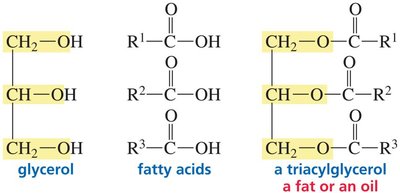
Fats and oils are triesters of glycerol and fatty acids, commonly referred to as triacylglycerols or triglycerides. The three fatty acid residues may be identical or different. The physical state (solid or liquid) at room temperature depends on the chain length and degree of unsaturation of the fatty acids present.
Fats (e.g., butter) are solids at room temperature and are rich in saturated fatty acids.
Oils (e.g., canola oil) are liquids at room temperature and contain a higher proportion of unsaturated fatty acids.
Molecular Structure and Packing
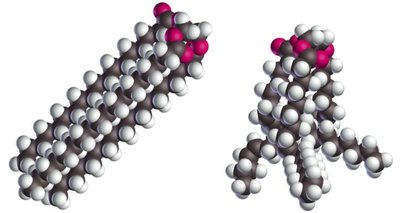
The molecular structure of saturated and unsaturated fatty acids affects how tightly they can pack together, influencing the melting point and physical state of fats and oils.
Phospholipids
Structure and Role in Membranes
Phospholipids are a major class of membrane lipids. Phosphoglycerides (or phosphoacylglycerides) are the most common phospholipids in biological membranes. Their basic structure, phosphatidic acid, consists of glycerol esterified to two fatty acids and one phosphoric acid. The phosphate group is further esterified to another alcohol, forming a phosphodiester.
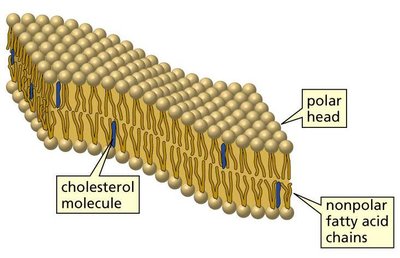
Phospholipids have both hydrophilic (polar) heads and hydrophobic (nonpolar) tails, making them amphipathic.
They form bilayers in aqueous environments, which are the structural basis of cell membranes.
The combination of saturated and unsaturated fatty acids in phospholipids imparts membrane fluidity.
Phospholipid bilayers are tightly packed and not leaky, which is essential for maintaining cellular integrity.
Terpenes
Isoprene Units and Classification
Terpenes are a large class of naturally occurring compounds whose carbon skeletons are built from isoprene units (C5H8). Although isoprene itself is not present in the final structure, the way these units are linked determines the classification and properties of the terpene.
Terpenes are classified by the number of carbon atoms (multiples of five) and the number of isoprene units.
Carbons | Classification | Isoprene Units | Linkages |
|---|---|---|---|
10 | Monoterpene | 2 | 1 head-to-tail linkage |
15 | Sesquiterpene | 3 | 2 head-to-tail linkages |
20 | Diterpene | 4 | 3 head-to-tail linkages |
25 | Sesterterpene | 5 | 4 head-to-tail linkages |
30 | Triterpene | 6 (2 sesquiterpenes) | tail-to-tail linkage |
40 | Tetraterpene | 8 (2 diterpenes) | tail-to-tail linkage |
Examples: Limonene (monoterpene, lemons), citral (citrus), camphene (camphor), δ-cadinene (juniper), β-bisabolene (oregano), lycopene (tetraterpene).
Steroids
Structure and Biological Importance
Steroids are a class of lipids derived from the C30 triterpene squalene. Through a series of cyclization and rearrangement reactions, squalene is converted to lanosterol, which is then transformed into cholesterol. Steroids are characterized by a tetracyclic fused-ring system (three six-membered rings and one five-membered ring).
Cholesterol is a key component of cell membranes and a precursor for steroid hormones.
Steroid hormones include cortisol (regulates stress response), estrogen (female reproductive hormone), testosterone (male reproductive and growth hormone), and aldosterone (regulates blood pressure via kidney function).
Minor structural variations in the steroid nucleus lead to a wide variety of biological functions.
