 Back
BackClaisen Rearrangement and Chorismate Mutase Reaction Mechanisms
Study Guide - Smart Notes
 Tailored notes based on your materials, expanded with key definitions, examples, and context.
Claisen Rearrangement and Chorismate Mutase Reaction Mechanisms
Claisen Rearrangement
The Claisen rearrangement is a classic example of a [3,3]-sigmatropic rearrangement, a pericyclic reaction in organic chemistry. It involves the migration of an allyl group in allyl aryl ethers to form ortho-allyl phenols via a concerted mechanism.
Definition: The Claisen rearrangement is a thermal rearrangement of allyl vinyl ethers or allyl aryl ethers to carbonyl compounds or ortho-allyl phenols, respectively.
Mechanism: The reaction proceeds through a six-membered cyclic transition state, where the allyl group migrates to the ortho position of the aromatic ring.
Key Features:
Concerted, pericyclic mechanism
Regioselective: migration occurs to the ortho position
Thermally induced (typically requires heating)
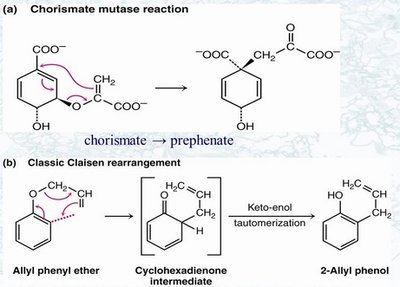
Example: Allyl phenyl ether rearranges to 2-allyl phenol via a cyclohexadienone intermediate, followed by keto-enol tautomerization.
Chorismate Mutase Reaction
The chorismate mutase reaction is a biologically important pericyclic reaction that converts chorismate to prephenate, a key step in the biosynthesis of aromatic amino acids. This reaction is catalyzed by the enzyme chorismate mutase and is mechanistically related to the Claisen rearrangement.
Definition: Chorismate mutase catalyzes the rearrangement of chorismate to prephenate via a [3,3]-sigmatropic rearrangement.
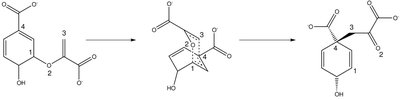
Mechanism: The reaction proceeds through a pericyclic transition state, similar to the Claisen rearrangement, involving the concerted migration of bonds.
Biological Importance: This reaction is a key step in the shikimate pathway, leading to the biosynthesis of phenylalanine and tyrosine.
Enzyme Catalysis: The enzyme stabilizes the transition state, greatly accelerating the reaction rate compared to the uncatalyzed process.
Example: Chorismate is converted to prephenate, as shown in the reaction scheme below.
Enzyme Mechanism and Transition State Stabilization
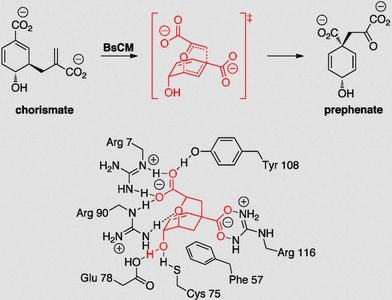
Chorismate mutase (BsCM) provides a well-studied example of enzyme-catalyzed pericyclic reactions. The enzyme binds chorismate and stabilizes the transition state through a network of hydrogen bonds and electrostatic interactions, involving several key amino acid residues.
Transition State: The enzyme stabilizes the highly ordered transition state, lowering the activation energy.
Active Site Residues: Key residues such as Arg 7, Arg 90, Arg 116, Glu 78, Cys 75, Phe 57, and Tyr 108 participate in substrate binding and catalysis.
Mechanistic Insight: The enzyme's active site is complementary to the transition state, not just the substrate, which is a hallmark of enzymatic catalysis.
Comparison: Claisen Rearrangement vs. Chorismate Mutase Reaction
Both reactions are [3,3]-sigmatropic rearrangements, but the chorismate mutase reaction is enzyme-catalyzed and occurs under physiological conditions, while the classic Claisen rearrangement is typically thermal and non-enzymatic.
Feature | Claisen Rearrangement | Chorismate Mutase Reaction |
|---|---|---|
Type | Pericyclic, [3,3]-sigmatropic | Pericyclic, [3,3]-sigmatropic |
Catalysis | Thermal (non-enzymatic) | Enzyme-catalyzed |
Biological Role | Synthetic organic chemistry | Biosynthesis of aromatic amino acids |
Intermediate | Cyclohexadienone | Pericyclic transition state |
Key Equations
General [3,3]-Sigmatropic Rearrangement:
Chorismate to Prephenate:
Additional info: The Claisen rearrangement and chorismate mutase reaction are classic examples of pericyclic reactions, illustrating the importance of concerted mechanisms in both synthetic and biological chemistry. Understanding these mechanisms provides insight into enzyme catalysis and the design of biomimetic reactions.
