 Back
BackConformations, Conformational Analysis, and Stereochemistry in Organic Chemistry
Study Guide - Smart Notes
 Tailored notes based on your materials, expanded with key definitions, examples, and context.
Conformations and Conformational Analysis
Introduction to Conformations
Conformations are different spatial arrangements of atoms in a molecule that arise from rotation about single (sigma) bonds. These arrangements are called conformers, and they are a type of stereoisomer. - Conformation: Arrangement formed by rotation about a single bond. - Conformer: A specific conformation. - Sigma bond rotation: Allows free movement, maintaining linear overlap. 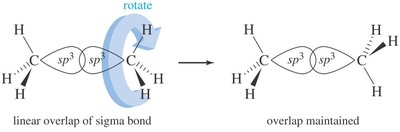
Representation of Conformations
Conformations can be represented using different formulas: - Sawhorse formula: Shows the molecule at an angle, highlighting spatial relationships. - Newman projection: Views the molecule along the axis of a bond, showing front and back atoms. 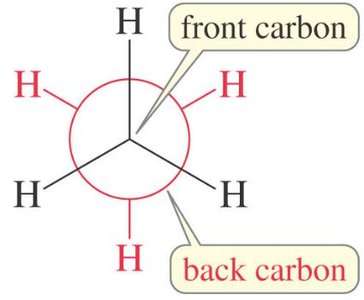
Dihedral Angle and Types of Conformations
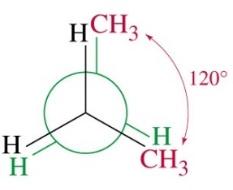
The dihedral angle (θ) is the angle between bonds on adjacent atoms in a Newman projection. - Eclipsed conformation: θ = 0°, bonds overlap. - Staggered conformation: θ = 60°, bonds are offset. - Gauche and skew conformations: Other dihedral angles. 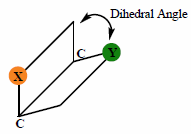
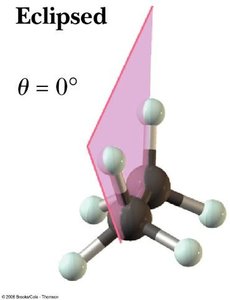
Conformational Analysis and Energetics
Conformational analysis studies the energetics of different conformations. - Potential energy: Changes as groups rotate about a bond. - Staggered conformation: Minimum energy. - Eclipsed conformation: Maximum energy due to torsional strain. - Torsional strain: Resistance to twisting, caused by repulsion between bonding electrons. - Torsional energy: Energy difference between staggered and eclipsed conformers. 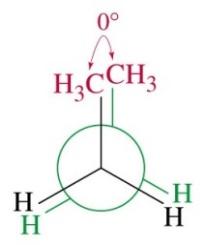
Conformational Analysis of Ethane, Propane, and n-Butane
- Ethane: Torsional energy ≈ 12.6 kJ/mol. - Propane: Torsional energy ≈ 13.8 kJ/mol (higher due to bulkier methyl group). - n-Butane: Free rotation around C2-C3 bond; highest energy when methyl groups are eclipsed, lowest when anti. 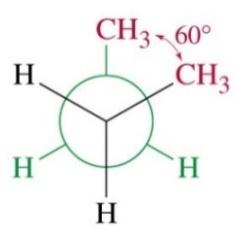
Factors Affecting Stability of Conformers
The stability of a conformer is influenced by: - Steric interactions: Repulsion between bulky groups. - Torsional strain: Repulsion between bonding electrons. - Angle strain: Deviation from ideal bond angles. 
Conformations of 1,2-Dihaloethanes and Gauche Effect
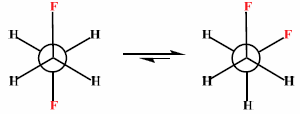
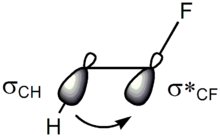
- 1,2-Dichloroethane: Higher energy barrier due to dipole repulsion between C–Cl bonds. - Gauche effect: Compounds with electronegative groups (X-C-C-Y) often adopt gauche conformations, stabilized by σ → σ* interactions. - 1,2-Difluoroethane: Gauche form is more stable than anti due to hyperconjugative interactions. 
Hydrogen Bonding and Other Effects
- Hydrogen bonding: Stabilizes gauche form in compounds like 1,2-ethanediol. - Other effects: Van der Waals, dipole-dipole, and hydrogen bonding interactions also affect conformational stability.
Conformations of Cycloalkanes
Angle Strain and Torsional Strain
Cycloalkanes experience strain due to deviations from ideal tetrahedral angles. - Angle strain: Increase in energy when bond angles deviate from 109.5°. - Torsional strain: Repulsion between eclipsed bonds. 
Puckering and Ring Strain
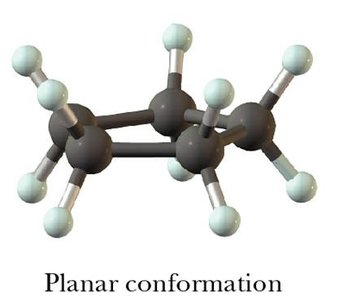
Cycloalkanes with more than three carbons are not planar; puckering reduces strain. - Puckered envelope conformation: Minimum energy for cyclopentane. 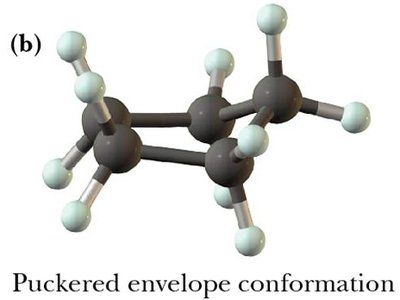
Cyclohexane Conformations
Cyclohexane adopts a chair conformation, which is the most stable. - Chair conformation: All bonds are staggered, minimizing strain. - Boat conformation: Less stable due to eclipsed interactions and flagpole hydrogens. - Twist-boat conformation: Slightly more stable than boat due to reduced steric strain. 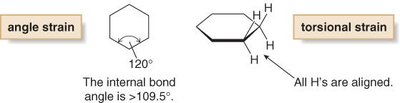
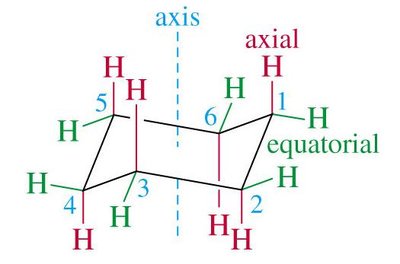

Ring Flipping in Cyclohexane
- Ring flip: Axial and equatorial positions interchange, but up/down orientation remains. 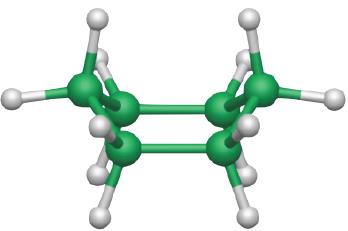
Steric Strain in Monosubstituted and Disubstituted Cyclohexanes
Substituents prefer equatorial positions to minimize steric strain.
X | Eaxial – Eeq. (kJ/mol) |
|---|---|
-H | 0.0 |
-CH3 | 3.8 |
-OH | 2.1 |
-COOH | 2.9 |
-C(CH3)3 | 11.4 |
-Ph | 6.3 |
-Cl | 1.0 |
-Br | 1.0 |
-F | 0.5 |
-CN | 0.4 |
-CH2CH3 | 4.0 |
-CH(CH3)2 | 4.6 |
Stereochemistry
Definitions and Types of Stereoisomers
Stereochemistry deals with the spatial arrangement of atoms and its effects on properties. - Stereoisomers: Same molecular formula and connectivity, different spatial arrangement. - Enantiomers: Non-superimposable mirror images; differ only in optical rotation direction. - Diastereomers: Not mirror images; different physical properties. - Chiral compound: Optically active; rotates plane-polarized light. - Racemic mixture: Equimolar mixture of enantiomers; optically inactive.
Tetrahedral Arrangement and Chirality
- Chiral center: Carbon with four different groups attached. - Handedness: Molecule is not identical to its mirror image.
Optical Activity and Measurement
- Plane-polarized light: Oscillates in a single plane. - Polarimeter: Measures degree of rotation. - Specific rotation: Standardized constant for optical activity. $ [\alpha]_D = \frac{\alpha}{l \times c} $ where $\alpha$ = observed rotation, $l$ = path length (dm), $c$ = concentration (g/mL).
Optical Purity and Enantiomeric Excess
- Enantiomeric excess (ee): Difference in percentage of two enantiomers. $ ee = | \, ext{percentage of major enantiomer} - ext{percentage of minor enantiomer} \, | $
Resolution of Enantiomers
- Resolution: Separation of enantiomers by converting to diastereomers, which have different properties.
Stereocenter and Chiral Center
- Stereogenic center: Swapping groups leads to a stereoisomer. - Chiral center: Carbon bonded to four different groups.
Cahn-Ingold-Prelog (CIP) Rules for R/S Designation
- Assign priorities based on atomic number. - Double/triple bonds treated as multiple single bonds. - Clockwise arrangement: R configuration; anticlockwise: S configuration.
Representation of Stereoisomers
- Wedge-and-dash drawing: Shows 3D arrangement. - Fischer projection: Horizontal bonds above the plane, vertical bonds below.
Multiple Stereocenters and Meso Compounds
- Maximum stereoisomers: $2^n$ for n chiral centers. - Meso compound: Contains stereogenic centers but is achiral due to internal symmetry.
Retention and Inversion of Configuration
- Retention: Configuration remains unchanged if bonds to chiral center are not broken. - Inversion: Occurs in SN2 reactions; configuration at attacked center is inverted.
Disubstituted Cyclic Molecules
- Cis isomer: Substituents on same side; can be meso and achiral. - Trans isomer: Substituents on opposite sides; can be chiral and optically active.
Geometrical Isomerism (E/Z Isomerism)
- Cahn-Ingold-Prelog convention: Z (same side), E (opposite side) for higher priority groups.
Reaction Mechanisms and Stereochemistry
SN2 Reaction
- Concerted mechanism: Nucleophile attacks, leaving group departs in one step. - Rate law: $ ext{Rate} = k[ ext{CH}_2 ext{RBr}][ ext{OH}^-] $ - Stereochemistry: Inversion at attacked stereocenter.
SN1 Reaction
- Stepwise mechanism: Formation of carbocation intermediate. - Carbocation: Trigonal planar, electron-deficient. - Racemic mixture: 50:50 chance of attack from either side.
Elimination Reactions (E2 and E1)
- E2 mechanism: Bimolecular, concerted, anti-periplanar geometry preferred. - E1 mechanism: Unimolecular, stepwise. - Stereochemistry: E2 is stereoselective and stereospecific; cis isomers react faster than trans.
Molecular Orbitals and Pericyclic Reactions
Molecular Orbitals
- σ orbitals: Built from orbitals with appropriate symmetry. - π orbitals: Overlap of p orbitals leads to π and π* orbitals. - Gerade (g): Symmetric; Ungerade (u): Asymmetric.
Pericyclic Reactions
- Cycloaddition: Two π-bond-containing molecules form a cyclic compound ([2+2], [4+2], etc.). - Electrocyclization: Intramolecular cyclization, new sigma bond formed. - Sigmatropic, chelotropic, and ene reactions: Other types of pericyclic reactions.
Diels-Alder Reaction
- s-cis conformation: Required for reactivity. - Stereospecificity: Both sigma bonds on same face (syn stereochemistry).
Electrocyclic Reactions
- Symmetry of HOMO: Determines reaction pathway (con-rotation or dis-rotation). - Symmetry-allowed pathway: In-phase orbital overlap. - Symmetry-forbidden pathway: Cannot proceed concertedly.
Summary Table: Types of Strain in Organic Molecules
Type of Strain | Description | Example |
|---|---|---|
Torsional Strain | Repulsion between bonding electrons in eclipsed bonds | Ethane, propane |
Steric Strain | Repulsion between bulky groups | n-Butane, cyclohexane |
Angle Strain | Deviation from ideal bond angles | Cyclopropane, cyclobutane |
Ring Strain | Combination of angle and torsional strain | Cycloalkanes |
Example: Calculation of Specific Rotation
$ [\alpha]_D = \frac{15}{1 \times (2.0/10)} = +75^\circ $
Example: Enantiomeric Excess Calculation
For a 90:10 mixture, $ ee = 90 ext{%} - 10 ext{%} = 80 ext{%} $
Example: Maximum Stereoisomers
For 2 chiral centers: $ 2^2 = 4 $ stereoisomers.
Example: Diels-Alder Reaction
Cyclopentadiene reacts with itself at room temperature to form a dimer, which can be cracked by heating.
Example: E2 Elimination Rate Law
$ ext{Rate} = k[(CH_3)_3CBr][OH^-] $
Example: Cahn-Ingold-Prelog R/S Assignment
Assign priorities, determine direction (clockwise = R, anticlockwise = S).
Example: Fischer Projection
Horizontal bonds above the plane, vertical bonds below; main carbon chain top to bottom.
Example: Chair Conformation Ring Flip
Axial and equatorial positions interchange, up/down orientation remains.
Example: Gauche Effect in 1,2-Difluoroethane
Gauche form is more stable due to hyperconjugative interactions.
Example: Boat and Chair Conformations of Cyclohexane
Chair is most stable; boat is less stable due to flagpole hydrogens.
Example: Potential Energy Diagram for n-Butane
Shows energy differences between anti and gauche conformers.
Example: Newman Projection for Ethane
Shows staggered and eclipsed conformations.
Example: Dihedral Angle Representation
Shows angle between bonds in a Newman projection. 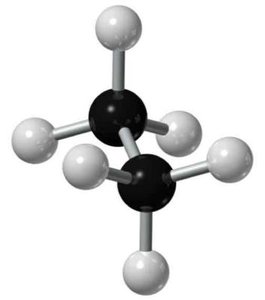
Example: Puckered Envelope Conformation
Minimum energy for cyclopentane.
Example: Ring Flip in Cyclohexane
Axial and equatorial positions interchange.
Example: Hyperconjugative Interaction in Difluoroethane
Stabilizes gauche conformation.
Example: Energy Profile for Cyclohexane Conformations
Shows energy differences between chair, boat, and twist-boat. 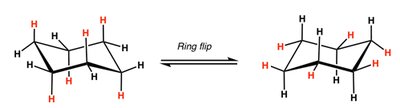
Example: Probability Distribution for Dihaloethane Conformations
Shows preference for gauche and anti conformers. 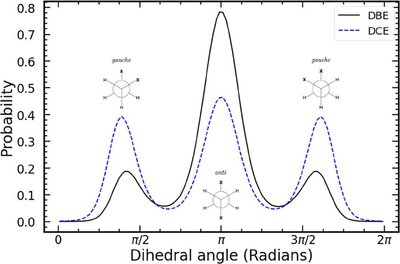
Example: Steric Strain Table for Monosubstituted Cyclohexanes
X | Eaxial – Eeq. (kJ/mol) |
|---|---|
-H | 0.0 |
-CH3 | 3.8 |
-OH | 2.1 |
-COOH | 2.9 |
-C(CH3)3 | 11.4 |
-Ph | 6.3 |
-Cl | 1.0 |
-Br | 1.0 |
-F | 0.5 |
-CN | 0.4 |
-CH2CH3 | 4.0 |
-CH(CH3)2 | 4.6 |
Additional info: Academic context and examples have been expanded for clarity and completeness. All images included are directly relevant to the adjacent explanations and reinforce key concepts in conformational analysis and stereochemistry.
