 Back
BackElimination and Substitution Mechanisms: E1, SN1, and Alkene Preferences
Study Guide - Smart Notes
 Tailored notes based on your materials, expanded with key definitions, examples, and context.
Elimination and Substitution Mechanisms
Overview
This section covers the fundamental mechanisms of unimolecular elimination (E1), unimolecular nucleophilic substitution (SN1), and their competition, as well as the regio- and stereochemical preferences in alkene formation. Understanding these mechanisms is crucial for predicting reaction outcomes and for synthetic planning in organic chemistry.
SN1 and E1 Mechanisms
SN1: Unimolecular Nucleophilic Substitution
The SN1 mechanism involves a two-step process where the leaving group departs first, forming a carbocation intermediate, followed by nucleophilic attack. This mechanism is favored by weak nucleophiles and polar protic solvents.
Step 1: Loss of leaving group to form a carbocation (rate-determining step).
Step 2: Nucleophile attacks the carbocation.
Key Features: Racemization at the reactive center, possible rearrangements (hydride or alkyl shifts).
Substrate Preference: Tertiary > Secondary >> Primary & Methyl (due to carbocation stability).
E1: Unimolecular Elimination
The E1 mechanism also proceeds via a carbocation intermediate, but instead of nucleophilic attack, a base removes a proton from a carbon adjacent to the carbocation, resulting in alkene formation.
Step 1: Leaving group departs, forming a carbocation (rate-determining step).
Step 2: Base abstracts a proton, forming a double bond (alkene).
Key Features: Competes with SN1 under similar conditions; rearrangements possible.
Substrate Preference: Tertiary >> Secondary >>> Primary & Methyl.
Base: Weak bases (often neutral or bulky) are sufficient.
Solvent: Polar protic solvents favor E1.
Temperature: Heat favors elimination (E1) over substitution (SN1).

Comparison: SN1 vs E1
Both mechanisms share the same rate-determining step: carbocation formation.
The identity of the other reactant (nucleophile or base) and reaction conditions (especially temperature) determine whether substitution (SN1) or elimination (E1) predominates.
Bulky bases and higher temperatures favor elimination (E1).
Alkene Preferences in E1 Reactions
Regioselectivity: Zaitsev vs Hofmann Products
E1 reactions are regioselective, typically favoring the most substituted (and thus most stable) alkene, known as the Zaitsev product. Less substituted alkenes (Hofmann products) are generally minor unless steric hindrance or specific conditions favor them.
Zaitsev Product (Thermodynamic): Most substituted alkene, major product in E1.
Hofmann Product (Kinetic): Less substituted alkene, minor product unless bulky bases are used.
Stability Order: Tetrasubstituted > Trisubstituted > Disubstituted > Monosubstituted.
Stereoselectivity: E/Z Isomerism
E1 reactions are also stereoselective, favoring the trans (E) alkene over the cis (Z) alkene due to lower steric strain and greater stability.
Trans (E) Alkenes: More stable, major product.
Cis (Z) Alkenes: Less stable, minor product.
Alkene Stability Trends
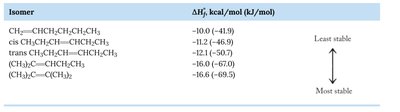
Alkene stability increases with greater substitution and with trans geometry. This is reflected in lower heats of hydrogenation for more stable alkenes.
Isomer | ΔHf, kcal/mol (kJ/mol) |
|---|---|
CH2=CHCH2CH2CH3 | -10.0 (-41.9) |
cis CH3CH=CHCH2CH3 | -12.2 (-46.9) |
trans CH3CH=CHCH2CH3 | -12.1 (-50.7) |
(CH3)2C=CHCH3 | -16.0 (-67.0) |
(CH3)2C=C(CH3)2 | -16.6 (-69.5) |
Carbocation Rearrangements in E1 and SN1
1,2-Hydride and 1,2-Alkyl Shifts
Carbocation intermediates can undergo rearrangements to form more stable carbocations. The most common rearrangements are 1,2-hydride shifts and 1,2-alkyl shifts.
1,2-Hydride Shift: A hydrogen atom with its bonding electrons moves to an adjacent carbocation, increasing stability.
1,2-Alkyl Shift: An alkyl group migrates to the carbocation center, also increasing stability.
These rearrangements can change the position of the double bond or the site of nucleophilic attack.
Summary Table: SN1 vs E1
Feature | SN1 | E1 |
|---|---|---|
Mechanism | Stepwise (carbocation intermediate) | Stepwise (carbocation intermediate) |
Major Product | Substitution (nucleophile adds) | Elimination (alkene forms) |
Base/Nucleophile | Weak nucleophile | Weak base |
Substrate | Tertiary > Secondary | Tertiary > Secondary |
Rearrangements | Possible | Possible |
Solvent | Polar protic | Polar protic |
Temperature | Lower | Higher (heat favors E1) |
Key Equations
Rate Law for SN1 and E1:
Heat of Hydrogenation (Alkene Stability):
Lower (more negative) indicates greater alkene stability.
Practice Problems
Predict the major alkene product for an E1 reaction given a tertiary alkyl halide and water under heat.
Identify possible rearrangements in a given SN1 or E1 reaction and predict the final product.
Classify a reaction as SN1, E1, SN2, or E2 based on substrate, nucleophile/base, and conditions.
Additional info:
This summary integrates the core concepts of E1 and SN1 mechanisms, alkene regio- and stereoselectivity, and carbocation rearrangements, as covered in a typical college-level organic chemistry course. The included tables and diagrams reinforce the trends and mechanistic details essential for mastering these reactions.
