 Back
BackElimination and Substitution Reactions of Alkyl Halides: Mechanisms, Regioselectivity, and Stereochemistry
Study Guide - Smart Notes
 Tailored notes based on your materials, expanded with key definitions, examples, and context.
Elimination vs. Substitution Reactions
Overview of Competing Pathways
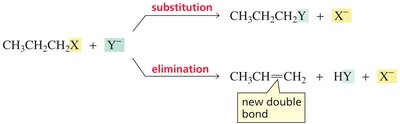
Alkyl halides can undergo two major types of reactions: substitution and elimination. The pathway taken depends on the nature of the substrate, the base/nucleophile, and reaction conditions.
Substitution: The halide is replaced by another group (nucleophile).
Elimination: The halide and a hydrogen from an adjacent carbon are removed, forming a double bond (alkene).
Key distinction: Substitution retains the saturated structure, while elimination creates unsaturation (alkene).
E2 Elimination Mechanism
Concerted Mechanism and Rate Law
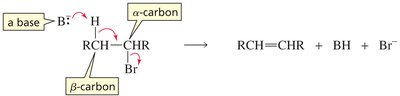
The E2 mechanism is a one-step, concerted process where a base removes a proton from the β-carbon as the leaving group departs from the α-carbon. The rate depends on both the alkyl halide and the base.
Rate law:
Transition state: Bonds are breaking and forming simultaneously.

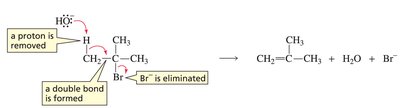
Example: E2 Reaction of 2-Bromo-2-methylpropane
Strong bases such as hydroxide can induce E2 elimination, forming alkenes.
Substrate: 2-bromo-2-methylpropane
Base: HO-
Product: 2-methylpropene

Mechanistic Details
The base abstracts a proton from the β-carbon, the leaving group departs from the α-carbon, and a double bond forms.
Concerted mechanism: All bond changes occur in a single step.
Key atoms: The hydrogen and halogen must be on adjacent carbons.
Regioselectivity and Product Distribution in E2 Reactions
Regioselectivity: Zaitsev's Rule
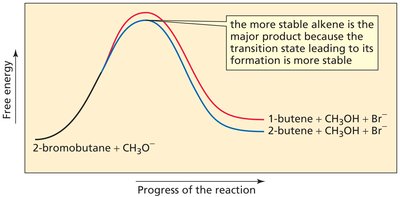
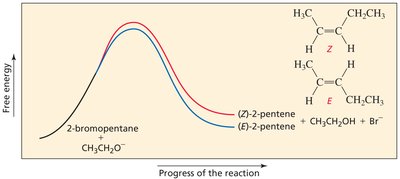
E2 reactions are regioselective, favoring the formation of the most substituted (and thus most stable) alkene. This is known as Zaitsev's rule.
Major product: Alkene with more alkyl substituents.
Minor product: Alkene with fewer alkyl substituents.

Transition State Stability
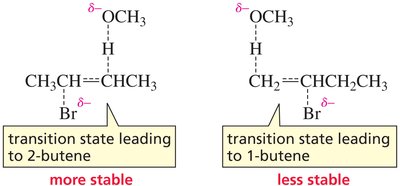
The more stable alkene is formed via a more stable transition state, which lowers the activation energy and increases its yield.
Transition state resembles alkene: Stability of the product influences transition state stability.
Examples of Regioselectivity
Product ratios reflect the relative stabilities of possible alkenes.
2-bromobutane: 2-butene (80%), 1-butene (20%)
2-bromo-2-methylbutane: 2-methyl-2-butene (70%), 2-methyl-1-butene (30%)
2-chloropentane: 2-pentene (67%), 1-pentene (33%)


Transition State Comparison
Transition states leading to more substituted alkenes are more stable due to better hyperconjugation and lower energy.
Relative Reactivity of Alkyl Halides in E2 Reactions
Substrate Structure and Reactivity
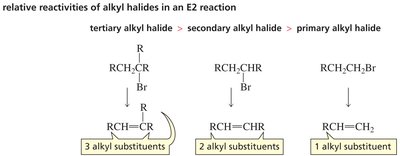
The reactivity of alkyl halides in E2 reactions depends on the degree of substitution at the α-carbon.
Tertiary alkyl halides: Most reactive
Secondary alkyl halides: Moderately reactive
Primary alkyl halides: Least reactive
Effect of Base Steric Properties on E2 Product Distribution
Bulky vs. Non-Bulky Bases
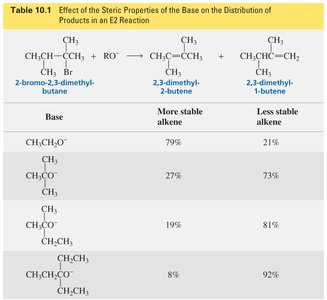
The steric bulk of the base can alter the regioselectivity of E2 reactions, sometimes favoring the formation of less substituted (less stable) alkenes.
Bulky bases: Prefer to remove more accessible hydrogens, leading to less substituted alkenes.
Small bases: Favor more substituted alkenes.

Stability of Carbocations and Carbanions
Carbocation Stability
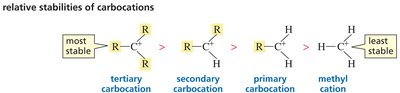
Carbocation stability increases with the number of alkyl substituents due to hyperconjugation and inductive effects.
Tertiary > Secondary > Primary > Methyl
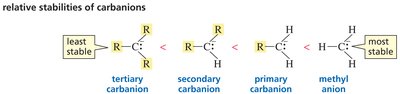
Carbanion Stability
Carbanion stability decreases with increasing alkyl substitution due to destabilizing inductive effects.
Methyl > Primary > Secondary > Tertiary

E1 Elimination Mechanism
Stepwise Mechanism and Rate Law
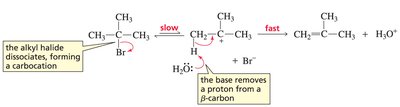
The E1 mechanism occurs in two steps: first, the leaving group departs, forming a carbocation; second, a base removes a proton from the β-carbon. The rate depends only on the concentration of the alkyl halide.
Rate law:
Carbocation intermediate: Allows rearrangements and affects regioselectivity.

Regioselectivity in E1 Reactions
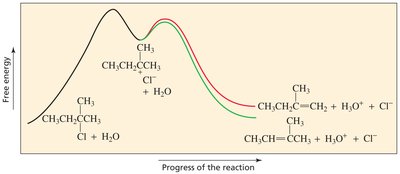
E1 reactions also favor the formation of the most substituted alkene, but exceptions can occur due to steric hindrance or conjugation effects.
Major product: Most stable (substituted) alkene
Minor product: Less stable alkene

Special Cases: Benzylic and Allylic Halides
E2 and E1 Reactions of Benzylic and Allylic Halides
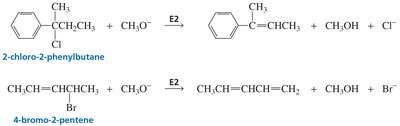
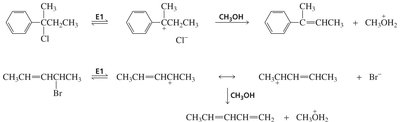
Benzylic and allylic halides can undergo both E2 and E1 eliminations, often forming conjugated alkenes as major products due to increased stability.
Conjugated alkenes: More stable due to resonance.
Isolated alkenes: Less stable, minor products.
Stereochemistry of Elimination Reactions
Anti vs. Syn Elimination
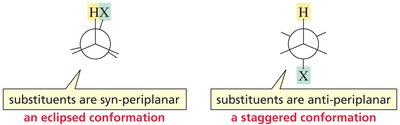
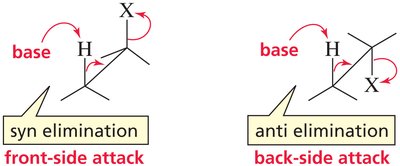
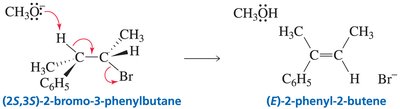
E2 eliminations typically occur via an anti-periplanar geometry, where the hydrogen and leaving group are on opposite sides of the molecule. This staggered conformation is preferred due to optimal orbital overlap and minimized electron repulsion.
Anti elimination: Back-side attack, more common and favored.
Syn elimination: Front-side attack, less common.
Stereochemistry of Alkene Products
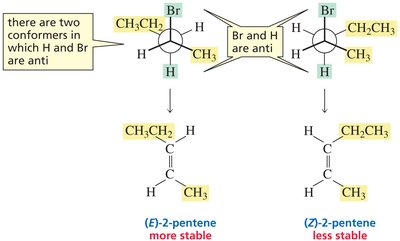
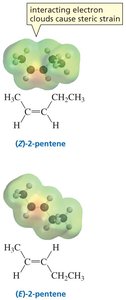
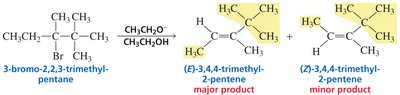
Both E and Z isomers can be formed, but the E isomer (with largest groups on opposite sides) is usually more stable and predominant.
E isomer: More stable due to reduced steric strain.
Z isomer: Less stable due to increased steric strain.
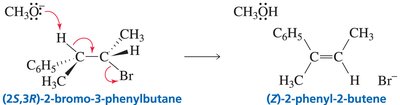
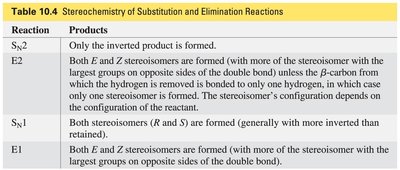
Summary Table: Stereochemistry of Substitution and Elimination
The stereochemical outcome depends on the mechanism and substrate configuration.
Reaction | Products |
|---|---|
SN2 | Only the inverted product is formed. |
E2 | Both E and Z stereoisomers are formed (with more of the stereoisomer with the largest groups on opposite sides of the double bond) unless the β-carbon from which the hydrogen is removed is bonded to only one hydrogen, in which case only one stereoisomer is formed. The stereoisomer's configuration depends on the configuration of the reactant. |
SN1 | Both stereoisomers (R and S) are formed (generally with more inverted than retained). |
E1 | Both E and Z stereoisomers are formed (with more of the stereoisomer with the largest groups on opposite sides of the double bond). |
Elimination from Six-Membered Rings
E2 Elimination: Axial Requirement
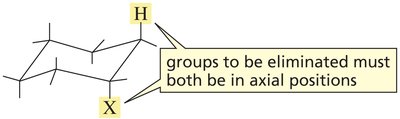
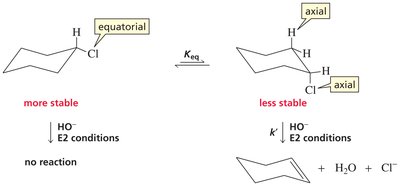
In cyclohexane derivatives, both the hydrogen and leaving group must be in axial positions for E2 elimination to occur.
Axial positions: Required for proper orbital alignment.
Equatorial positions: Do not allow E2 elimination.
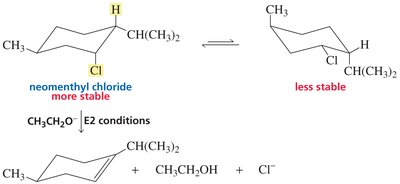
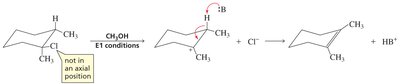
E1 Elimination: No Axial Requirement
E1 eliminations do not require both groups to be axial, as the reaction is not concerted and can occur from less favorable conformations.
Summary Table: Reactivity of Alkyl Halides in Elimination Reactions
The type of elimination reaction (E1 or E2) depends on the structure of the alkyl halide.
Alkyl Halide Type | Reaction Type |
|---|---|
1° and 2° alkyl halides | E2 only |
3° alkyl halides and allylic/benzylic halides | E1 and E2 |

Additional info: These notes expand on the original slides and images by providing definitions, mechanistic details, and academic context for each topic, ensuring completeness and clarity for exam preparation.
