 Back
BackFree-Radical Halogenation of Alkanes and Thermodynamics of Organic Reactions
Study Guide - Smart Notes
 Tailored notes based on your materials, expanded with key definitions, examples, and context.
Halogenation of Alkanes
Reaction Overview
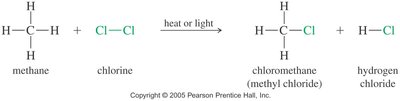
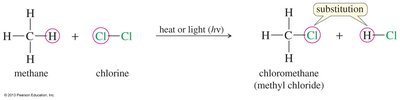
The halogenation of alkanes is a substitution reaction in which a halogen atom replaces a hydrogen atom in an alkane. This process is commonly initiated by heat or light and can produce a variety of products, especially when excess halogen is present.
Substitution Reaction: A hydrogen atom in methane is replaced by a chlorine atom, forming chloromethane and hydrogen chloride.
Initiation: Requires heat or light to generate reactive intermediates.
Chain Reaction: Many product molecules are formed from the absorption of a single photon.
Mechanism of Free-Radical Chain Reaction
The halogenation of alkanes proceeds via a free-radical chain mechanism, which consists of three main steps: initiation, propagation, and termination.
Initiation: Formation of free radicals by homolytic cleavage of a halogen molecule.
Propagation: Free radicals react with stable molecules to produce new radicals and products.
Termination: Side reactions that remove free radicals, slowing or stopping the chain reaction.

Free Radicals and Their Lewis Structures
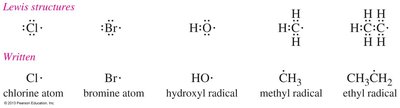
Free radicals are highly reactive species with an unpaired electron. Their Lewis structures show the unpaired electron as a dot.
Halogen Radicals: Halogens have seven valence electrons, one of which is unpaired in the radical form.
Examples: Chlorine atom (Cl•), bromine atom (Br•), methyl radical (CH3•), ethyl radical (CH3CH2•).
Propagation Steps
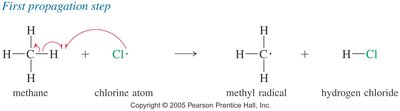
Propagation involves two key steps in the chain reaction:
First Propagation: Chlorine radical abstracts a hydrogen atom from methane, forming a methyl radical and hydrogen chloride.
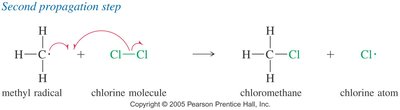
Second Propagation: Methyl radical reacts with chlorine molecule, forming chloromethane and regenerating the chlorine radical.
Termination Steps
Termination occurs when two free radicals combine, forming a stable, non-radical product. This step reduces the concentration of radicals and slows the reaction.
Examples: Cl• + Cl• → Cl2; CH3• + Cl• → CH3Cl
Radical Concentration: Low during chain reaction, but increases as reactants are depleted.
Thermodynamics of Organic Reactions
Equilibrium and Free Energy
For a reaction to be practical, the equilibrium must favor the products and the reaction rate must be sufficient. Thermodynamics describes the energy relationships between reactants and products, determining the equilibrium position.
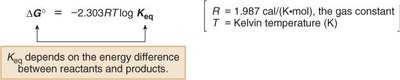
Equilibrium Constant (Keq): Relates the concentrations of products and reactants at equilibrium.
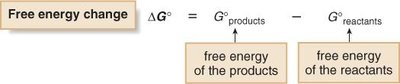
Free Energy Change (ΔG0): The difference in energy between products and reactants.

Interpreting Equilibrium Constants
The size of Keq indicates whether products or reactants predominate at equilibrium:
Keq > 1: Equilibrium favors products; reaction lies to the right.
Keq < 1: Equilibrium favors reactants; reaction lies to the left.
ΔG0: Negative when products are lower in energy (more stable), positive when products are higher in energy.
Application: Conformers and Equilibrium
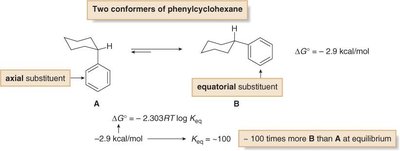
Thermodynamic equations can be applied to any equilibrium process, such as the interconversion of chair conformers in cyclohexane derivatives. The more stable conformer is favored at equilibrium.
Example: Monosubstituted cyclohexanes favor the equatorial position due to lower energy.
Calculation: Knowing ΔG0 allows prediction of the relative amounts of each conformer.
Enthalpy and Entropy
The total energy change in a reaction is determined by both enthalpy (ΔH0) and entropy (ΔS0):
Enthalpy (ΔH0): Heat released or absorbed during a reaction. Negative ΔH0 indicates exothermic (heat released), positive indicates endothermic (heat absorbed).
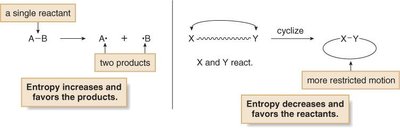
Entropy (ΔS0): Measure of disorder or randomness. Positive ΔS0 means increased disorder; negative means decreased disorder.
Favorability: Reactions favor products with lower enthalpy and higher entropy.

Key Equations
Equilibrium Constant:
Free Energy Change:
Relationship between ΔG0 and Keq:
Total Energy Change:
Representative Values Table
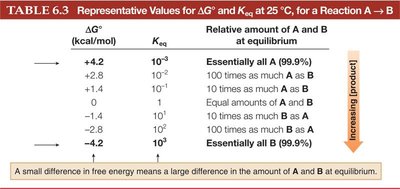
The following table summarizes representative values for ΔG0, Keq, and the relative amounts of reactants and products at equilibrium:
ΔG0 (kcal/mol) | Keq | Relative amount of A and B at equilibrium |
|---|---|---|
+4.2 | 10-3 | Essentially all A (99.9%) |
+2.8 | 10-2 | 100 times as much A as B |
+1.4 | 10-1 | 10 times as much A as B |
0 | 1 | Equal amounts of A and B |
-1.0 | 10 | 10 times as much B as A |
-2.8 | 102 | 100 times as much B as A |
-4.2 | 103 | Essentially all B (99.9%) |
Summary
Free-radical halogenation is a chain reaction involving initiation, propagation, and termination steps.
Thermodynamics determines whether a reaction favors products or reactants, based on energy differences.
Enthalpy and entropy both contribute to the overall free energy change, influencing reaction favorability.
