 Back
BackFundamentals of Catalysis in Organic Chemistry
Study Guide - Smart Notes
 Tailored notes based on your materials, expanded with key definitions, examples, and context.
Fundamentals of Catalysis
Introduction to Catalysis
Catalysis is a central concept in organic chemistry, enabling the acceleration of chemical reactions by providing alternative reaction pathways with lower activation energies. Catalysts are crucial in both laboratory and industrial processes, including the synthesis of fine chemicals, pharmaceuticals, and bulk materials.
Catalyst: A substance that increases the rate of a reaction without being consumed in the overall process.
Activation Energy (ΔG‡): The energy barrier that must be overcome for a reaction to proceed. Catalysts lower this barrier, increasing reaction rates.
Gibbs Free Energy (ΔG): The overall energy change of a reaction; catalysts do not alter the standard Gibbs energy change.
Wilkinson's Catalyst: [RhCl(PPh3)3] is a paradigm organometallic catalyst developed for homogeneous catalysis.
Reaction Pathways and Energy Profiles
Catalysts function by stabilizing transition states or by creating alternative pathways with accessible intermediates. The reaction coordinate diagram illustrates the energy changes during a reaction, highlighting the effect of catalysis.
Transition State: The highest energy point along the reaction coordinate; not directly observable.
Intermediate: A species formed during the reaction with a finite lifetime, theoretically observable.
Effect of Catalysts: Catalysts may stabilize the transition state or provide a new pathway with lower energy intermediates.
Active Site Model
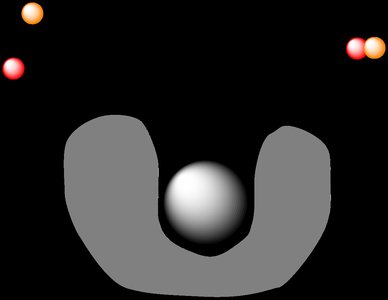
The active site is the region where reactants interact with the catalyst to form products. The surrounding coordination sphere influences the selectivity and reactivity of the catalyst.
Mass Transport: Reactants must reach the active site, which can be rate-limiting, especially in heterogeneous catalysis.
Coordination Sphere: The three-dimensional arrangement around the active site that governs selectivity.
Types of Catalysis
Homogeneous vs. Heterogeneous Catalysis
Catalysis can be classified based on the phase of the catalyst relative to the reactants and products.
Homogeneous Catalysis: Catalyst, reactants, and products are in the same phase (usually solution). Offers high selectivity and activity, easy to study, but can have issues with catalyst separation and longevity.
Heterogeneous Catalysis: Catalyst is in a different phase (often solid) from reactants and products. Allows easy separation and recyclability, high longevity, but often lower selectivity and more difficult mechanistic study.
Homogeneous Catalysis | Heterogeneous Catalysis |
|---|---|
Well-defined active site | Easy separation of catalyst and products |
High selectivity | High catalyst longevity |
Easy to study in solution | Works at extreme conditions |
Separation can be difficult | Poorer selectivity/activity |
Examples of Catalysts
Homogeneous: Simple acid/base catalysis (e.g., ester hydrolysis), enzymes, organocatalysts, organometallic complexes.
Heterogeneous: Pd on carbon, clays, zeolites, nanoparticles, metal oxides, metal-organic frameworks, complexes on surfaces.
Analysis of Catalytic Cycles
Structure of Catalytic Cycles
A catalytic cycle consists of a sequence of elementary steps, each with its own intermediates and transition states. The cycle returns the catalyst to its original state after product formation.
Steady State Approximation: Concentrations of intermediates remain constant during the reaction, though they may differ from each other.
Rate Law: The rate of product formation is determined by the rate constants and concentrations of intermediates.
Rate Determining Step (RDS)
The rate determining step is the slowest step in the catalytic cycle, characterized by the largest activation energy barrier (ΔG‡) from the preceding stable intermediate. It controls the overall reaction rate.
Identification: Look for the largest energy span in the reaction coordinate diagram, not necessarily the highest point.
Mathematical Representation:
Resting State of the Catalyst
The resting state is the intermediate with the highest concentration and the smallest rate constant, typically found at the start of the rate-determining step.
Experimental Identification of Mechanistic Features
Kinetic Measurements: Use spectroscopic techniques (NMR, IR, UV-Vis) to monitor concentration changes over time.
Computational Modeling: Density Functional Theory (DFT) can be used to estimate energies of intermediates and transition states.
Kinetic Isotope Effect (KIE): Substitution of isotopes (e.g., H by D) can reveal mechanistic details based on rate changes.
Kinetic Isotope Effect (KIE)
Definition and Application
The kinetic isotope effect is the change in reaction rate when a reactant atom is replaced by one of its isotopes, most commonly hydrogen by deuterium. It provides insight into which bonds are broken or formed in the rate-determining step.
Primary KIE: Observed when the bond to the isotopomer is broken or formed in the RDS.
Normal KIE: Lighter isotopomers react faster.
Inverse KIE: Occurs when a bond changes hybridization (e.g., sp2 to sp3), not broken.
Measuring KIE
Parallel reactions (measure directly)
Intermolecular and intramolecular competition experiments (compare product ratios)
Activation and Deactivation of Catalysts
Activation Processes
Often, the added catalyst is a precursor (pre-catalyst) that requires activation before entering the catalytic cycle. Activation can involve ligand loss, photoejection, or hydrogenation. Slow activation can cause an induction period in the reaction.
Pre-equilibrium: Activation may establish a pre-equilibrium, affecting the effective catalyst concentration and rate law.
Example: Excess PPh3 can hinder activation of Wilkinson's catalyst.
Off-Cycle Intermediates and Deactivation
Catalysts may form inactive species (off-cycle intermediates) reversibly or irreversibly. Irreversible deactivation removes the catalyst from the cycle, reducing efficiency.
Principle of Microscopic Reversibility
The mechanism of the reverse reaction is identical to the forward reaction, including the transition state. Absolute thermodynamic driving forces (e.g., gas loss, precipitate formation) are required to push the catalytic cycle forward.
Assessing Catalytic Efficiency
Key Metrics
Activity: Amount of product formed per catalyst per hour (g mol–1 h–1).
Turnover Number (TON): Number of cycles a catalyst completes before deactivation.
Turnover Frequency (TOF): Number of cycles per unit time (s–1 or h–1).
Summary Table: Homogeneous vs. Heterogeneous Catalysis
Feature | Homogeneous | Heterogeneous |
|---|---|---|
Phase | Same as reactants | Different from reactants |
Active Site Definition | Well-defined | Often ill-defined |
Separation | Difficult | Easy |
Longevity | Lower | Higher |
Study | Easy | Difficult |
Selectivity | High | Lower |
Conclusions
Catalytic cycles involve multiple steps with intermediates and transition states.
Identifying the resting state and rate-determining step is crucial for understanding mechanisms.
Kinetic analysis, isotope effects, and computational studies are essential tools.
Activation, deactivation, and off-cycle processes significantly impact observed rates and efficiency.
TON and TOF are more informative than yield for assessing catalyst performance.
