 Back
BackFundamentals of Organic Chemistry: Structure, Nomenclature, Properties, and Reactivity
Study Guide - Smart Notes
 Tailored notes based on your materials, expanded with key definitions, examples, and context.
Remembering General Chemistry: Electronic Structure and Bonding
Atomic Structure and Carbon Bonding
Organic chemistry is fundamentally the chemistry of carbon compounds. Carbon's unique ability to form four covalent bonds leads to a vast array of molecular structures. Understanding the electronic structure and hybridization of carbon is essential for predicting molecular geometry and reactivity.
Electronic Configuration of Carbon:
Bonding: Carbon forms four bonds to achieve a stable octet. If it forms fewer, it exists as an ion or radical.
Hybridization: The mixing of atomic orbitals to form new hybrid orbitals suitable for bonding.
sp3 Hybridization: Tetrahedral geometry, bond angle 109.5° (e.g., methane, ethane).
sp2 Hybridization: Trigonal planar geometry, bond angle 120° (e.g., ethene).
sp Hybridization: Linear geometry, bond angle 180° (e.g., ethyne).
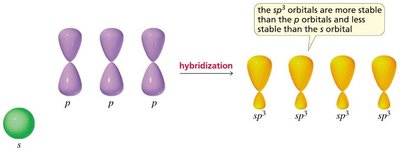
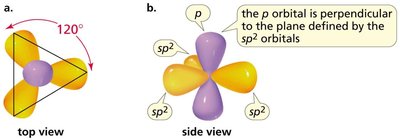

Carbocations, Carbanions, and Radicals: The hybridization of carbon changes with its electronic state. Carbocations and radicals are typically sp2 hybridized, while carbanions are sp3 hybridized.
Acids and Bases: Central to Understanding Organic Chemistry
Brønsted Acids and Bases
Acid-base behavior is central to organic reactivity. The strength of acids and bases is quantified by the acid dissociation constant () and its logarithmic form, .
Acid: Proton donor
Base: Proton acceptor
pKa:
Conjugate Acid-Base Pairs: When an acid loses a proton, it forms its conjugate base, and vice versa.
Factors Affecting Acidity:
Electronegativity of the atom bearing the negative charge
Hybridization (sp > sp2 > sp3 in acidity)
Inductive and resonance effects
Henderson–Hasselbalch Equation:
An Introduction to Organic Compounds: Nomenclature, Physical Properties, and Structure
Nomenclature of Organic Molecules
Systematic naming (IUPAC) ensures clarity and avoids ambiguity. The structure of a molecule can be deduced from its name and vice versa.
Longest Chain Rule: Identify the longest continuous carbon chain as the parent hydrocarbon.
Numbering: Number the chain to give substituents the lowest possible numbers.
Substituents: Name and list substituents alphabetically, ignoring prefixes like di-, tri-, sec-, tert- (except iso-).
Functional Groups: The highest-priority functional group determines the suffix and numbering.
Types of Names:
Trivial/Common Names (e.g., isopropanol)
Systematic (IUPAC) Names (e.g., 2-propanol)
Radicofunctional Names (e.g., methyl alcohol)
Isomerism: Compounds with the same molecular formula but different structures or spatial arrangements.
Constitutional (Structural) Isomers: Different connectivity of atoms.
Stereoisomers: Same connectivity, different spatial arrangement (e.g., cis/trans, E/Z, R/S).
Isomers: The Arrangement of Atoms in Space
Types of Isomerism
Constitutional Isomers: Differ in the order of atom connectivity.
Stereoisomers: Same connectivity, different spatial arrangement.
Conformers: Interconvert by rotation around single bonds.
Cis/Trans (Geometric) Isomers: Restricted rotation (double bonds or rings).
Enantiomers: Non-superimposable mirror images (chiral centers).
Diastereomers: Stereoisomers not related as mirror images.
Chirality: A molecule is chiral if it cannot be superimposed on its mirror image. Chiral centers are typically tetrahedral carbons with four different substituents.
Alkanes, Alkenes, Alkynes: Structure, Nomenclature, and Properties
Alkanes (CnH2n+2)
Structure: Saturated hydrocarbons with only single bonds.
Physical Properties: Non-polar, low boiling and melting points, insoluble in water.
Effect of Branching: More branching lowers boiling and melting points.
Alkenes (CnH2n)
Structure: Contain at least one double bond.
Physical Properties: Slightly higher boiling points than alkanes, but lower melting points.
Nomenclature: Number the chain to give the double bond the lowest possible number.
Alkynes (CnH2n-2)
Structure: Contain at least one triple bond.
Physical Properties: Boiling points similar to alkanes; internal alkynes have higher boiling points than terminal alkynes.
Physical Properties of Organic Molecules
Intermolecular Forces
The physical properties of organic molecules are determined by the types and strengths of intermolecular forces present.
Van der Waals (London Dispersion) Forces: Weak, present in all molecules, increase with molecular size.
Dipole-Dipole Interactions: Stronger, present in polar molecules.
Hydrogen Bonding: Strongest, occurs when H is bonded to N, O, or F.
Boiling and Melting Points: Increase with stronger intermolecular forces and molecular size; branching lowers boiling/melting points.
Solubility: "Like dissolves like"—polar molecules dissolve in polar solvents, non-polar in non-polar solvents.
Functional Groups and Their Properties
Alcohols, Ethers, Amines, Carboxylic Acids, Esters, Amides, Aldehydes, Ketones, Aromatics
Alcohols: Contain -OH group; higher boiling points due to hydrogen bonding; soluble in water (short chains).
Ethers: R-O-R'; lower boiling points than alcohols; limited water solubility.
Amines: Contain -NH2, -NHR, or -NR2; basic; hydrogen bonding possible in primary/secondary amines.
Carboxylic Acids: -COOH group; strong hydrogen bonding; high boiling points; acidic.
Esters: RCOOR'; pleasant odors; lower boiling points than acids; limited water solubility.
Amides: RCONH2; high boiling points; hydrogen bonding.
Aldehydes/Ketones: Carbonyl group; polar; moderate boiling points; good solvents.
Aromatics: Benzene ring; unique stability due to delocalized π electrons (aromaticity).
Polymers
Types and Properties
Polymers are large molecules made by linking repeating units (monomers). They are classified by their synthesis and properties.
Addition Polymers: Formed by chain reactions (e.g., polyethylene, PVC).
Condensation Polymers: Formed by step-growth reactions with loss of small molecules (e.g., nylon, polyester).
Physical Properties: Crystallinity, melting point, density, and mechanical strength depend on polymer structure.
Polymer Type | Example | Monomer | Use |
|---|---|---|---|
Addition | Polyethylene | Ethene | Bottles, bags |
Condensation | Nylon | Diamine + Dicarboxylic acid | Textiles |
Condensation | Polyester | Diol + Dicarboxylic acid | Clothing, bottles |
Reactivity and Reactive Intermediates
Nucleophiles and Electrophiles
Nucleophile: Electron-rich species that donates an electron pair (e.g., OH-, NH3).
Electrophile: Electron-poor species that accepts an electron pair (e.g., H+, CH3+).
Types of Organic Reactions
Addition: Atoms added to a double/triple bond.
Elimination: Atoms removed, forming double/triple bonds.
Substitution: One atom/group replaces another.
Oxidation/Reduction: Change in oxidation state, often involving O or H atoms.
Summary Table: Hybridization and Bond Properties
Molecule | Hybridization | Bond Angles | C-H Bond Length (Å) | C-C Bond Length (Å) | C-H Bond Strength (kcal/mol) | C-C Bond Strength (kcal/mol) |
|---|---|---|---|---|---|---|
Ethane | sp3 | 109.5° | 1.10 | 1.54 | 101.1 | 90.2 |
Ethene | sp2 | 120° | 1.08 | 1.33 | 110.7 | 174.5 |
Ethyne | sp | 180° | 1.06 | 1.20 | 133.3 | 230.4 |
Additional info:
Some images and exercises referenced in the original material are omitted here for clarity and relevance.
For more advanced topics (e.g., spectroscopy, advanced reactivity), refer to the corresponding textbook chapters.
