 Back
BackIntrinsic Properties of Materials: Stiffness, Thermal Expansion, Dielectric, Piezoelectric, and Ferroelectric Properties
Study Guide - Smart Notes
 Tailored notes based on your materials, expanded with key definitions, examples, and context.
Macromolecules and Materials: Synthesis and Properties
Intrinsic Properties of Materials
This section explores the fundamental properties of materials, focusing on how atomic structure, bonding, and composition determine macroscopic behaviors such as mechanical stiffness, thermal expansion, and dielectric properties. These concepts are essential for understanding the design and application of materials in organic and inorganic chemistry.
Lonsdaleite: Structure and Hardness
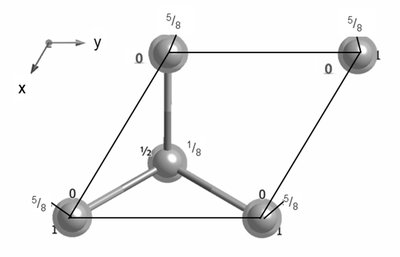
Lonsdaleite is an allotrope of carbon formed during meteor impacts, with a hexagonal lattice structure. Its unique arrangement of carbon atoms results in a material predicted to be approximately 60% harder than diamond. The structure is defined by specific lattice parameters and atomic motifs.
Hexagonal P lattice: a = 2.52 Å, c = 4.12 Å
Motif positions: C [0, 0, 0]; [2/3, 1/3, 1/2]; [0, 0, 5/8]; [2/3, 1/3, 1/8]
Hardness: Predicted to be ~60% harder than diamond
Determinants of Material Properties
The properties of materials depend on several factors:
Composition: Elements and stoichiometry
Atomic structure: Crystal/molecular structure and bonding
Defects and microstructure: Influence real-world properties
Intrinsic properties are primarily determined by composition and structure, but defects can modulate these properties.
Mechanical Stiffness (Young’s Modulus)
Young’s modulus (E) quantifies the stiffness of a material, representing the ratio of stress to strain in the linear elastic region. It is a fundamental property for comparing materials.
Stress (\(\sigma\)): Force per unit area, \(\sigma = \frac{F}{A}\)
Strain (\(\varepsilon\)): Fractional elongation, \(\varepsilon = \frac{\Delta L}{L}\)
Young’s modulus: \(E = \frac{d\sigma}{d\varepsilon}|_{\varepsilon \to 0}\)
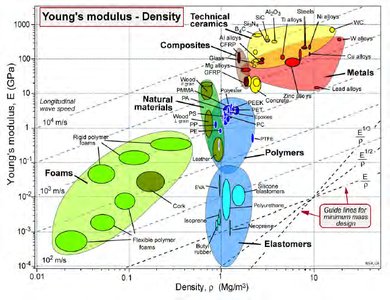
Bonding and Stiffness
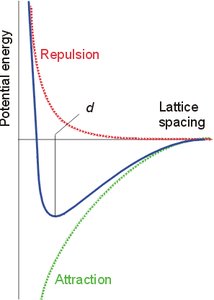
The stiffness of a material is fundamentally linked to the bonding potential between atoms and the packing density of bonds. The Born-Mayer equation describes the force and energy associated with bond stretching:
Individual bond stretching around equilibrium bond length defines bond stiffness.
Number of bonds per unit area: \(A = (1 / r_e)^2\)
Young’s modulus: \(E = \frac{1}{r_e} \frac{d^2U}{dr^2}|_{r \to r_e}\)
Material Properties Table
The relationship between bonding energy, melting point, and modulus is illustrated in the following table:
Material | ΔH (kJ/mol) | Tm (°C) | E (GPa) |
|---|---|---|---|
Pb | 5.4 | 327 | 14 |
Al | 10.5 | 660 | 69 |
Cu | 13.5 | 1084 | 117 |
Fe | 15.3 | 1538 | 207 |
W | 32 | 3410 | 407 |
Thermal Expansion
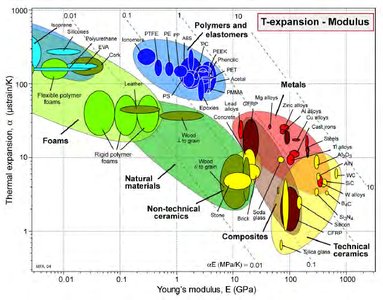
Materials expand with temperature due to the anharmonicity of the bond potential. The linear thermal expansion coefficient (\(\alpha_L\)) quantifies this effect:
\(\Delta L / L = \Delta r / r_e = \varepsilon_T = \alpha_L \Delta T\)
\(\alpha_L\) is related to bond energy and modulus
Strength and Real-World Performance
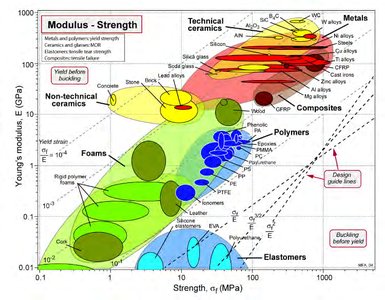
The maximum theoretical strength of a material is related to the depth of the bonding potential and the number of bonds per unit cross-section. Real strength is always lower due to defects and non-linearities in stress-strain curves.
Rule of thumb: Maximum strength ≈ E/10
Defects reduce real strength
Thermal Conductivity
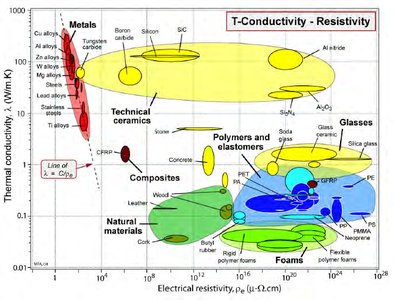
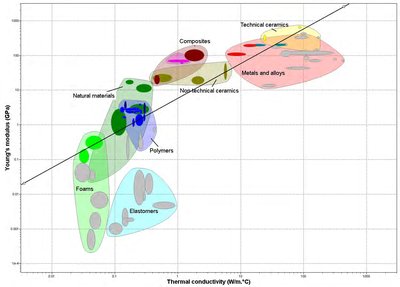
Thermal conductivity (\(\lambda\)) in solids is governed by lattice vibrations (phonons) and, in metals, by conduction electrons. The relationship between thermal diffusivity (\(D_T\)), heat capacity, and density is:
\(D_T = \frac{\lambda}{\rho C_p}\)
Heat flux: \(J_T = -\lambda \frac{dT}{dx}\)
Fick’s laws describe diffusive transport
Dielectric Properties
Dielectrics: Definition and Mechanisms
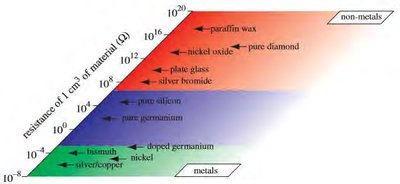
A dielectric is an electrical insulator that can be polarized by an applied electric field. The capacitance of a parallel plate capacitor is increased by the presence of a dielectric material:
Capacitance: \(C_0 = \varepsilon_0 \frac{A}{d}\)
Relative permittivity (\(\varepsilon_r\)): \(C'/C_0 = \varepsilon_r\)
\(\varepsilon_r = 1 + \chi_e\), where \(\chi_e\) is electric susceptibility
Dielectric Response Mechanisms
Dielectric polarization arises from several mechanisms:
Polarization of electron clouds
Bond stretching
Molecular rotation
Ion movement
Polarization (P) can be considered as charge per unit area or the sum of dipoles per unit volume:
\(P = \varepsilon_0 \chi_e E \sim \varepsilon_0 \varepsilon_r E\)
Frequency Dependence of Dielectric Response
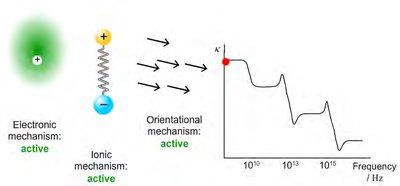
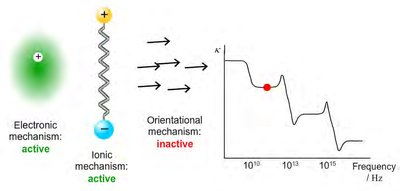
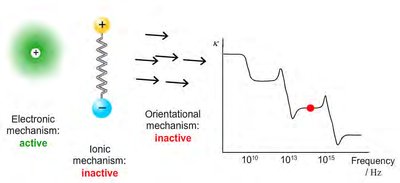
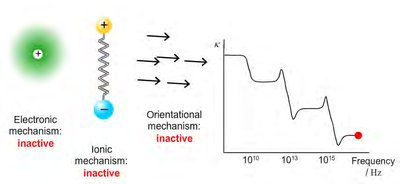
Different polarization mechanisms operate at different frequencies:
Electronic, ionic, and orientational mechanisms
Dielectric constant decreases with increasing frequency
Dielectric Constant and Strength
Both high and low dielectric constant materials are critical for silicon transistor miniaturization. Dielectric strength is the maximum electric field a material can withstand before breakdown, important for high voltage systems and capacitors.
Dielectric Strength (MV/m) | Example |
|---|---|
1.5 - 3 | Air |
9.8-13.8 | Window glass |
470-670 | Fused silica |
~20 – 180 | PTFE (Teflon) |
2000 | Diamond |
Complex Dielectric Properties: Piezoelectric, Pyroelectric, and Ferroelectric Materials
Piezoelectrics
Piezoelectric materials develop a temporary change in polarization under mechanical load or strain, or mechanical strain under an applied electric field. Applications include sensors, actuators, and transducers.
Non-centrosymmetric crystal structures are required
Efficiency and operating temperature vary by material

Piezoelectric Mechanism in Quartz
In quartz, SiO4 tetrahedra are non-centrosymmetric, allowing dipole formation when distorted. The piezoelectric effect disappears above the Curie temperature, where symmetry increases.
Pyroelectrics
Pyroelectric materials develop a temporary change in polarization when heated or cooled. The effect is transient, as it is neutralized by environmental charges or dipoles.
Polarization change: \(\Delta P = \pi \Delta T\), where \(\pi\) is the pyroelectric coefficient
Ferroelectrics
Ferroelectric materials exhibit spontaneous polarization without applied electric field or mechanical strain. They undergo a phase transition below the Curie temperature (Tc) to a non-centrosymmetric phase.
All ferroelectrics are piezoelectric
Ferroelectric phase forms by distortion of the paraelectric phase
Perovskites (ABX3) are classic examples
Ferroelectric domains form, separated by domain walls. Applied electric fields move these walls, generating a characteristic hysteresis loop.
TC (°C) | Ferroelectric |
|---|---|
~120 | BaTiO3 |
~ -150 | KH2PO4 |
~490 | PbTiO3 |
~159 | Gd(MoO4)3 |
Summary: Intrinsic material properties such as stiffness, thermal expansion, dielectric constant, and piezoelectric/ferroelectric behavior are determined by atomic structure and bonding. Understanding these properties is essential for designing materials with desired functionalities in chemistry and materials science.
