 Back
BackIsomerism and Stereochemistry: Arrangement of Atoms in Space
Study Guide - Smart Notes
 Tailored notes based on your materials, expanded with key definitions, examples, and context.
Isomers: The Arrangement of Atoms in Space
Definition and Classification of Isomers
Isomers are compounds that share the same molecular formula but differ in the arrangement of their atoms. Understanding isomerism is fundamental in organic chemistry, as it explains the diversity of molecular structures and their properties.
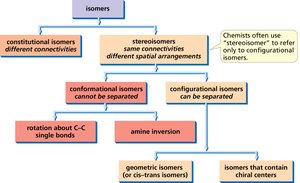
Constitutional Isomers: Isomers with different connectivities among atoms.
Stereoisomers: Isomers with the same connectivity but different spatial arrangements.
Constitutional Isomers
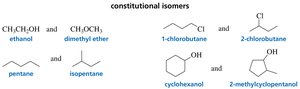
Constitutional isomers differ in the way atoms are connected, resulting in distinct compounds with unique physical and chemical properties.
Examples: Ethanol and dimethyl ether, pentane and isopentane, 1-chlorobutane and 2-chlorobutane, cyclohexanol and 2-methylcyclopentanol.
Stereoisomerism
Classification of Stereoisomers
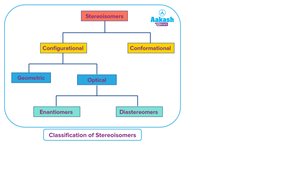
Stereoisomers are divided into two main types:
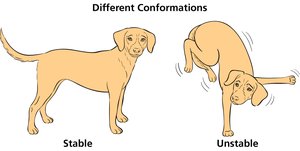
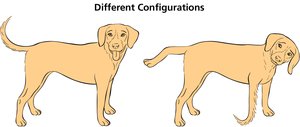
Conformational Isomers: Differ by rotation about single bonds; cannot be separated.
Configurational Isomers: Can be separated; include geometric (cis-trans) and optical isomers (enantiomers and diastereomers).
Conformational vs. Configurational Isomers
Conformational Isomers: Interconvert by rotation about C–C single bonds; not isolable.
Configurational Isomers: Require bond breaking to interconvert; can be isolated.
Cis-Trans Isomerism (Geometric Isomers)
Cyclic and Double Bond Systems
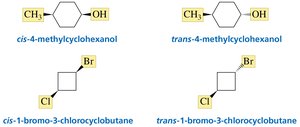
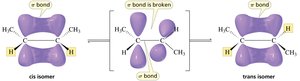
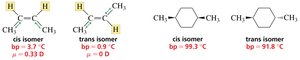
Cis-trans isomers arise from restricted rotation, either due to cyclic structures or double bonds.
Cyclic Structures: Substituents on the same side (cis) or opposite sides (trans) of the ring.
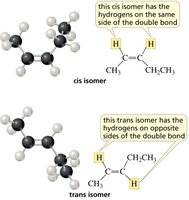
Double Bonds: Hydrogens or substituents on the same side (cis) or opposite sides (trans) of the double bond.
Physical Properties of Cis and Trans Isomers
Cis and trans isomers often exhibit different physical properties, such as boiling points and dipole moments, due to their spatial arrangement.
Example: Cis isomers typically have higher dipole moments and boiling points than trans isomers.
Limitations of Cis-Trans Isomerism
Not all alkenes can exhibit cis-trans isomerism; it is only possible when each carbon of the double bond has two different substituents. 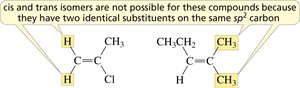
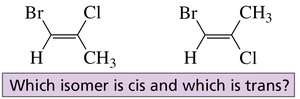
Identifying Cis and Trans Isomers
Cis Isomer: Substituents are on the same side.
Trans Isomer: Substituents are on opposite sides.
The E, Z System of Nomenclature
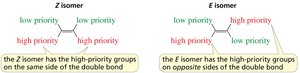
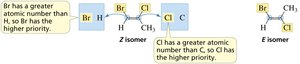
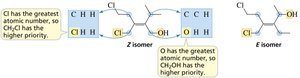
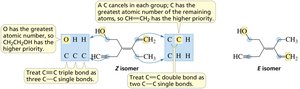
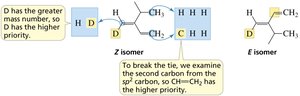
The E/Z system is used for naming geometric isomers when there are more than two different substituents on the double bond.
Z (zusammen): High-priority groups are on the same side.
E (entgegen): High-priority groups are on opposite sides.
Chirality and Optical Activity
Chiral and Achiral Objects
Chiral: Objects or molecules with nonsuperimposable mirror images.
Achiral: Objects or molecules with superimposable mirror images.
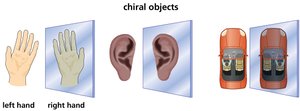
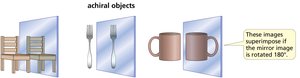
Chiral Centers
A chiral center is an atom (usually carbon) attached to four different groups, leading to chirality in molecules. 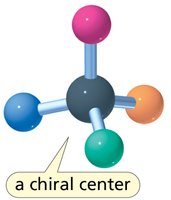
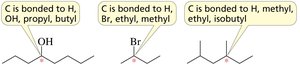
Enantiomers
Enantiomers are pairs of stereoisomers that are nonsuperimposable mirror images of each other.
They have identical physical and chemical properties except for their interaction with plane-polarized light and chiral environments.
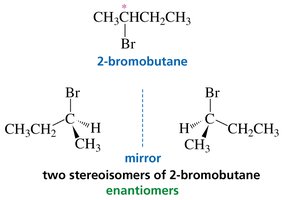
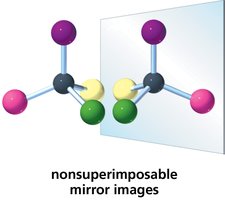
Chiral and Achiral Molecules
Chiral molecules: Have nonsuperimposable mirror images.
Achiral molecules: Have superimposable mirror images.
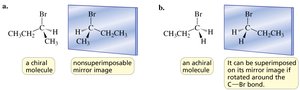
Drawing Enantiomers
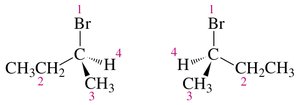
Perspective Formulas: Use wedges and dashes to indicate three-dimensional arrangement.
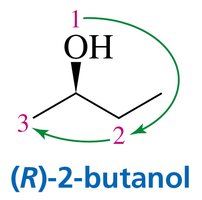
Skeletal Structures: Show connectivity and stereochemistry.
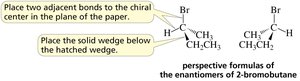
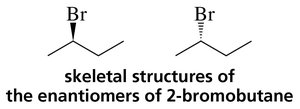
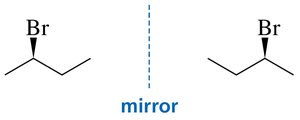
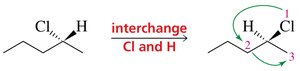
Interchanging Groups
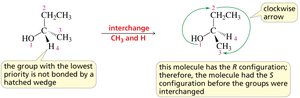
Interchanging two groups at a chiral center forms the enantiomer; repeating the interchange restores the original molecule. 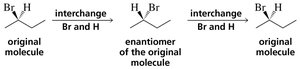
Naming Enantiomers: The R/S System
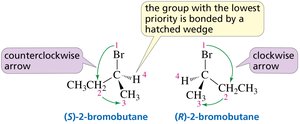
Assign priorities to the four groups attached to the chiral center based on atomic number.
Draw an arrow from highest to lowest priority (excluding the lowest).
If the lowest-priority group is on a hatched wedge, clockwise is R, counterclockwise is S.
If not, interchange groups to place the lowest-priority group on a hatched wedge.
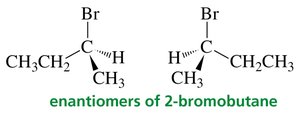
Optical Activity
Plane-Polarized Light
Plane-polarized light is used to distinguish between chiral and achiral compounds. 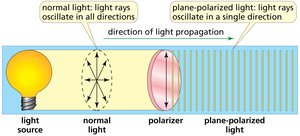
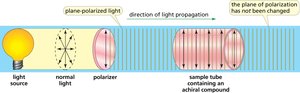
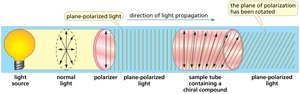
Optical Inactivity and Activity
Achiral compounds: Do not rotate plane-polarized light (optically inactive).
Chiral compounds: Rotate plane-polarized light (optically active).
Diastereomers and Meso Compounds
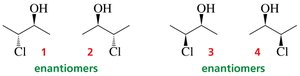
Diastereomers
Diastereomers are stereoisomers that are not mirror images of each other.
They have different physical and chemical properties.
Meso Compounds
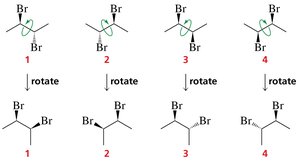
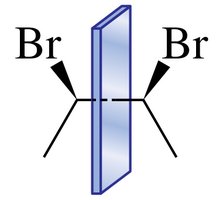
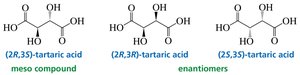
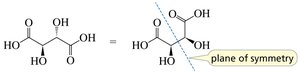
Meso compounds contain chiral centers but are achiral due to an internal plane of symmetry.
They are optically inactive.
Physical Properties of Stereoisomers
Comparison Table
Stereoisomers can have different melting points, specific rotations, and solubilities.
Compound | Melting Point (°C) | Specific Rotation | Solubility (g/100 mL H2O at 15°C) |
|---|---|---|---|
(2R,3R)-Tartaric acid | 171 | +11.98 | 13 |
(2S,3S)-Tartaric acid | 171 | -11.98 | 13 |
(2R,3S)-Tartaric acid (meso) | 140 | 0 | 125 |
4,5-Tartaric acid | 206 | 0 | 21 |

Chirality in Nitrogen and Phosphorus
Chiral Centers Beyond Carbon
Nitrogen and phosphorus atoms can also serve as chiral centers when attached to four different groups, contributing to molecular chirality. 
Summary of Learning Objectives
Draw all stereoisomers of a compound.
Classify molecules as chiral or achiral.
Identify chiral centers and determine their configurations.
Calculate specific rotation and enantiomeric excess.
Represent configurations using skeletal and perspective formulas.
Identify constitutional isomers, stereoisomers, geometric isomers, enantiomers, diastereomers, and meso compounds.
Interconvert structural representations.
Determine E/Z configuration of geometric isomers.
Additional info:
Expanded explanations and context were provided for clarity and completeness.
