 Back
BackIsomers: The Arrangement of Atoms in Space (Chirality and Stereochemistry)
Study Guide - Smart Notes
 Tailored notes based on your materials, expanded with key definitions, examples, and context.
Isomers: The Arrangement of Atoms in Space
Introduction to Isomers
Isomers are compounds that share the same molecular formula but differ in the arrangement of their atoms. This difference in structure leads to distinct physical and chemical properties. Understanding isomerism is fundamental to organic chemistry, as it explains the diversity of organic compounds.
Constitutional Isomers: Compounds with the same molecular formula but different connectivity of atoms.
Stereoisomers: Compounds with the same connectivity but different spatial arrangements of atoms.
Conformations and Configurations
Conformations are different spatial arrangements of a molecule that can be converted into one another by rotation around single bonds. These conformers cannot be separated as they interconvert rapidly. In contrast, compounds with different configurations (such as cis-trans isomers or enantiomers) can be separated because their interconversion requires breaking and reforming bonds.
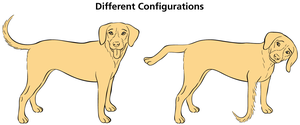
Cis-Trans (Geometric) Isomerism
Cis-trans isomers arise due to restricted rotation, either from cyclic structures or double bonds. These isomers have distinct physical properties.
Cyclic Structures: Rotation is restricted by the ring, leading to cis (substituents on the same side) and trans (substituents on opposite sides) isomers.
Double Bonds: The π-bond restricts rotation, resulting in cis (hydrogens on the same side) and trans (hydrogens on opposite sides) isomers.
Even small structural differences, as seen in constitutional isomers, can lead to different melting points and other physical properties.
Dipole Moments in Geometric Isomers
The arrangement of substituents in geometric isomers affects the overall dipole moment of the molecule. For example, certain symmetrical arrangements can result in a net dipole moment of zero.
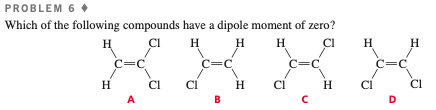
The E,Z System of Nomenclature
When more than two different substituents are attached to the carbons of a double bond, the E,Z system is used. Priority is assigned based on atomic number; if a tie occurs, the next set of atoms is considered. For multiple bonds, sp2 and sp carbons are counted as multiple connections, and isotopic mass is used as a tiebreaker if necessary.
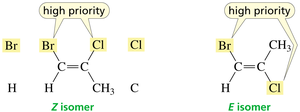
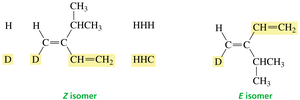
Chirality and Stereochemistry
Chirality is a property of a molecule that makes it non-superimposable on its mirror image. A chiral molecule has at least one asymmetric center—an atom (usually carbon) bonded to four different groups. Enantiomers are pairs of chiral molecules that are non-superimposable mirror images of each other.
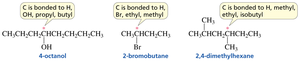
Asymmetric Center: An atom attached to four different groups.
Stereocenter: An atom where the interchange of two groups produces a stereoisomer.
Enantiomers and Their Properties
Enantiomers have identical physical properties except for their interaction with plane-polarized light and reactions in chiral environments. For example, the drug thalidomide exists as two enantiomers: one is a sedative, the other is teratogenic.
Identifying Asymmetric Centers
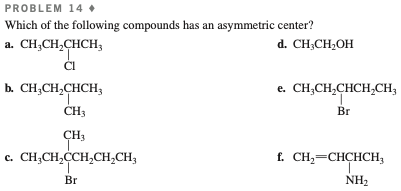
To determine if a molecule is chiral, look for a carbon atom bonded to four different groups. If such a center exists, the molecule can exist as a pair of enantiomers.
Drawing and Naming Enantiomers
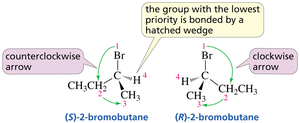
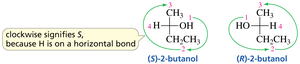
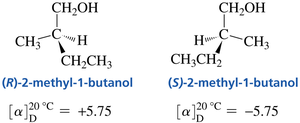
Enantiomers can be represented using perspective formulas (solid and dashed wedges) or Fischer projections. Assign priorities to the four groups attached to the asymmetric center using the Cahn-Ingold-Prelog rules. The configuration is R (rectus, clockwise) or S (sinister, counterclockwise) depending on the order of the groups.
Optical Activity
Chiral compounds rotate plane-polarized light and are said to be optically active. Achiral compounds do not rotate plane-polarized light and are optically inactive. There is no direct relationship between R/S configuration and the direction of optical rotation (+ or -).
Enantiomeric Excess (ee)
Enantiomeric excess quantifies the excess of one enantiomer over the other in a mixture. If ee = 0%, the mixture is racemic (equal amounts of both enantiomers).
Multiple Stereocenters and Diastereomers
Compounds with more than one asymmetric center can have multiple stereoisomers. Diastereomers are stereoisomers that are not mirror images of each other. For a molecule with n asymmetric centers, the maximum number of stereoisomers is 2n, though symmetry can reduce this number (as in meso compounds).
Meso Compounds: Compounds with multiple asymmetric centers that are superimposable on their mirror image due to an internal plane of symmetry. Meso compounds are optically inactive.
Naming Stereoisomers
Each asymmetric center is assigned an R or S configuration independently. Fischer projections are often used for molecules with multiple stereocenters, especially carbohydrates and amino acids.
Heteroatoms as Asymmetric Centers
Nitrogen and phosphorus atoms can also serve as asymmetric centers if bonded to four different groups. However, amine inversion (rapid interconversion of enantiomers due to lone pair inversion) prevents the isolation of enantiomers for most amines, while phosphorus inversion is much slower.
Biological Importance of Chirality
Chirality is crucial in biological systems. Protein receptors are chiral and often bind only one enantiomer of a compound, leading to different physiological effects for each enantiomer.
Separation of Enantiomers
Enantiomers can be separated by crystallization or by chromatography using a chiral stationary phase.
Summary
Isomers include constitutional isomers and stereoisomers (enantiomers and diastereomers).
Chirality arises from asymmetric centers; enantiomers are non-superimposable mirror images.
Cis-trans isomerism and E/Z nomenclature describe geometric isomers.
Optical activity is a key property of chiral compounds.
Multiple stereocenters lead to diastereomers and meso compounds.
Chirality is essential in biological recognition and drug action.
