 Back
BackNomenclature of Alkanes, Cycloalkanes, Alkenes, and Alkynes (IUPAC System)
Study Guide - Smart Notes
 Tailored notes based on your materials, expanded with key definitions, examples, and context.
Naming Organic Compounds: The IUPAC System
Introduction to Organic Nomenclature
The systematic naming of organic compounds is essential for clear communication in chemistry. The International Union of Pure and Applied Chemistry (IUPAC) provides standardized rules for naming both inorganic and organic molecules, ensuring that each compound has a unique and descriptive name.
Common names were often given by discoverers, but IUPAC names are now preferred for clarity and universality.
The IUPAC system uses a combination of prefixes, roots, and suffixes to describe the structure of a molecule.
Alkanes and Cycloalkanes
Alkanes: Structure and Nomenclature
Alkanes are saturated hydrocarbons containing only single bonds between carbon atoms. Their names end with the suffix "-ane" and use prefixes to indicate the number of carbons.
General formula:
No functional groups are present in alkanes.
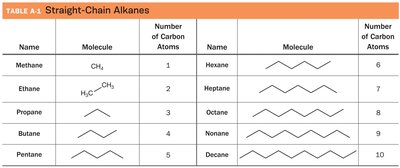
Table: Straight-Chain Alkanes
Name | Molecule | Number of Carbon Atoms | Name | Molecule | Number of Carbon Atoms |
|---|---|---|---|---|---|
Methane | CH4 | 1 | Hexane |
| 6 |
Ethane | H3C–CH3 | 2 | Heptane | 7 | |
Propane | 3 | Octane | 8 | ||
Butane | 4 | Nonane | 9 | ||
Pentane | 5 | Decane | 10 |
Cycloalkanes
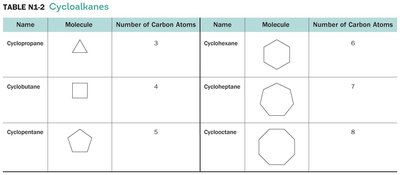
Cycloalkanes are saturated hydrocarbons with carbon atoms arranged in a ring. Their names use the prefix "cyclo-" followed by the alkane name corresponding to the number of carbons in the ring.
General formula:
Name | Molecule | Number of Carbon Atoms | Name | Molecule | Number of Carbon Atoms |
|---|---|---|---|---|---|
Cyclopropane | Triangle | 3 | Cyclohexane | Hexagon | 6 |
Cyclobutane | Square | 4 | Cycloheptane | Heptagon | 7 |
Cyclopentane | Pentagon | 5 | Cyclooctane | Octagon | 8 |
Substituted Alkanes and Alkyl Groups
Substituents and Their Nomenclature
When a hydrogen atom in an alkane is replaced by another atom or group, the new group is called a substituent. Common substituents include halogens (chloro, bromo, iodo) and nitro groups (NO2).
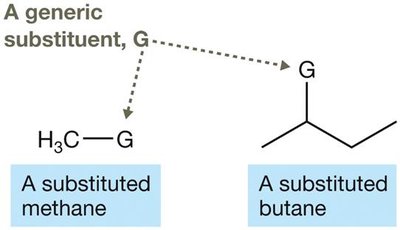
Alkyl groups are derived from alkanes by removing one hydrogen and are named by replacing "-ane" with "-yl" (e.g., methyl, ethyl).
Abbreviations: Me (methyl), Et (ethyl), Pr (propyl), Bu (butyl).

Locator Numbers (Locants)
Locants are numbers assigned to carbon atoms in the main chain to indicate the position of substituents. The chain is numbered to give the lowest possible numbers to the substituents.
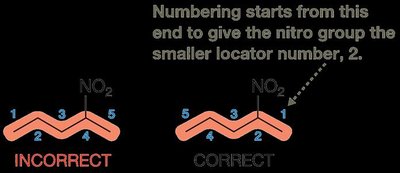
Use hyphens to separate numbers from words and commas to separate numbers.
When multiple substituents are present, each gets its own locant.
IUPAC Nomenclature Steps
The IUPAC system for naming alkanes and their derivatives follows these steps:
Find the longest continuous carbon chain (parent hydrocarbon).
Number the chain to give the substituents the lowest possible locants.
Name and number the substituents.
Assemble the name: locants, prefixes (substituents), parent name, suffix (functional group).

Multiple Substituents
When more than one of the same substituent is present, prefixes such as di-, tri-, tetra-, etc., are used. These prefixes are not considered when alphabetizing substituents.
Number of Substituents | Prefix |
|---|---|
2 | di- |
3 | tri- |
4 | tetra- |
5 | penta- |
6 | hexa- |
7 | hepta- |
8 | octa- |
9 | nona- |
10 | deca- |

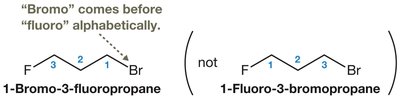
Substituents are listed alphabetically, ignoring these prefixes.
In case of a tie, the substituent that comes first alphabetically gets the lower number.
Common Names and Ethers
Common Substituent Names
Some groups have common names that are widely used, such as isopropyl and tert-butyl. Ethers are named using the alkoxy group (e.g., methoxy, ethoxy, propoxy).
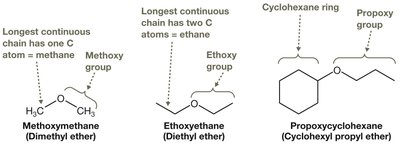
Methoxy: –OCH3
Ethoxy: –OCH2CH3
Propoxy: –OCH2CH2CH3
Alkenes and Alkynes
Introduction to Unsaturated Hydrocarbons
Alkenes and alkynes are unsaturated hydrocarbons, meaning they contain fewer than the maximum number of hydrogens due to the presence of double or triple bonds.
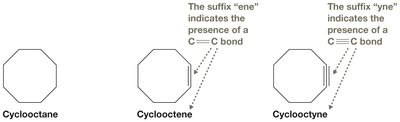
Alkenes: Contain at least one carbon-carbon double bond (C=C), end in "-ene".
Alkynes: Contain at least one carbon-carbon triple bond (C≡C), end in "-yne".
Naming Alkenes and Alkynes
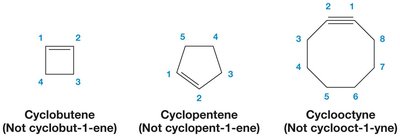
The parent chain must include the double or triple bond. The chain is numbered to give the multiple bond the lowest possible locant, which is placed before the "-ene" or "-yne" suffix.
For cycloalkenes, the double bond is always at position 1 unless substituents require otherwise.
Cycloalkynes are only stable with rings of 8 or more carbons.
Multiple Double or Triple Bonds
If more than one double or triple bond is present, use prefixes (di-, tri-, tetra-, etc.) and indicate the position of each bond with locants. The suffix is modified to reflect the number of multiple bonds (e.g., diene, triyne).
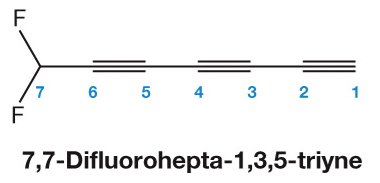
"Terminal" refers to a multiple bond at the end of a chain.
Cis-Trans Isomerism in Alkenes
Alkenes can exhibit cis-trans isomerism (geometric isomerism) when each carbon of the double bond has two different substituents. "Cis" means substituents are on the same side; "trans" means they are on opposite sides.
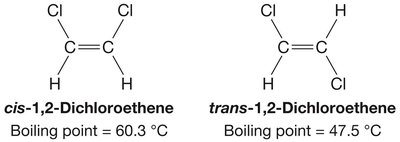
Double bonds restrict rotation, so cis and trans isomers are distinct compounds with different physical properties.
Bond Rotation: Single vs. Double Bonds
Single bonds allow free rotation, but double bonds do not. All atoms involved in a double bond are coplanar.
Cis and Trans Fatty Acids
Saturated fats contain no double bonds, while unsaturated fats contain one or more C=C bonds, which can be cis or trans. Partial hydrogenation can convert cis double bonds to trans, affecting the physical properties of fats.
Trans fats are formed during partial hydrogenation and are associated with health risks.
Summary Table: Key Prefixes and Suffixes in Nomenclature
Number of Carbons | Root |
|---|---|
1 | meth- |
2 | eth- |
3 | prop- |
4 | but- |
5 | pent- |
6 | hex- |
7 | hept- |
8 | oct- |
9 | non- |
10 | dec- |
Practice Problems
Name the following molecules according to IUPAC rules (see images for structures):
Draw the structures for the following IUPAC names:
1,1-dimethylcyclohexane
3-ethyl-2,3-dimethylpentane
2,2,3,3-tetramethylhexane
2-bromo-1-cyclopropyl-1,1-diiodobutane
Additional info: For more complex molecules, always identify the parent chain, assign locants to minimize numbers, and alphabetize substituents as per IUPAC rules.
