 Back
BackNucleophilic Substitution and Elimination Reactions of Alkyl Halides (SN1, E1, E2, E1cB)
Study Guide - Smart Notes
 Tailored notes based on your materials, expanded with key definitions, examples, and context.
Reactions of Alkyl Halides: Nucleophilic Substitutions and Eliminations
SN1 Reaction: Mechanism and Characteristics
The SN1 reaction (Substitution, Nucleophilic, Unimolecular) is a two-step nucleophilic substitution mechanism that proceeds via a carbocation intermediate. It is favored by substrates that can stabilize a positive charge and occurs most rapidly with tertiary, allylic, and benzylic halides.
Step 1: Carbocation Formation (Rate-Limiting) – The alkyl halide undergoes spontaneous dissociation to form a carbocation and a halide ion. This is the slow, rate-determining step.
Step 2: Nucleophilic Attack – The nucleophile rapidly attacks the carbocation, forming the substitution product.
Step 3: Deprotonation (if necessary) – If the nucleophile is neutral (e.g., H2O), deprotonation yields the neutral product.
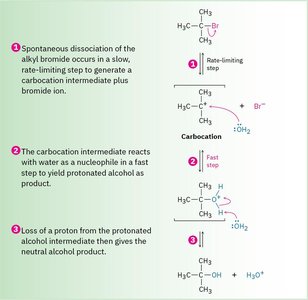
The rate law for the SN1 reaction is first-order with respect to the alkyl halide:
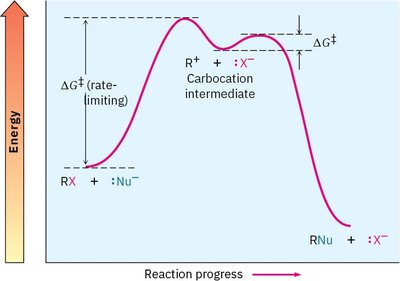
The energy diagram shows a high activation energy for carbocation formation, followed by a lower barrier for nucleophilic attack.
Substrate Reactivity and Carbocation Stability
The reactivity of alkyl halides in SN1 reactions depends on the stability of the carbocation intermediate. Tertiary carbocations are most stable, followed by secondary, primary, and methyl. Allylic and benzylic carbocations are also highly stabilized by resonance.
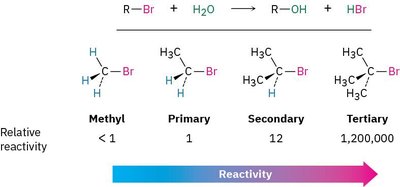
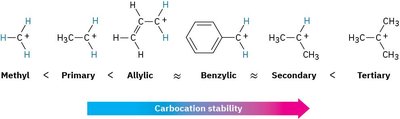
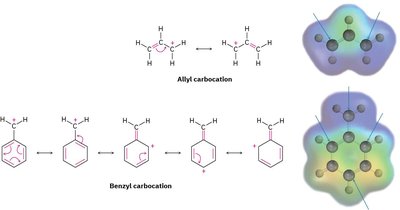
Table: Relative Reactivity of Alkyl Halides in SN1
Type | Relative Reactivity |
|---|---|
Methyl | < 1 |
Primary | 1 |
Secondary | 12 |
Tertiary | 1,200,000 |
Leaving Group Effects
A good leaving group is essential for the SN1 reaction, as it facilitates carbocation formation. The best leaving groups are weak bases that can stabilize the negative charge after departure.
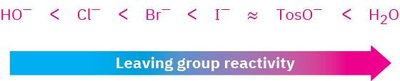
Order of Leaving Group Ability:
Role of the Nucleophile
Unlike the SN2 reaction, the nucleophile does not affect the rate of the SN1 reaction. Neutral nucleophiles are often used, and the reaction is best performed under non-basic conditions to avoid elimination side reactions.
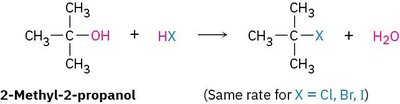
Solvent Effects
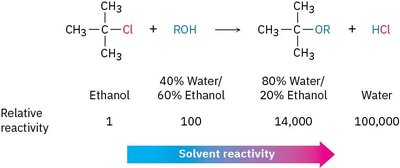
Polar protic solvents stabilize the carbocation intermediate and the leaving group, increasing the rate of the SN1 reaction. Water and alcohols are common solvents.
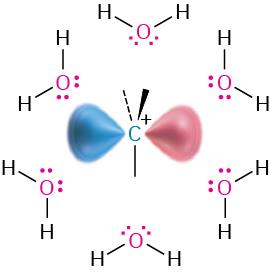
Stereochemistry of the SN1 Reaction
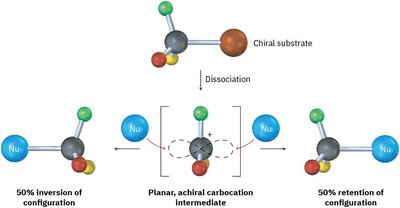
Because the SN1 reaction proceeds via a planar, achiral carbocation intermediate, nucleophilic attack can occur from either side, leading to racemization (a mixture of enantiomers) if the starting material is chiral. However, complete racemization is rarely observed due to ion-pair effects.

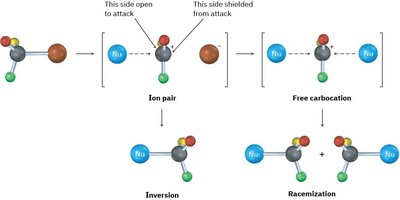
Example: (R)-6-Chloro-2,6-dimethyloctane reacts with H3O+ in ethanol to give 60% S (inversion) and 40% R (retention) products, illustrating incomplete racemization.
Summary Table: SN1 Reaction Characteristics
Variable | Effect on SN1 Reaction |
|---|---|
Substrate | Best for tertiary, allylic, and benzylic halides (most stable carbocations) |
Leaving Group | Good leaving groups increase rate |
Nucleophile | Nonbasic, neutral nucleophiles preferred; does not affect rate |
Solvent | Polar protic solvents increase rate by stabilizing carbocation |
Elimination Reactions: Zaitsev’s Rule and Mechanisms
Zaitsev’s Rule
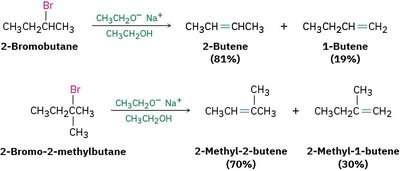
Zaitsev’s rule states that in base-induced elimination reactions, the more substituted (and thus more stable) alkene is generally the major product. This is due to the increased stability of alkenes with more alkyl substituents on the double bond.
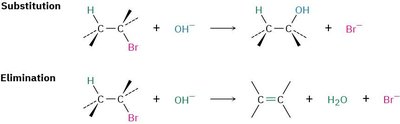
Example: 2-Bromobutane reacts with sodium ethoxide to give 2-butene (81%) and 1-butene (19%).
Elimination Mechanisms: E1, E2, and E1cB
There are three main mechanisms for elimination reactions, differing in the timing of bond-breaking events:
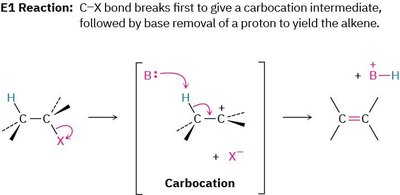
E1 (Unimolecular Elimination): The C–X bond breaks first to form a carbocation, followed by base removal of a proton to yield the alkene. Favors tertiary substrates and weak bases.
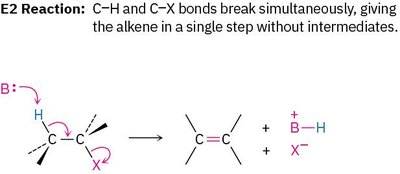
E2 (Bimolecular Elimination): The C–H and C–X bonds break simultaneously in a single concerted step, requiring a strong base. Stereochemistry is important (anti-coplanar geometry).
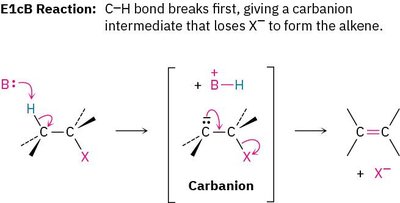
E1cB (Elimination via Conjugate Base): The C–H bond breaks first, forming a carbanion intermediate, which then loses the leaving group to form the alkene. Occurs with poor leaving groups and electron-withdrawing groups adjacent to the leaving group.
Comparison Table: Elimination Mechanisms
Mechanism | Key Features | Substrate Preference | Base Strength |
|---|---|---|---|
E1 | Carbocation intermediate; two steps | Tertiary > Secondary | Weak base |
E2 | Concerted; one step | Primary, Secondary, Tertiary | Strong base |
E1cB | Carbanion intermediate; two steps | With electron-withdrawing groups | Strong base |
Summary
SN1 and E1 reactions both proceed via carbocation intermediates and are favored by substrates that stabilize positive charge.
SN1 leads to racemization at stereocenters, while E1 and E2 lead to alkene formation, with Zaitsev’s rule predicting the major product.
Leaving group ability, solvent, and substrate structure are critical factors in determining the reaction pathway and product distribution.
