 Back
BackNucleophilic Substitution Reactions: SN1 and SN2 Mechanisms
Study Guide - Smart Notes
 Tailored notes based on your materials, expanded with key definitions, examples, and context.
Nucleophilic Substitution Reactions
Introduction to Nucleophilic Substitution
Nucleophilic substitution reactions are fundamental processes in organic chemistry, where a nucleophile replaces a leaving group attached to an electrophilic carbon atom. These reactions are crucial for the synthesis of a wide variety of organic compounds.
Nucleophile: A species with lone-pair electrons or a negative charge that seeks a positive center.
Electrophile: A species that seeks an electron pair or negative charge for bonding.
Substrate: The molecule (often an alkyl halide) at which the nucleophilic substitution occurs.
Leaving Group: The atom or group that is replaced by the nucleophile and departs with an electron pair.
General Reaction: The nucleophile attacks the electrophilic carbon, displacing the leaving group.

For a successful nucleophilic substitution, the attacking nucleophile must be stronger than the leaving group.
SN2 Mechanism (Bimolecular Nucleophilic Substitution)
Mechanism and Features
The SN2 reaction is a one-step, concerted process where the nucleophile attacks the substrate from the side opposite to the leaving group, resulting in inversion of configuration at the carbon center.
Backside Attack: The nucleophile attacks from the side opposite the leaving group due to electrostatic repulsion and the orientation of the antibonding orbital.
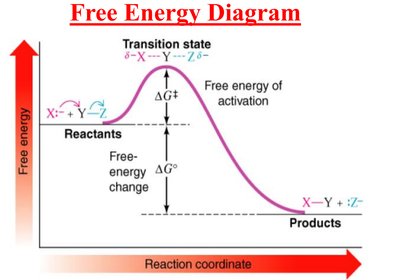
Transition State: Bond formation and bond breaking occur simultaneously in a single transition state.
Inversion of Configuration: The stereochemistry at the carbon center is inverted (Walden inversion).
Concerted Reaction: All bond changes occur in one step without intermediates.
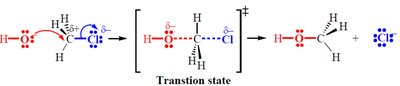
Example: The reaction of hydroxide ion with methyl chloride proceeds via an SN2 mechanism.
Kinetics and Reactivity
The rate of the SN2 reaction depends on the concentration of both the substrate and the nucleophile, making it a second-order reaction.
Rate Law:
Reactivity Order: Methyl > Primary > Secondary >> Tertiary (due to steric hindrance).


Energy Profile
The SN2 reaction has a single transition state and no intermediates. The activation energy is the energy difference between the reactants and the transition state.
Activation Energy (): The minimum energy required for the reaction to proceed.
Stereochemistry of SN2
SN2 reactions at a chiral center result in inversion of configuration. This is important in the synthesis of optically active compounds.
Chiral Carbon: A carbon atom attached to four different groups, leading to non-superimposable mirror images (enantiomers).
Example: 2-Bromobutane (S-configuration) reacts with cyanide ion to give 2-cyanobutane (R-configuration), demonstrating inversion.

SN1 Mechanism (Unimolecular Nucleophilic Substitution)
Mechanism and Features
The SN1 reaction proceeds via a two-step mechanism involving the formation of a carbocation intermediate. It is favored for tertiary alkyl halides due to steric hindrance that prevents SN2 reactions.
Step 1 (Rate-Determining): The leaving group departs, forming a carbocation intermediate.
Step 2: The nucleophile attacks the planar carbocation, forming the product.
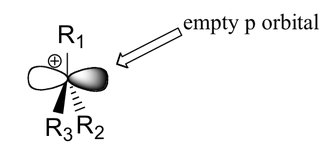
Carbocation: An sp2-hybridized, trigonal planar species with an empty p orbital.
Kinetics and Reactivity
The rate of the SN1 reaction depends only on the concentration of the substrate (alkyl halide), making it a first-order reaction.
Rate Law:
Reactivity Order: Tertiary > Secondary > Primary >> Methyl (due to carbocation stability).
Solvent: Polar protic solvents stabilize the carbocation and leaving group, favoring SN1.
Stereochemistry of SN1
Because the carbocation intermediate is planar, the nucleophile can attack from either side, leading to a racemic mixture of enantiomers if the reaction occurs at a chiral center.
Racemization: Both enantiomers are formed in equal amounts.
Energy Profile
The SN1 reaction involves two transition states and a carbocation intermediate. The energy diagram shows a valley for the intermediate and two peaks for the transition states.
Carbocation Intermediate: Higher in energy than both reactants and products, but lower than the transition states.

Comparison of SN1 and SN2 Mechanisms
Feature | SN1 | SN2 |
|---|---|---|
Order of Reaction | First order (unimolecular) | Second order (bimolecular) |
Mechanism | Two-step (carbocation intermediate) | One-step (concerted) |
Stereochemistry | Racemization | Inversion of configuration |
Substrate Preference | Tertiary > Secondary > Primary | Methyl > Primary > Secondary |
Nucleophile Strength | Weak nucleophile sufficient | Strong nucleophile required |
Solvent | Polar protic | Polar aprotic preferred |
Key Terms and Concepts
Activation Energy (): The minimum energy required for a reaction to proceed.
Transition State: A high-energy, unstable arrangement of atoms during a reaction.
Carbocation: A positively charged carbon species, sp2 hybridized, with an empty p orbital.
Racemization: Formation of a 1:1 mixture of enantiomers.
Inversion of Configuration: Stereochemical outcome of SN2 reactions at a chiral center.
