 Back
BackOrganic Chemistry 141: Nomenclature and Reaction Mechanisms (Chapters 8 & 9)
Study Guide - Smart Notes
 Tailored notes based on your materials, expanded with key definitions, examples, and context.
Q1. Name the following compounds:
Background
Topic: IUPAC Nomenclature of Organic Compounds
This question tests your ability to apply IUPAC rules to name alkanes, alkenes, alkynes, and cyclic compounds. Recognizing the longest carbon chain, identifying substituents, and assigning correct locants are key skills here.
Key Terms and Concepts:
Longest Chain: The main carbon chain containing the highest-priority functional group.
Substituents: Groups attached to the main chain (e.g., methyl, ethyl, phenyl).
Double/Triple Bonds: Indicate with -ene (alkene) or -yne (alkyne) and number their position.
Cycloalkanes: Ring structures are named with the prefix 'cyclo-'.
Step-by-Step Guidance
For each structure, identify the longest continuous carbon chain and the position of any double or triple bonds.
Number the chain so that the highest-priority group (double/triple bond or substituent) gets the lowest possible number.
Identify and name all substituents, and assign their positions based on the numbering.
Combine the names, using hyphens to separate numbers and commas for multiple numbers. Use prefixes (di-, tri-) if needed.
Try solving on your own before revealing the answer!
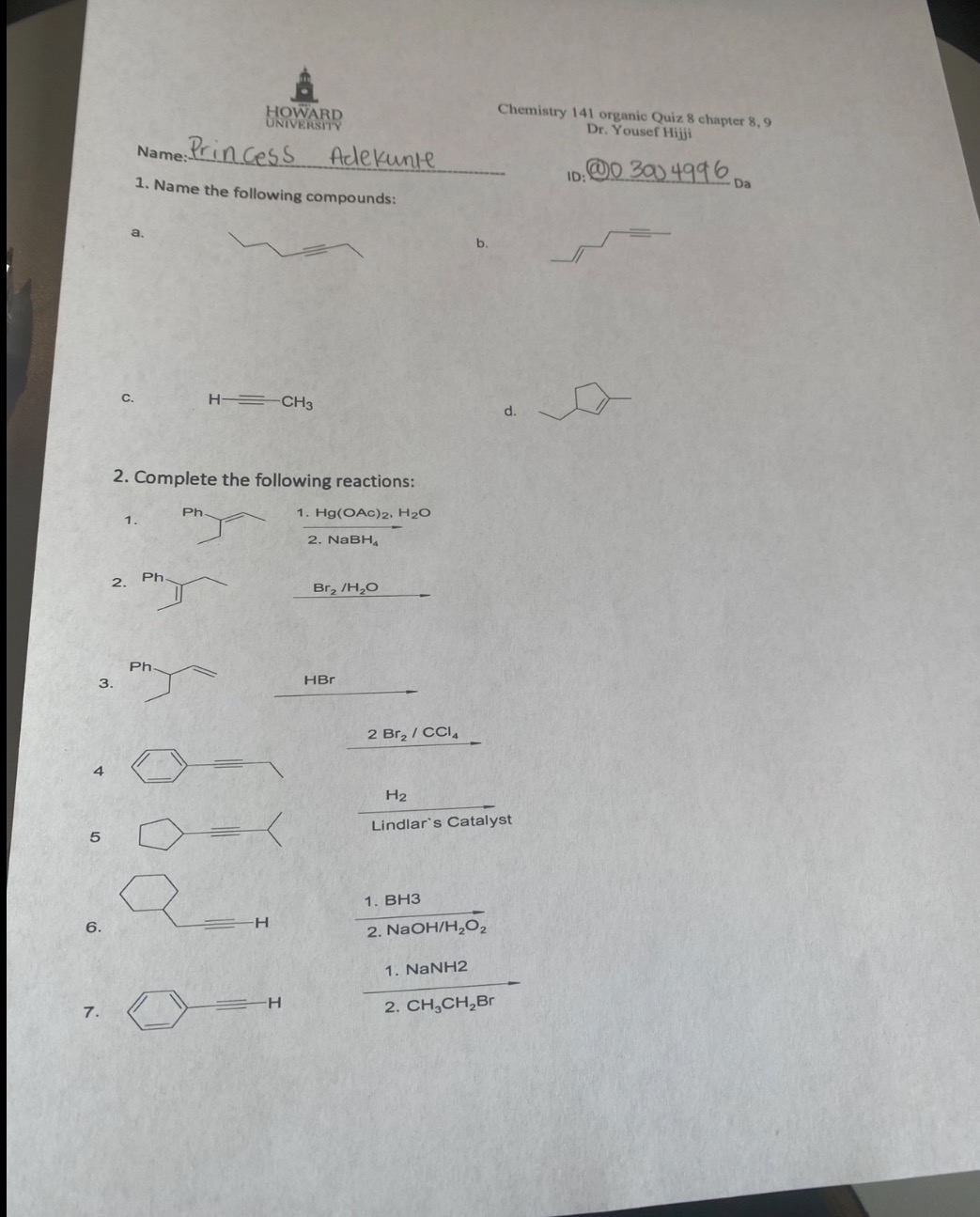
Q2. Complete the following reactions:
Background
Topic: Organic Reaction Mechanisms (Addition, Elimination, and Substitution)
This section tests your understanding of common organic reactions, including hydration, halogenation, hydroboration-oxidation, and alkylation. You need to predict the major product and understand the regiochemistry and stereochemistry involved.
Key Terms and Reagents:
Hg(OAc)2, H2O / NaBH4: Oxymercuration-demercuration (Markovnikov hydration of alkenes).
Br2 / H2O: Halohydrin formation (anti addition of Br and OH across a double bond).
HBr: Hydrohalogenation (Markovnikov or anti-Markovnikov addition depending on conditions).
Br2 / CCl4: Halogenation (anti addition of Br2 across a double bond).
H2 / Lindlar's Catalyst: Partial hydrogenation of alkynes to cis-alkenes.
BH3 / NaOH, H2O2: Hydroboration-oxidation (anti-Markovnikov hydration of alkynes/alkenes).
NaNH2: Strong base for deprotonation of terminal alkynes, enabling alkylation with alkyl halides.
Step-by-Step Guidance
For each reaction, identify the starting material and the reagents provided.
Recall the mechanism and regiochemistry/stereochemistry associated with each reagent (e.g., Markovnikov vs. anti-Markovnikov addition).
Draw the intermediate or product after the first reagent, if the reaction is multi-step.
Predict the major organic product, considering all stereochemical and regiochemical outcomes, but stop before drawing the final structure.
Try solving on your own before revealing the answer!
