 Back
BackOrganic Chemistry Exam II Study Guidance – Spring 2026
Study Guide - Smart Notes
 Tailored notes based on your materials, expanded with key definitions, examples, and context.
Q1. Describe the mechanism and energetics for the free radical halogenation of propane.
Background
Topic: Free Radical Halogenation Mechanism
This question tests your understanding of the stepwise mechanism (initiation, propagation, termination) for the halogenation of alkanes, specifically propane, and how to calculate the enthalpy changes for each step.
Key Terms and Formulas
Initiation: Formation of radicals (usually by homolytic cleavage of a halogen molecule).
Propagation: Radicals react with stable molecules to form new radicals and products.
Termination: Two radicals combine to form a stable molecule.
Bond Dissociation Energy (BDE): Energy required to break a bond homolytically.
Enthalpy change ():
Step-by-Step Guidance
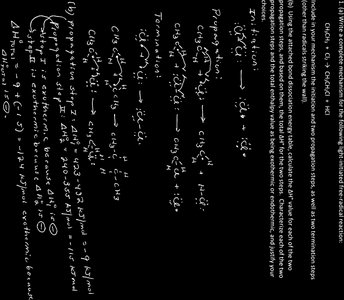
Write the initiation step: Show the homolytic cleavage of the halogen molecule (e.g., ).
Write the propagation steps: First, a halogen radical abstracts a hydrogen from propane, forming a propyl radical and HCl. Second, the propyl radical reacts with another halogen molecule to form the halogenated product and another halogen radical.
Write the termination steps: Combine two radicals to form stable molecules (e.g., ).
Set up the enthalpy calculation for each propagation step using bond dissociation energies. Identify which bonds are broken and which are formed in each step.
Calculate for each propagation step using the formula above, but stop before plugging in the final numbers.
Try solving on your own before revealing the answer!
Final Answer:
The mechanism involves initiation, propagation, and termination steps. The enthalpy change for the propagation steps is calculated using bond dissociation energies, resulting in a net exothermic reaction for halogenation.
For example, for the propagation step.
The calculation shows the reaction is energetically favorable due to the formation of strong H-Cl and C-Cl bonds.
Q2. For the following molecule, determine if it is chiral or achiral. Explain your reasoning.
Background
Topic: Chirality and Stereochemistry
This question tests your ability to identify chiral centers and determine whether a molecule is chiral or achiral based on its symmetry and the presence of stereocenters.
Key Terms and Formulas
Chiral center: A carbon atom bonded to four different groups.
Achiral: A molecule that is superimposable on its mirror image or has a plane of symmetry.
Chiral: A molecule that is not superimposable on its mirror image and lacks a plane of symmetry.
Step-by-Step Guidance
Identify all stereocenters in the molecule. Look for carbons attached to four different groups.
Check for internal planes of symmetry. If the molecule has a plane of symmetry, it is achiral.
Determine if the molecule is superimposable on its mirror image. If not, it is chiral.
Draw the mirror image and compare it to the original structure to confirm chirality or achirality.
Try solving on your own before revealing the answer!
Final Answer:
The molecule is chiral if it has at least one chiral center and lacks a plane of symmetry. If it has a plane of symmetry or is superimposable on its mirror image, it is achiral.
In this case, the molecule has a chiral center and no plane of symmetry, so it is chiral.
